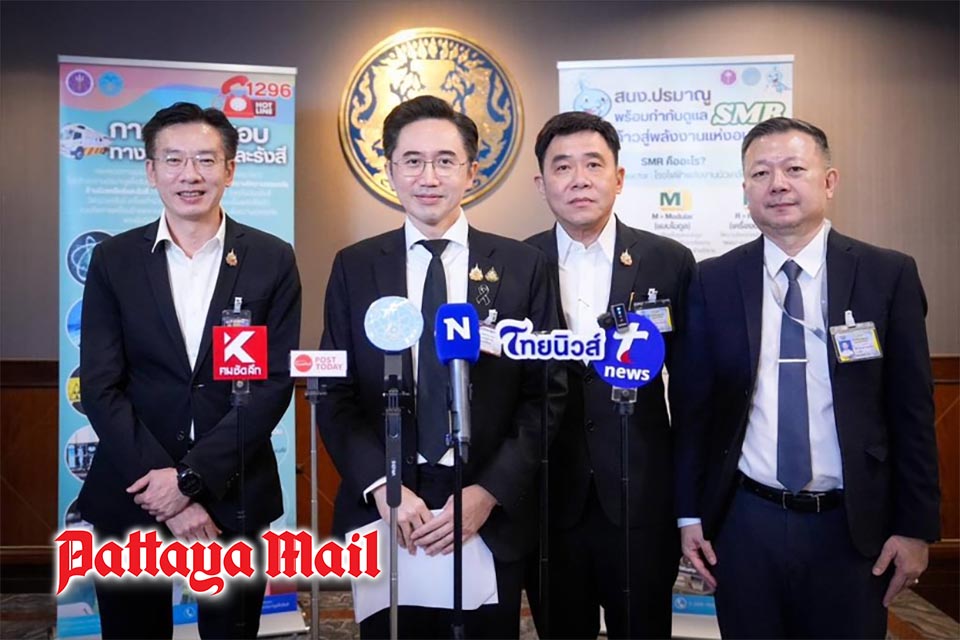
BANGKOK, Thailand – Thailand is preparing the regulatory framework, workforce and industrial capabilities needed for possible future use of small modular reactors (SMRs), with the government stressing that the move does not yet represent a decision to build a nuclear power plant. Deputy Prime Minister and Higher Education, Science, Research and Innovation Minister Yodchanan Wongsawat chaired the second 2026 meeting of the Nuclear Energy for Peace Commission at Government House on Sept. 8, where officials discussed the country’s long-term nuclear energy strategy.
The commission approved a policy framework for regulating SMRs in line with international standards set by the International Atomic Energy Agency (IAEA), as Thailand seeks to prepare for future energy needs and reduce its reliance on imported fuels. Yodchanan said Thailand has faced continuing energy price and supply volatility because of its dependence on imported fuel. Establishing the foundations for nuclear energy could help strengthen the country’s energy security, while giving Thai industries an opportunity to participate in an emerging high-technology sector.
An assessment of Thailand’s nuclear energy infrastructure against 19 IAEA requirements found that the country is already prepared in 10 areas. Six areas require further development, while three major areas require urgent action: establishing a national policy, creating a Nuclear Energy Program Implementing Organization (NEPIO) to drive the program, and developing a financing plan.
The commission agreed on four key areas of preparation.
On legislation, the Office of Atoms for Peace has been instructed to accelerate preparation of a Nuclear Damage Civil Liability Bill for submission to the Cabinet. The legislation is intended to establish an insurance system, financial guarantees and a transparent and fair state fund consistent with international standards.
On human resources, the Higher Education, Science, Research and Innovation Ministry, Education Ministry, Office of the National Higher Education Science Research and Innovation Policy Council and Energy Ministry will work together on education programs and a long-term workforce development plan covering SMR technology and nuclear safety regulation.
Thailand will also develop a national policy for the comprehensive management of radioactive waste and spent nuclear fuel throughout their life cycle. Officials said the approach must place the highest level of responsibility on the present generation to prevent nuclear waste from becoming a burden on future generations. The fourth area involves the SMR supply chain. The Board of Investment will work with the Office of Atoms for Peace and relevant research institutions to develop a strategy linking Thai businesses to the global SMR supply chain.
Yodchanan stressed that the meeting did not mean Thailand had decided where an SMR plant would be built or which technology would be selected. Instead, he said the government was preparing the country in advance so that it would have sufficient information, expertise and regulatory capacity before any major policy decision is made. He said Thailand should move beyond being merely a technology buyer and become a technology value creator.
The SMR sector could create opportunities for Thai manufacturers in areas ranging from high-performance pumps and valves to advanced construction materials capable of withstanding radiation. Other potential areas include electricity grid integration, advanced engineering and artificial intelligence-powered digital twin systems. Yodchanan said developing these capabilities to international standards would require serious and careful preparation, particularly given the need to maintain the highest safety standards.
Supachai Pathumnakul, permanent secretary of the Higher Education, Science, Research and Innovation Ministry, said the ministry was ready to mobilize universities and research institutes across the country to support research and development, develop specialist courses and produce highly skilled personnel. The workforce could include nuclear engineers, cybersecurity specialists, data scientists and technology lawyers needed to support the development of a new nuclear-related industrial ecosystem.
Rungruang Kitphati, secretary-general of the Office of Atoms for Peace, said nuclear safety would remain the top priority. The regulator will follow the three principles known as the nuclear safety “3S” framework: Safety, Security and Safeguards. The office is also developing regulations and emergency preparedness plans for nuclear and radiological incidents, with the aim of linking national policy with local-level response systems. Officials also stressed the importance of public participation, transparency and access to information to build public confidence in any future nuclear energy program.
The commission additionally approved the appointment of six experts to its board, covering science, engineering, agriculture, law and medicine. The appointments are intended to bring together expertise from different fields as Thailand develops the foundations for a nuclear energy ecosystem that officials say must be safe, internationally compliant and capable of supporting greater national self-reliance.
For now, however, Thailand’s approach remains one of preparation rather than construction, with the government seeking to put the rules, people and industrial capabilities in place before deciding whether and how SMR technology should form part of the country’s future energy mix.