PATTAYA, Thailand – In late May 2026, a strange movement in the Stock Market of Thailand has caught the attention of financial legal experts and market analysts. A massive volume of Chinese capital is flowing heavily into the Thai capital market.
At first glance, this looks like a positive sign that reflects foreign confidence in Thai stocks. However, looking closer at the actual flow of capital reveals that this phenomenon is not about normal economic confidence. Instead, it is a clear strategy of regulatory arbitrage where investors use legal loopholes to find a new safe haven for their money.
When real estate reaches a dead end Chinese capital flips to the stock market
Historically, Chinese capital flowed mainly into Thai real estate. However, the Thai government has recently cracked down on using nominees to hold property. A joint effort by twenty three government agencies has made it very difficult and risky for foreign investors to hold land or buildings through holding companies because they face a high risk of asset seizure.
Since real estate has reached a dead end, the Thai stock market has become the perfect exit. The capital market allows investors to hide their true identity through international financial tools. One main tool is the Non Voting Depositary Receipt, which lets foreign investors buy Thai stocks without revealing the beneficial owner to the public. Another tool is the use of custodian accounts in financial hubs like Singapore or Hong Kong to act as a front for these transactions.
Pressure from Beijing and the hunt for cross border wealth
The pressure from mainland China is another major driver. The Beijing government has strictly tightened its capital outflow controls and shut down illegal cross border brokerage platforms. At the same time, global tax data exchange systems like the Common Reporting Standard are fully operational.
Because wealthy individuals in China can no longer easily move their money to Western markets, and because cryptocurrency routes are blocked, Thailand has become a highly strategic and safe door to protect the value of their wealth.
Tracking the statistics of mainland Chinese capital
You will never see the words Mainland Chinese Investor listed as a top buyer on daily stock market reports because strict Chinese exchange laws prevent citizens from directly opening offshore accounts to buy Thai stocks. However, the actual data is hidden inside three deep financial statistics.
First, there is a massive jump in Foreign Direct Investment from mainland China. Before the money reaches the stock board, it enters Thailand as direct investment to set up Thai companies. Data from the Department of Business Development shows that mainland China ranks first in setting up new businesses in Thailand, accounting for twenty three percent of all new foreign companies. This money is often placed in the Eastern Economic Corridor. Once these Chinese holding companies are established in Thailand, they use their cash to buy large blocks of shares in the stock market. On the market books, this is counted as a local Thai institution buy, even though the true owner is one hundred percent Chinese.

Second, the money moves through financial conduits in Singapore and Hong Kong. Capital flow reports show that direct investments from mainland China have grown significantly, while investments from Hong Kong and Singapore have jumped at a matching rate. In international finance, it is well known that these two locations act as the accounting front for wealthy Chinese citizens to spread their assets into Thailand.
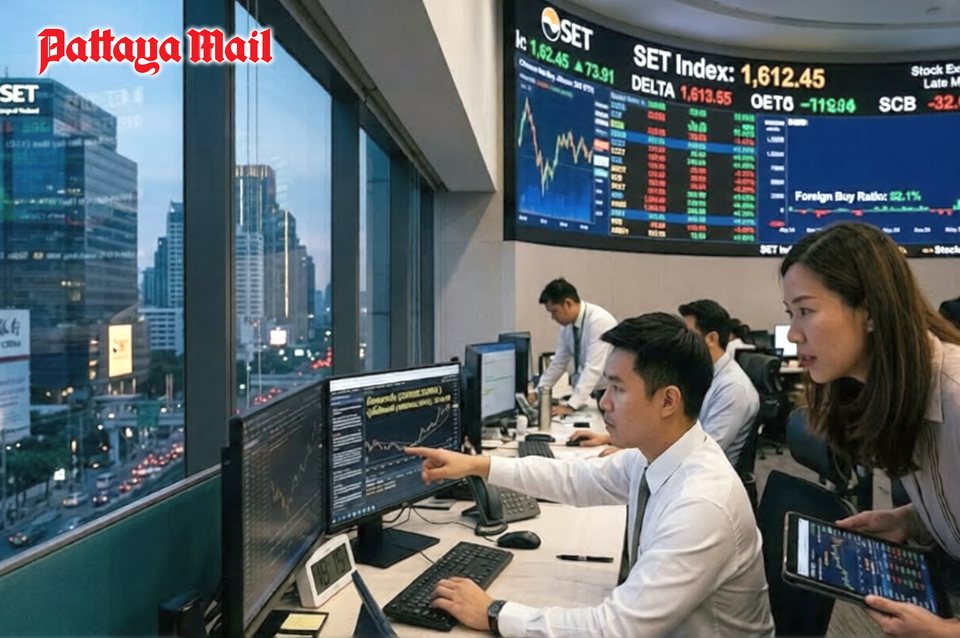
Third, there is a massive concentration of trading volume in specific stock sectors through Non Voting Depositary Receipts. On May twenty six, 2026, foreign trading volume made up over fifty two percent of the total market, which is much higher than the historical average of forty percent. This foreign buying concentrated heavily on electronic component stocks linked to Chinese supply chains and large commercial banks used as safe places to park cash.
This hidden data breaks the myth that there is no Chinese capital in the Thai stock market. Even if the word China does not appear on the daily board, the fact that foreign investors control more than half of the market trading volume proves the reality. This is a financial game of hide and seek where mainland Chinese capital uses the Thai stock market as both a safe haven and a springboard to spread risk while global tax laws and regulations tighten around them.