Written from the perspective of a practitioner in tax, commercial and investment law, this article aims to shed light on developments that increasingly shape how Thailand is perceived by global investors. In a world where geopolitical dynamics, supply chains and regulatory environments can shift almost overnight, investment decisions are no longer guided by growth narratives alone. They are anchored in legal certainty, policy direction and strategic geography. Against this backdrop, Pattaya and the Eastern Economic Corridor offer a revealing case study of how Thailand is positioning itself amid a rapidly evolving regional and global order.
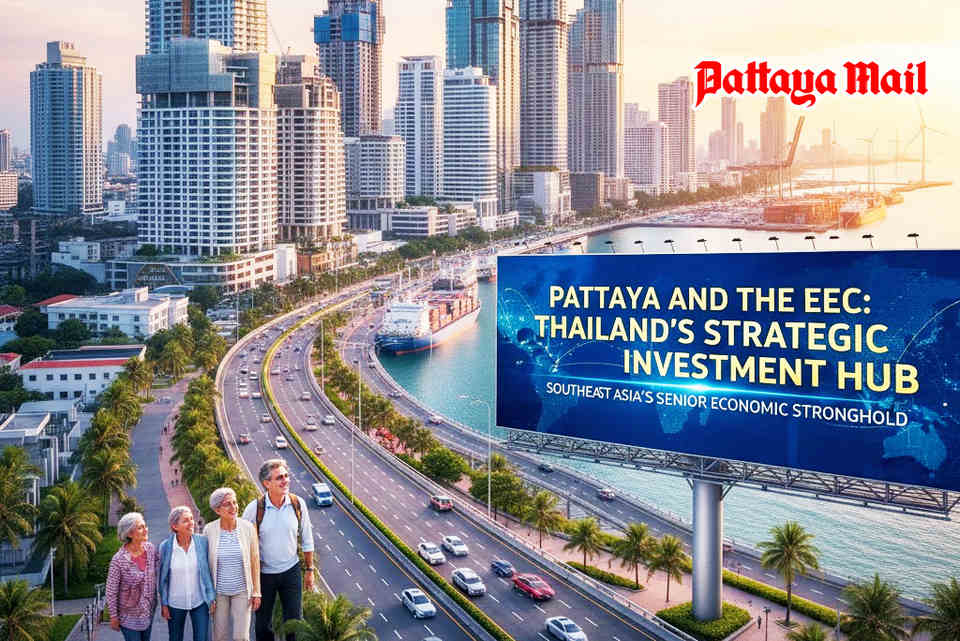
PATTAYA, Thailand – In 2026, Thailand’s Eastern Economic Corridor (EEC) is entering what many investors describe as a “harvest phase” the point at which a decade of state-led infrastructure spending begins to translate into measurable economic returns. At the centre of this shift stands Pattaya, a city long associated with tourism, now repositioned as a residential and strategic hub for the country’s most ambitious industrial corridor. The transformation is not accidental. It reflects a deliberate policy choice by Bangkok to reinforce Thailand’s role as a regional anchor economy at a time when Vietnam and Indonesia are aggressively competing for foreign direct investment.
Infrastructure as industrial policy: Mega-projects such as the high speed rail link connecting Bangkok’s two main airports with Utapao, the expansion of Laem Chabang Port, and the redevelopment of Utapao Airport are redrawing Thailand’s economic map. Together, they are compressing travel times, lowering logistics costs, and effectively integrating Pattaya into the daily operational footprint of the EEC. For executives and technical specialists working in advanced manufacturing, EV supply chains, and digital infrastructure, Pattaya is increasingly viewed not as a weekend destination but as a viable long-term base.
Law, incentives and regulatory continuity: Thailand’s enduring advantage lies less in cost arbitrage and more in regulatory predictability. Through the Board of Investment (BOI), the government offers extended corporate tax holidays, foreign land ownership rights for promoted projects, and streamlined visa regimes for highly skilled professionals. Such incentives are not unique in Southeast Asia. What differentiates Thailand is the institutional maturity behind them a legal framework that international investors understand, and a track record of policy continuity across political cycles.
Real estate as a proxy for economic confidence: Pattaya’s property market is increasingly mirroring these structural shifts. Demand is strongest in high end condominiums, branded residences and wellness-oriented developments, particularly in Jomtien and Na Jomtien, where live ability, infrastructure access and long-term value appreciation converge. This marks a departure from speculative excesses of the past, replacing them with asset-backed investment driven by genuine end-user demand.
Why Thailand still matters: Beyond macro narratives, Thailand’s competitive position is anchored in the depth of its New S-Curve industries concentrated along the Eastern Seaboard Corridor.
EV and advanced mobility investments extend well beyond vehicle assembly to battery production, power electronics and charging infrastructure, reinforcing Thailand’s role as an integrated automotive hub rather than a low-cost manufacturing base.
Medical Hub and wellness economy projects in Chonburi and Rayong including precision medicine, rehabilitation and long-stay healthcare position the EEC to capture ageing demographics across Asia, Europe and the Middle East.
Digital infrastructure and data centres are expanding rapidly, driven by cloud computing, AI workloads and regional data localization requirements, while smart logistics and warehousing linked to Laem Chabang Port Phase 3 are strengthening Thailand’s role in regional supply chains. Together, these sectors provide the economic gravity that underpins Pattaya’s evolution from a leisure market to a strategic residential and investment location.
Real estate, capital structure and foreign participation: Property investment in Pattaya and the EEC is increasingly institutional in nature. Demand is strongest for freehold condominiums, particularly high rise developments with clear sea views and proximity to completed infrastructure. For larger capital deployments, joint venture structures typically pairing foreign capital with local landholding entities are becoming the preferred model for industrial estates, logistics facilities and branded residential projects.
These structures mitigate regulatory risk while allowing foreign investors to participate in asset appreciation and operating income. This combination of freehold residential assets and JV based commercial development reflects a maturing market aligned with long-term capital rather than speculative flows.
Pattaya and the EEC, taken together, illustrate how Thailand intends to defend its status as Southeast Asia’s senior economic player not by racing to the bottom on costs, but by doubling down on infrastructure, New S-Curve industries, governance and strategic geography.