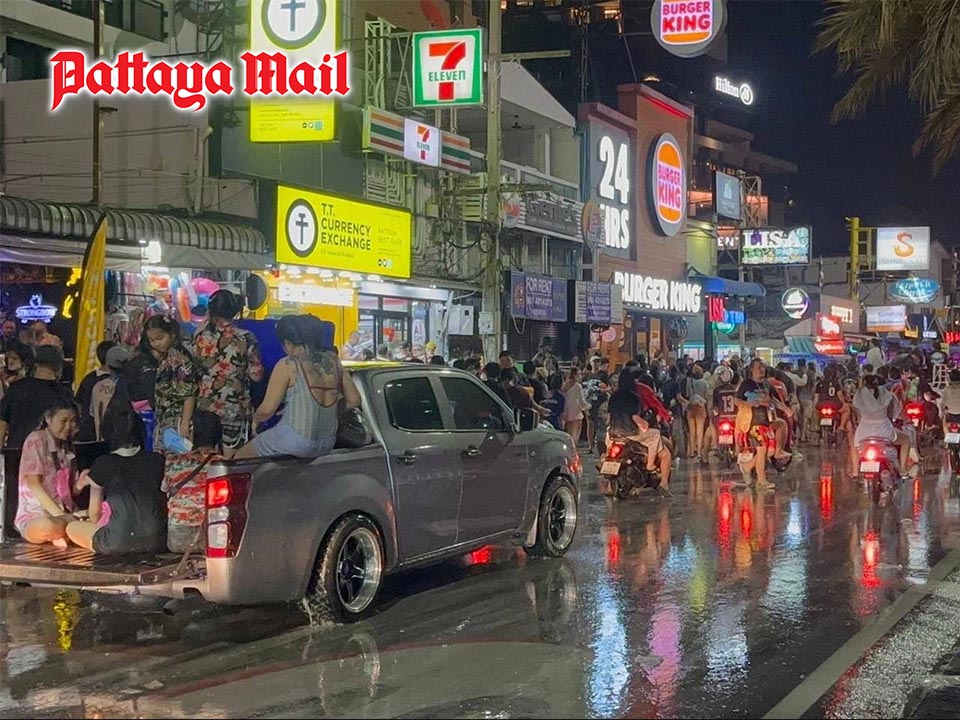
PATTAYA, Thailand – Online discussions among foreign tourists and long-term visitors have revealed sharply divided opinions over Pattaya’s version of Songkran, with some describing it as one of the city’s most exciting and unique traditions, while others argue it has become an uncontrolled and exhausting “water war.”
Many forum users said Pattaya’s Songkran celebrations have changed dramatically over the years, evolving from a few days of light-hearted water splashing into a much longer period of all-day and all-night activity stretching across more than a week.
Some commenters who experienced Songkran in Pattaya for the first time said they found it overwhelming and said they would not return during the festival period again. Others who have visited for decades argued that the event had already “gone too far” many years ago, saying the city’s celebrations have become increasingly chaotic, commercialized, and disconnected from the traditional roots of Songkran.
Several posters suggested that celebrations should be limited to one or two main days, with some proposing that Pattaya should focus only on April 18 and 19 during Wan Lai. Others argued there should be a clear evening cut-off time for water throwing activities, saying the previous practice of stopping around 6 p.m. created a more manageable and family-friendly atmosphere.
A repeated complaint was that safety rules often appear to be ignored, with commenters pointing to continued use of large ice blocks, high-pressure water guns, drunk driving, and aggressive behaviour despite annual warnings from authorities. Some even described recent celebrations as more like a “festival of violence” than a traditional Thai holiday.
Others blamed foreign visitors for helping transform Pattaya’s Songkran into a mass party atmosphere focused more on drinking and street chaos than cultural traditions. At the same time, some commenters pushed back against criticism from foreigners, arguing that locals still have every right to celebrate in their own way and noting that foreign visitors are often involved in many of the problems they later complain about.
Many users contrasted Pattaya with smaller towns and villages, saying traditional Songkran celebrations are still alive in rural areas where families visit temples, pour water on Buddha statues, give food to monks, splash water gently among relatives and friends, and spend time together in a calmer atmosphere.
Despite the criticism, others said they still enjoy Pattaya’s Songkran, especially families with children, and believe the festival can still be fun if people behave responsibly.
For many, however, the broader question remains: has Pattaya’s Songkran become too long, too lawless, and too far removed from the traditional celebration it once was?