PATTAYA, Thailand – Poppy Quinn and Ren Lexander offered sharply contrasting views on the apocalypse, the rapture, and the meaning of Christian belief during a well‑attended presentation at the Pattaya City Expats Club, sparking an extended and wide‑ranging audience discussion.
The event was framed as an exploration rather than a debate, with Poppy presenting a faith‑based, apocalyptic interpretation of Christianity titles “Apocalypse Now,” followed by Ren’s historical and scholarly critique titled “Apocalypse Never?”. Music, personal testimony, and audience participation played a central role throughout the session.
Poppy’s presentation centered on the belief that humanity is approaching an imminent Judgment Day, which he equated with the biblical apocalypse. He defined the Rapture as a supernatural event in which faithful believers would be removed from Earth prior to its destruction, emphasizing that while no one can know the exact date, global conditions strongly suggest proximity.
Drawing on scripture, personal intuition, prayer, and what he described as “vibrational messages,” Poppy cited nuclear tensions, expiring arms treaties, environmental disasters, earthquakes, and the Doomsday Clock as signs pointing toward an extinction‑level event. He interpreted the biblical reference to “Babylon the Great” as modern‑day America and argued that nuclear war could be the mechanism by which sudden destruction occurs.
Poppy also introduced unconventional theological ideas, including the belief that humanity consists of fallen spiritual beings living in a “prison reform school,” sent to Earth to atone for a primordial rebellion against God. According to this view, salvation depends on choosing divine alignment over destructive forces before the end of the current “redemption cycle.”
Modern science featured prominently in his warning. Poppy suggested that advanced technologies, including particle physics experiments, could unleash forces beyond human understanding, potentially triggering planetary collapse. He argued that such outcomes would be the result of human action rather than divine intervention, with God allowing, rather than causing, the destruction.

In his talk, Poppy used popular music such as Get Happy, Like a Rolling Stone, and singing his version of House of the Rising Sun as symbolic illustrations of spiritual exile, judgment, and redemption.
Ren followed with a presentation that challenged the very foundations of apocalyptic belief. He traced a long history of failed end‑times predictions, from early Christianity through the 19th and 20th centuries, noting that each generation has produced figures convinced the apocalypse would occur in their lifetime.
He framed this pattern through the concept of cognitive dissonance, arguing that believers often reinterpret disappointment rather than abandon deeply held expectations. Ren cited bestselling apocalyptic literature and prominent religious movements as examples of how certainty persists despite repeated failure.
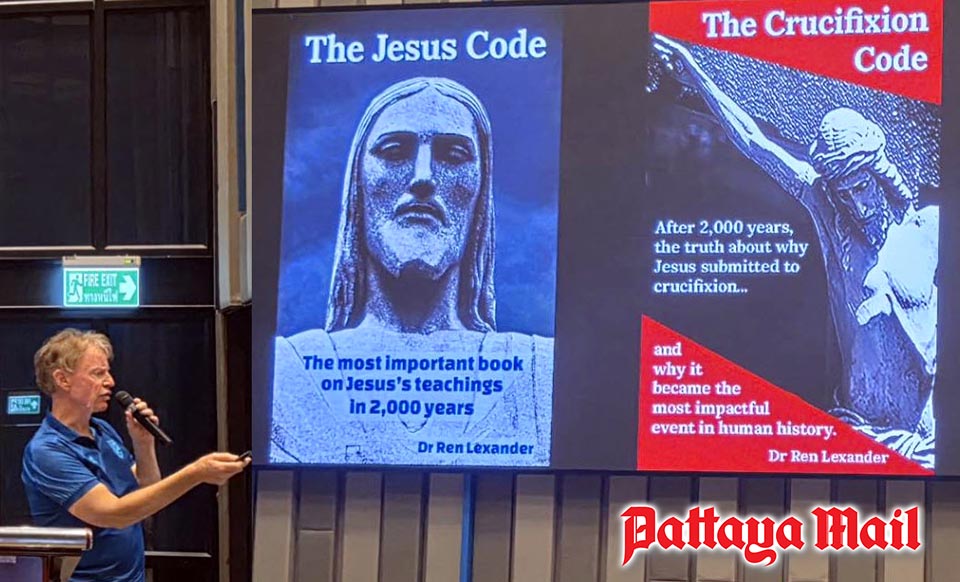
Central to his argument was a reinterpretation of Jesus’s teachings. Ren contended that Jesus was primarily a mystic teacher focused on inner transformation, not a prophet predicting global destruction. He emphasized passages describing the “Kingdom of God” as internal and present, rather than future and catastrophic.
Ren was critical of the Book of Revelation, questioning its inclusion in the biblical canon and describing its imagery as symbolic, political, or reflective of Roman‑era oppression rather than literal prophecy. He also argued that early Christian figures, particularly Paul, reshaped Jesus’s message by emphasizing an imminent return that never occurred.
According to Ren, Christianity’s enduring influence stems not from apocalyptic prediction but from the crucifixion itself, which he described as a profound psychological and spiritual turning point that reshaped human consciousness and religious thought.
The discussion that followed featured contributions from believers, atheists, and those identifying as spiritual but not religious. Participants raised themes ranging from environmental collapse as a “real” apocalypse to the influence of Roman occupation on biblical language. Others proposed extraterrestrial interpretations of Jesus, while some focused on moral responsibility, free will, and authority.
While Poppy and Ren differed fundamentally in their conclusions, the event highlighted a shared concern with meaning, morality, and humanity’s future. One speaker warned of imminent judgment and cosmic consequences, the other urged historical awareness and inward transformation. Taken together, the presentations framed the apocalypse not as a single prediction, but as an enduring human idea—shaped by fear, hope, faith, and the search for purpose in uncertain times.
After the presentation, MC Ren Lexander brought everyone up to date on upcoming Club events. This was followed by the Open Forum where questions are asked and comments made about Expat living in Thailand. To learn more about the PCEC, visit their website at https:/pcec.club. To view the video of the presentation, visit the PCEC’s YouTube Channel at https://www.youtube.com/watch?v=0M92muoSqGA.