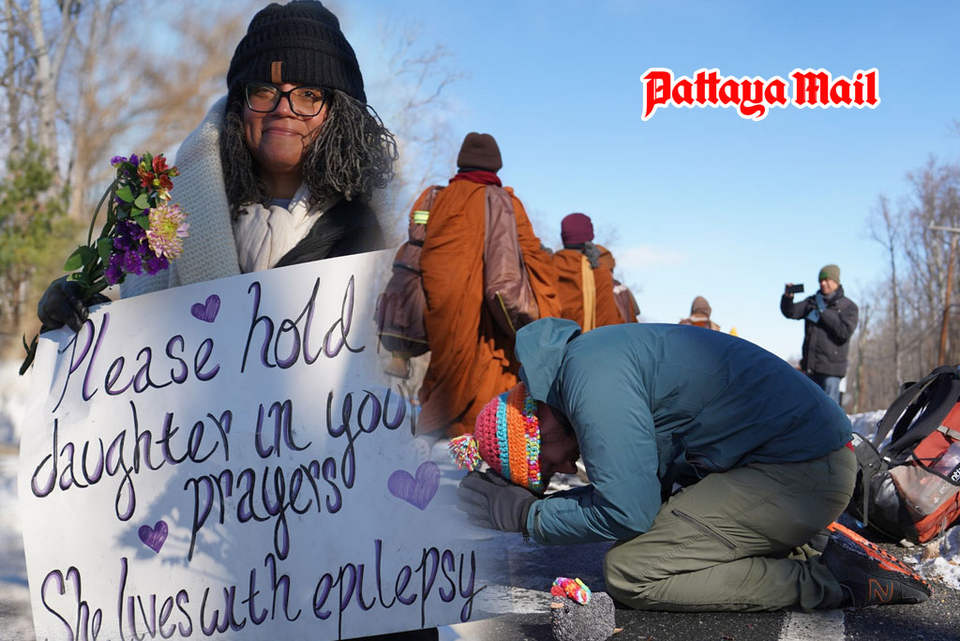
PATTAYA, Thailand – On February 10, the monks of the Walk for Peace journey entered the heart of Washington, D.C., concluding a 15-week, 3,700-kilometer walk that began in Fort Worth. From a news perspective, it was a powerful and moving image. From a religious perspective, it was an act of spiritual devotion. But viewed through the lens of business and law, it becomes something else entirely a compelling case study in what may be called mental infrastructure the invisible framework that determines how societies function long before laws are enforced or contracts are signed.
Thousands stood along ice-covered sidewalks, not because they were instructed to do so, and not because there was anything to gain. They came because certain actions carry meaning strong enough to draw people together without coercion. When the procession paused at Washington National Cathedral and was welcomed by dozens of religious leaders from different denominations including the Episcopal Bishop of Washington it was more than an interfaith moment. It was a visible expression of social trust, a form of capital far more valuable than financial capital in any modern economy.
Bhikkhu Pannakara, the leader of the monastic group, described the moment simply “This has been an overwhelming experience for us.” Translated into the language of business, this is an acknowledgment that soft power still matters in a world dominated by regulations, contracts, and enforcement mechanisms.
In law, we rely on the rule of law. But law cannot function sustainably without what might be called a rule of mind. Even the most well-drafted constitution will fail if a society does not share a basic respect for human dignity. Without that foundation, justice systems become mechanical technically sound but morally hollow. This walk did not demand legislative change. It did not advocate for policy reform. It did not align itself with any political movement. Yet it achieved something many governments struggle to accomplish it inspired people to want to be better without fear of punishment.
At American University, more than 3,500 people chose silence over applause as the monks entered the arena. This was not coincidence. It was instinct. Humans tend to quiet themselves in the presence of actions that carry genuine moral authority. From a structural standpoint, regardless of religion Buddhist, Christian, Muslim, or otherwise human societies require some form of psychological anchor. Something that disciplines thought, tempers emotion, and restrains the darker impulses that law alone cannot fully control.
In this sense, religion is not merely a private belief system. It functions as a form of public mental utility reducing the cost of conflict, lowering the burden on law enforcement, and increasing trust among people who may otherwise have little reason to trust one another. When people choose to think well, speak well, and act well, not because they fear legal consequences but because they believe it is right, societies rely less on coercion and more on conscience. Economies then become more stable not because GDP increases, but because friction decreases.
Walk for Peace, therefore, is not about religion. It is not about politics. It is a reminder that peace begins with mentality, before it becomes policy, and long before it is written into law. In a world saturated with contracts, disputes, and litigation, what is often missing is not another regulation but an inner reason not to harm one another in the first place. And that may be the most valuable investment any society can ever make.