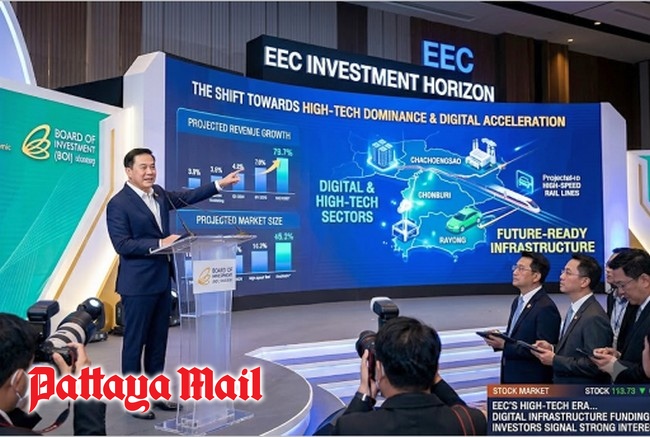
PATTAYA, Thailand – The narrative surrounding Thailand’s Eastern Economic Corridor (EEC) has fundamentally shifted. The region is undergoing a major structural transition from high-level policy blueprints to aggressive project execution. While global investors once viewed the corridor as an ambitious infrastructure initiative, the current economic reality shows it has become a key engine of growth for high-technology manufacturing and digital infrastructure in Southeast Asia.
The government has sharpened its strategic focus on advanced green manufacturing and next-generation industries. With an ambitious cumulative investment target of 2.2 trillion baht across five priority sectors by the end of this year, the EEC is attracting substantial international capital inflows. This momentum is being driven by the rapid adoption of artificial intelligence (AI), expanding hyperscale data centres, and the continued evolution of the regional electric vehicle (EV) ecosystem.
The AI and hyperscale data centre boom
The digital infrastructure sector has emerged as the clear frontrunner for foreign direct investment. Industry revenue is expanding at an exceptional pace as hyperscale data centre operators establish major hubs to serve surging demand across the ASEAN region. Chonburi has become the preferred destination for smart electronics and digital platforms, thanks to its advanced digital connectivity and strategic location.
Market projections indicate that data centre investment within the EEC will experience a compound annual growth rate (CAGR) of 59 percent over the next several years. The expansion is expected to be so rapid that the region could surpass the Greater Bangkok metropolitan area in data centre capacity. However, this unprecedented growth is placing increasing pressure on power generation and distribution, prompting authorities to accelerate upgrades to smart grid infrastructure and expand renewable energy integration to ensure a reliable electricity supply.
EV Hub 2.0 and the Chinese automotive influx
Thailand has long been known as the “Detroit of the East,” but the country’s industrial strategy is now focused firmly on the electric vehicle ecosystem. The emphasis has moved beyond vehicle assembly to high-value battery manufacturing, including the production of battery cells, modules and packs.
Rayong has strengthened its position as the country’s industrial heartland for EV production and component manufacturing, supported by advanced smart industrial estates that integrate 5G automation, artificial intelligence and edge computing.
This transformation is creating significant opportunities throughout the supply chain, particularly for small and medium-sized foreign component manufacturers. Recent trade analysis indicates that international auto parts suppliers are increasingly interested in establishing local production facilities to support the large Chinese and other multinational manufacturers already operating in the region. At the same time, Thai industry groups are urging domestic manufacturers to modernise their technology and pursue joint ventures to remain competitive.
Victor’s take on the realities of the industrial corridor
On the positive side, the surge of investment in data centres and advanced EV manufacturing demonstrates that Thailand’s regulatory framework and strategic location continue to appeal to global technology companies. Initiatives such as the Thailand FastPass programme and streamlined digital work permit systems show the government’s commitment to reducing bureaucracy for major investors.
However, companies must also contend with growing challenges. Key infrastructure projects, including high-speed rail links and major seaport expansions, continue to face implementation delays, requiring businesses to develop alternative logistics strategies in the meantime. In addition, local communities are becoming increasingly vocal about the environmental impact of rapid industrialisation, making land development more complex than in the past.
Success in the EEC now depends on far more than reading government investment brochures. Investors need a detailed understanding of local infrastructure constraints, utility capacity, supply chain bottlenecks and regulatory realities to translate investment plans into successful long-term operations.