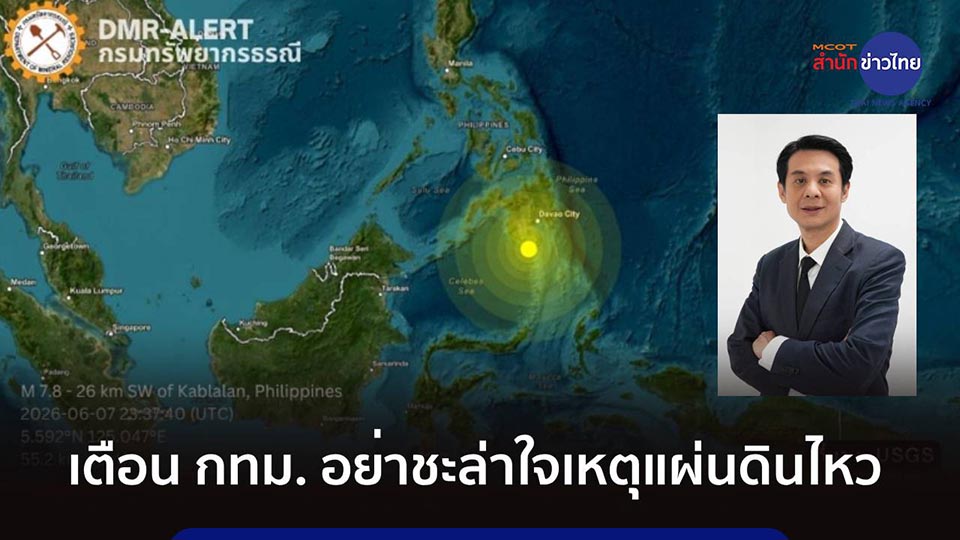
BANGKOK, Thailand – Thailand’s capital remains vulnerable to earthquake impacts and should not be considered safe, a leading structural engineering expert has warned following a powerful magnitude 7.8 earthquake off the western coast of Mindanao, Philippines. On June 8, Assoc. Prof. Dr. Amon Pimanmas, President of the Structural Engineers Association of Thailand and lecturer at Kasetsart University, said the Philippines quake occurred in a high-risk seismic zone known as the Pacific “Ring of Fire,” and was located relatively close to populated areas, making it a “near-field earthquake” with strong high-frequency ground shaking. He explained that such earthquakes tend to severely affect low-rise buildings, particularly structures under five floors, which are more vulnerable to rapid, high-frequency vibrations. Reports from the Philippines indicated damage and partial collapse of low-rise buildings in affected areas.
Dr. Amon noted that the seismic behavior of the Philippines earthquake differs from earthquake risks affecting Bangkok. Earthquakes impacting the Thai capital are typically linked to distant fault lines such as the Sagaing Fault in Myanmar and fault systems in Kanchanaburi, located hundreds to over a thousand kilometers away. These distant earthquakes generate long-period seismic waves, which tend to affect high-rise buildings more significantly rather than low-rise structures.
Despite the distance from major fault lines, Bangkok is not immune to earthquake effects, he warned. The city is built on soft soil that can amplify seismic waves several times, increasing the risk to tall buildings. He urged authorities to take earthquake preparedness seriously, including conducting structural risk assessments of buildings across the city, strengthening vulnerable structures, and installing seismic sensor alert systems in critical buildings and facilities with high occupancy. The expert emphasized that Bangkok’s seismic risk should not be underestimated, especially from distant but powerful earthquakes that can still produce significant ground motion effects in the capital. He called for improved data collection, stronger building standards, and proactive mitigation measures to reduce potential future damage and ensure public safety. (TNA)