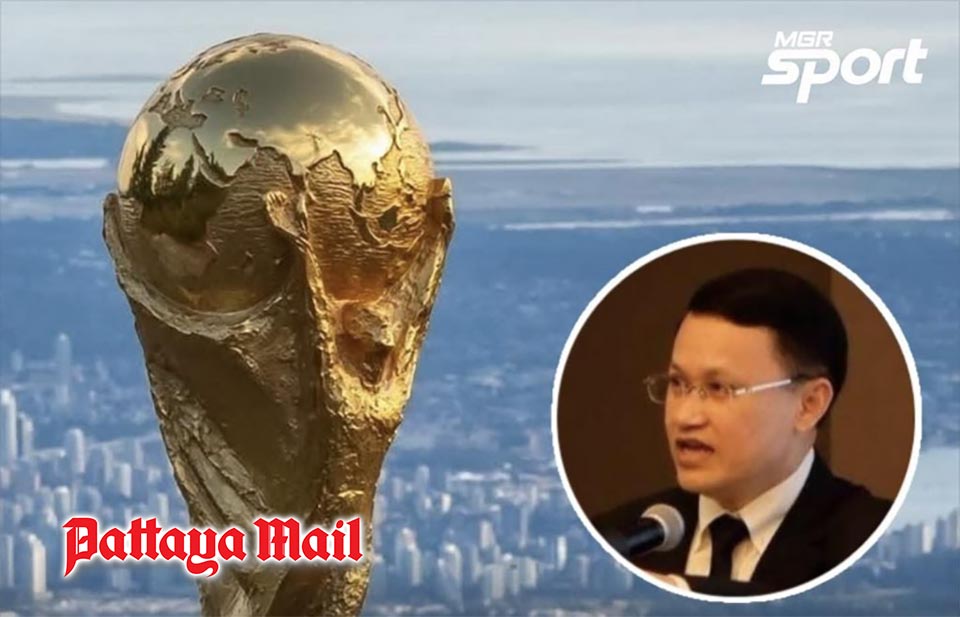
PATTAYA, Thailand – As Thailand once again faces uncertainty over FIFA World Cup broadcasting rights, former National Broadcasting and Telecommunications Commission (NBTC) vice chairman Col. Dr. Natee Sukonrat has proposed a new model that he says could balance public access with commercial realities in the modern media landscape. In a Facebook post, Dr. Natee argued that Thailand should move beyond the recurring cycle that emerges every four years, when concerns arise over whether Thai viewers will be able to watch the FIFA World Cup free of charge and whether government agencies or sponsors will need to step in to secure expensive broadcasting rights.
According to Dr. Natee, the issue stems from a changing media environment in which FIFA increasingly treats the World Cup as a premium commercial entertainment product, while traditional free-to-air television broadcasters face declining revenues and reduced purchasing power. “Every four years, Thai people find themselves wondering whether they will be able to watch the World Cup,” he wrote. “The discussion usually ends with calls for free access, followed by efforts to find sponsors or public funding to cover the rights fees.”
He noted that Thailand’s “Must Have” broadcasting rules, introduced in 2012, were created with the intention of ensuring that major sporting events remained accessible to all citizens. At the time, the World Cup was viewed primarily as a public-interest sporting event capable of inspiring young people and promoting sports participation. However, he argued that the global broadcasting landscape has changed dramatically with the rise of streaming platforms, over-the-top (OTT) services, and subscription television.
Proposed Two-Tier System
Rather than removing the World Cup from Thailand’s Must Have list entirely, Dr. Natee suggested a two-tier broadcasting framework designed to protect public access while creating stronger incentives for private investment.
Under the proposal, major matches deemed to be of national importance would continue to be available on free-to-air television. These would include:
- The opening match
- Semi-finals
- The final
- Any match involving the Thai national team, should Thailand qualify
All other matches would be available for exclusive acquisition by pay-TV operators, streaming services, and OTT platforms, allowing broadcasters to recover costs and generate profits through subscriptions. As a condition, rights holders would be required to provide at least five-minute highlight packages for free-to-air television broadcasts, ensuring that viewers without subscriptions could still follow the tournament. Dr. Natee said the model would encourage private-sector participation while preserving the public interest.
Balancing Business and Public Access
The former regulator rejected suggestions that Thailand should simply abolish the Must Have requirement and allow the market to determine access.
He argued that doing so would effectively leave lower-income viewers behind and undermine the broader social value of major sporting events.
“In my view, removing the World Cup from the Must Have list altogether is too simplistic,” he wrote. “That would mean abandoning the public and leaving everything to market forces without any safety net.”
He added that major sporting events can serve purposes beyond entertainment, including promoting sports development, inspiring youth participation, and creating shared national experiences. At the same time, he acknowledged that Thailand lacks the bargaining power of larger markets such as China and India when negotiating with FIFA, making it increasingly difficult to secure affordable broadcasting agreements under the existing framework.
Call for Regulatory Reform
Dr. Natee urged the NBTC to review and modernize its regulatory approach to reflect changes in the global media industry. He suggested that Thailand could learn from international models that seek to balance commercial broadcasting rights with public access requirements. According to Dr. Natee, a revised framework could prevent future controversies over World Cup rights and reduce pressure on public funds or emergency sponsorship campaigns whenever the tournament approaches.
He also pointed to the possibility that other major sporting organizations could adopt similar commercial strategies in the future, making regulatory reform increasingly important. “If one day Thailand qualifies for the World Cup, or if other major sporting events become fully commercialized in the same way, we should already have a fair and sustainable system in place,” he said. The proposal comes amid ongoing speculation over who will secure broadcasting rights for the 2026 FIFA World Cup in Thailand, with media and telecommunications companies reportedly exploring various options as rights negotiations continue.