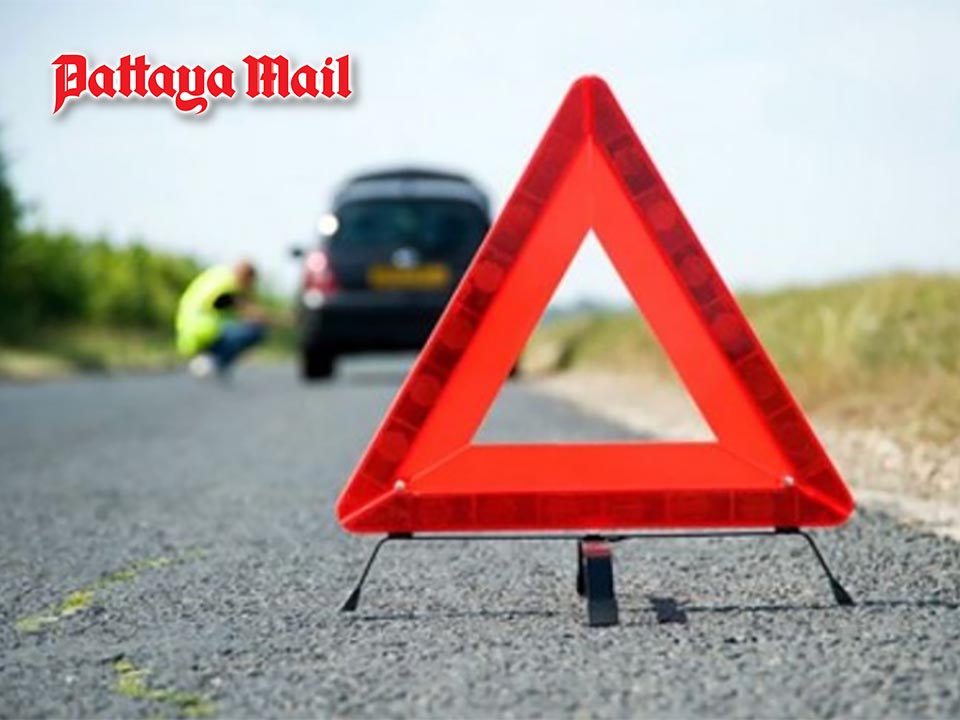
PATTAYA, Thailand – Many drivers, especially owners of European vehicles, may have noticed a folded red reflective triangle stored in the trunk or attached to the inside of the tailgate. While often overlooked, this simple device is one of the most important emergency safety tools a driver can carry.
What is a warning triangle?
A warning triangle is a red reflective triangular sign designed to alert approaching motorists when a vehicle has broken down or is stopped due to an emergency. It is commonly used when a car suffers a mechanical failure, a flat tire, battery problems, or is involved in an accident and cannot be moved immediately.
The bright red color and reflective surfaces make it highly visible during both daytime and nighttime conditions, particularly when illuminated by headlights.
Why do European cars often include one?
In many European countries, carrying a warning triangle is a legal requirement. Drivers involved in roadside emergencies are often required to place the triangle behind their vehicle to warn approaching traffic and reduce the risk of secondary collisions.
As a result, many European manufacturers build dedicated storage compartments for the device in the trunk area, making it easily accessible when needed.
When should it be used?
A warning triangle should be deployed whenever a vehicle is stopped in a location that could pose a danger to other road users, including:
- Vehicle breakdowns on roadsides or traffic lanes
- Flat tires requiring roadside replacement
- Battery failures while awaiting assistance
- Traffic accidents where the vehicle cannot be moved
- Emergency stops on highways or expressways
- Dark, curved, or low-visibility sections of road
How far behind the vehicle should it be placed?
Recommended distances vary depending on road conditions:
- Urban roads: approximately 30–50 meters behind the vehicle
- Rural roads and highways: approximately 100 meters behind the vehicle
- High-speed roads: farther distances may be appropriate
- Curves or hills: position the triangle before the blind spot so approaching drivers receive advance warning
The key principle is that drivers should see the warning triangle before they see the disabled vehicle, giving them enough time to slow down safely.
Always use it with hazard lights
When a vehicle breaks down, the first step should be activating the hazard warning lights. If conditions are safe, the warning triangle should then be placed behind the vehicle.
Hazard lights provide a nearby visual warning, while the triangle offers advance notice from a greater distance. Together, they significantly reduce the risk of rear-end collisions, especially at night, during rain, or on high-speed roads.
Breakdowns on highways require extra caution
On expressways or motorways, personal safety must come first. Drivers should:
- Activate hazard lights immediately
- Move the vehicle to the shoulder if possible
- Avoid standing behind the vehicle
- Exit from the safest side and move away from traffic
- Place the warning triangle only if it can be done safely
- Contact roadside assistance or emergency services
If traffic is moving at high speeds or visibility is poor, attempting to place a triangle may be more dangerous than remaining in a safe location.
Don’t confuse it with the hazard-light button
Many drivers mistake the reflective warning triangle for the triangular hazard-light button found on the dashboard.
The difference is simple:
- Hazard-light button: Activates all four turn signals to warn nearby traffic.
- Warning triangle: Is physically placed on the road to alert approaching vehicles from a greater distance.
Safety experts emphasize that the two devices are designed to work together during emergencies.
A small investment that can prevent a major accident
Even if your vehicle was not supplied with a warning triangle from the factory, it remains a worthwhile safety accessory. They are inexpensive, compact, and can make a significant difference when a breakdown or emergency occurs. Combined with other emergency items such as reflective vests, flashlights, jumper cables, first-aid kits, and emergency contact information, a warning triangle can help keep both drivers and passengers safer when the unexpected happens.