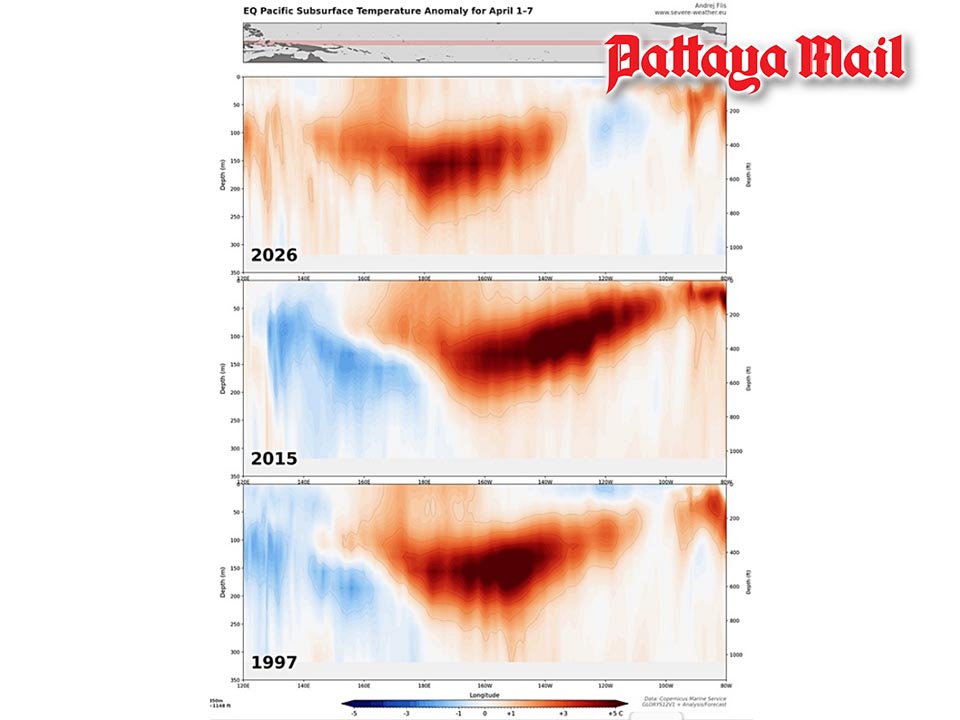
PATTAYA, Thailand – Early indicators of a potential powerful El Niño are emerging beneath the Pacific Ocean, with scientists closely monitoring subsurface heat buildup that mirrors patterns seen before past “super” events.
Recent analysis of subsurface temperature anomalies—measured within the upper 300 meters of the tropical Pacific—shows a rapidly intensifying pool of warm water forming, particularly in the western Pacific. While the buildup appears slightly delayed compared to previous major events, experts say the rate of warming is accelerating sharply.
This is partly due to the recent transition from a weak La Niña phase, meaning the system is still “catching up” in terms of timing. However, strong bursts of westerly winds are now driving warm water eastward, a key trigger in the development of El Niño conditions.
When compared to historical benchmarks—such as the major El Niño events of 1997 and 2015—the 2026 pattern shows similar characteristics, with even higher heat accumulation in some regions. Scientists believe this stored energy could shift eastward in the coming weeks, intensifying the phenomenon.
According to the World Meteorological Organization, the developing event spanning 2026–2027 could become one of the strongest in over 140 years. If current trends continue, 2027 may rank as the hottest year ever recorded globally.
El Niño does not simply mean less rain—it disrupts the timing and distribution of rainfall. In regions like Southeast Asia, including Thailand, this often leads to long dry spells interrupted by short bursts of intense rain, making water management more challenging.
For Thailand, the impacts can be particularly complex. Extended dry periods may strain agriculture and water supplies, while sudden heavy rainfall events increase the risk of flash flooding. The real challenge lies not in total rainfall, but in its unpredictability—when and where it falls.
As subsurface heat continues to build and atmospheric conditions evolve, scientists warn that the coming months will be critical in determining whether 2026–2027 develops into a full-scale super El Niño with far-reaching global consequences.