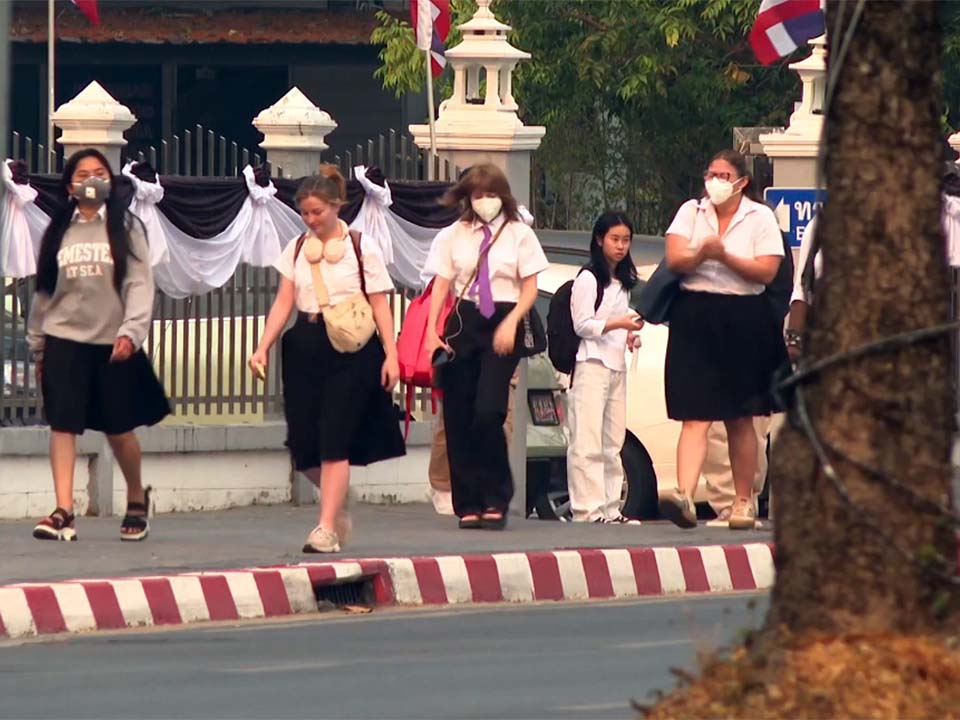
CHIANG MAI, Thailand – Dense toxic smog continued to blanket northern Thailand for a week on Thursday, with Chiang Mai ranked as the world’s second most polluted city as air-borne particulates triggered a 1.5-fold increase in respiratory-related hospital visits compared to normal levels.
Visibility in Chiang Mai remained severely restricted, with the landmark Doi Suthep mountain obscured by thick haze. Hourly readings of PM2.5 — the most dangerous fine particulate matter — peaked at 808 micrograms per cubic meter in Chiang Mai’s Chiang Dao district, more than 20 times the national safety limit, according to Chiang Mai University’s Climate Change Data Center.

Dr. Waranyu Jamnongprasatporn, Chiang Mai’s provincial public health chief, reported that the Maharaj Nakorn Chiang Mai Hospital has seen a 1.5-fold increase in patients suffering from acute respiratory issues, eye irritation, and nosebleeds compared to normal periods.
Medical officials warned that prolonged exposure to the current pollutant levels is comparable to heavy cigarette smoking and can aggravate stroke and heart disease risks. Residents have been advised to stay indoors and wear N95 masks.
The Third Army Region’s haze control center reported 722 hotspots across 17 northern provinces, with the highest concentrations in Chiang Mai (163) and Mae Hong Son (162), primarily within protected forest reserves.
In response, the Royal Thai Army deployed MI-17 helicopters to assist in firefighting operations in Lamphun’s Li district and Chiang Mai’s Hod district. The mission is part of a coordinated air-to-ground strategy involving the air force and the Department of Disaster Prevention and Mitigation.
Meanwhile, military units have been dispatched to spray water vapor in urban areas to reduce ground-level dust concentrations.
The Forestry Department and the Department of National Parks, Wildlife and Plant Conservation said they are integrating GIS technology and real-time hotspot analysis to coordinate fire control efforts. (TNA)