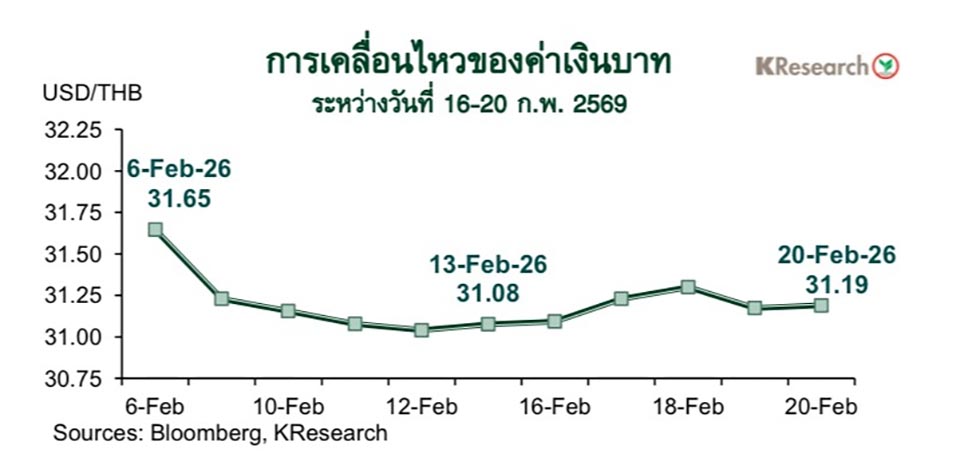
PATTAYA, Thailand – The Kasikorn Research Center reported that the Thai baht weakened last week in line with falling global gold prices and a strengthening U.S. dollar, closing at 31.19 baht per dollar, while Thailand’s stock market surged more than 3 percent on strong foreign inflows.
The baht softened early in the week, tracking declines in gold prices, despite Thailand’s fourth-quarter 2025 GDP growth coming in above market expectations. Meanwhile, the U.S. dollar gained ground after U.S. economic data—including durable goods orders, housing starts, industrial production, and jobless claims—exceeded forecasts.
Minutes from the U.S. Federal Reserve also indicated that some officials remain open to further interest rate hikes if inflation stays elevated, prompting markets to scale back expectations of near-term rate cuts.
Toward the end of the week, the baht’s depreciation slowed as gold prices rebounded on safe-haven demand amid rising tensions between the United States and Iran. On Friday, Feb 20, the baht closed at 31.19 per dollar, weaker than 31.08 the previous week.
Foreign investors posted net purchases of Thai equities worth 11.04 billion baht, while recording net sales of 8.63 billion baht in the bond market.
Thailand’s stock market rose almost throughout the week, supported by continued foreign buying, expectations of domestic political stability, stronger-than-expected fourth-quarter GDP data, and an upward revision of Thailand’s 2026 GDP growth forecast to 2.0 percent.
Banking stocks gained on dividend expectations, energy stocks were supported by higher global oil prices, and select electronics stocks posted better-than-expected earnings. The SET Index hit a 16-month high of 1,496.61 points before closing the week at 1,479.71 points, up 3.45 percent. Average daily trading value stood at 73.84 billion baht.
Looking ahead to Feb 23–27, markets will closely monitor the policy meeting of the Monetary Policy Committee on Feb 25, along with January export figures, Thailand’s economic and financial reports, and foreign capital flows.
Investors are also watching key U.S. indicators, including producer prices, private-sector employment data, and weekly jobless claims, as well as China’s loan prime rate decision and euro zone inflation data, all of which could influence capital flows.
Kasikornbank forecasts the baht to trade within a range of 30.90–31.60 per dollar next week, while Kasikorn Securities expects the Thai stock index to find support at 1,465 and 1,440 points, with resistance at 1,500 and 1,510 points. (TNA)