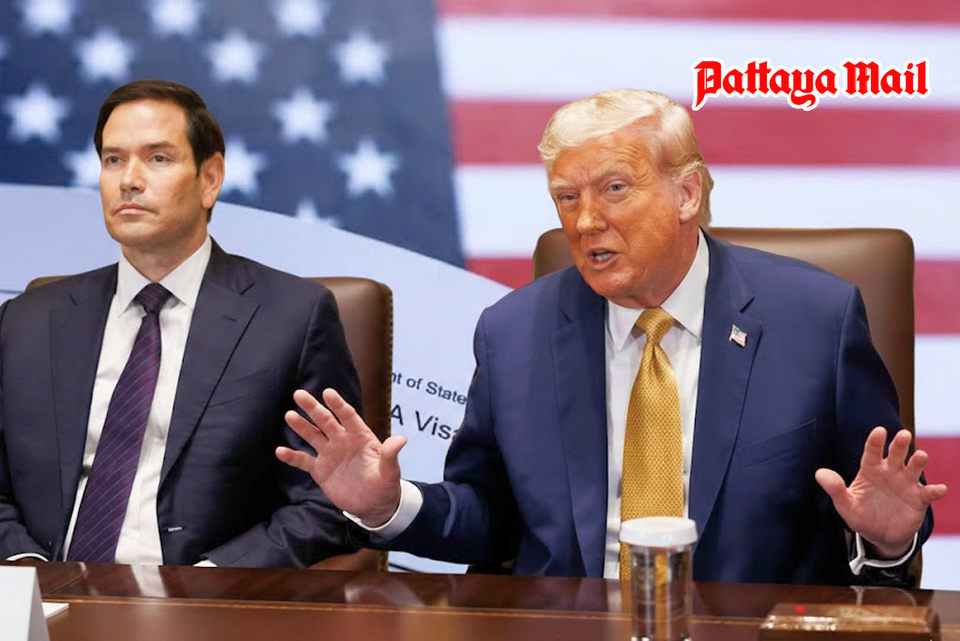
PATTAYA, Thailand – I read the news today that the United States is moving to suspend visa processing for citizens of some 75 countries Thailand included. At first glance, it sounded like another familiar Washington announcement: security reviews, tighter screening, and administrative caution. Immigration policy framed as a technical necessity. But reading it from Thailand, the story felt less procedural and more symbolic.
Not because most people here are planning an immediate trip to the US, but because such decisions quietly reveal how conditional access to the global system has become. Visas are not just paperwork. They are signals of openness, predictability, and trust. When they are suspended on a broad, country-based scale, the message travels far beyond embassy counters.
Access, power, and the currency beneath it
For decades, global mobility and the US dollar have moved together. Students studied abroad in dollars. International trade cleared in dollars. Investments flowed through dollars before reaching local markets. The assumption was that the system was stable and largely permanent. That assumption has been eroding for some time. Policies like this accelerate the process. When a major power demonstrates how quickly access can be restricted, governments, businesses, and individuals begin doing what they always do in uncertain times planning alternatives. This is where visas quietly meet currencies.
Trade without the dollar is becoming normal
Much has been written about “dedollarisation,” often in dramatic language. In practice, what is happening is far more pragmatic. Countries within the BRICS grouping Brazil, Russia, India, China, South Africa, and a growing list of partners are not trying to overthrow the dollar. They are reducing their exposure to it. Energy deals are increasingly settled in yuan or rupees. Bilateral trade agreements bypass the need to clear transactions through US financial systems. Payment infrastructure is being developed to function independently of Western frameworks.
This is not ideological rebellion. It is risk management. For Thailand, a country deeply integrated into global trade yet carefully non-aligned politically, this matters. When major economies trade more directly in their own currencies, the dollar’s role as universal middleman weakens gradually and quietly. And when that happens, currencies like the baht operate in a more complex environment.
The Baht in a multipolar world
In the short term, little changes. The baht still responds to tourism numbers, US interest rates, and capital flows. Over time, however, a world less dependent on a single dominant currency alters the rules. There are more bilateral currency arrangements, greater exposure to regional volatility, and less certainty about what constitutes a neutral reference point. For Thailand’s central bank, this means careful balancing. For businesses, higher hedging costs. For ordinary residents Thai and foreign alike volatility seeps quietly into prices, savings, and long term planning.
Where expats feel it first
Expats are often the first to notice currency shifts. Many earn in one currency, spend in another, and save in a third. When the baht weakens, those with dollar or euro incomes feel temporarily wealthier. When volatility increases, transfers cost more, timing matters more, and budgeting becomes less predictable. Visa uncertainty adds another layer. When the US shows how quickly access can be curtailed, expats everywhere reassess what makes a country a safe long-term base. Thailand still scores highly: lifestyle, healthcare, affordability. But predictability now matters as much as cost. Clear visa rules, stable tax policy, and a financial system that works smoothly across multiple currencies are no longer luxuries they are competitive advantages.
Thailand’s quiet opportunity
Ironically, moments like this may offer Thailand an opportunity. As major powers harden borders and weaponize access, countries that remain open, administratively clear, and politically neutral become attractive not for ideology, but for stability. Thailand does not need to choose sides in a currency debate. It needs to manage its position wisely: maintaining baht stability, expanding regional financial cooperation, and offering residents something increasingly rare. A place where rules change slowly, systems work, and life remains livable.
A closing thought
The US visa suspension may be temporary. Or it may not be. Its significance lies less in duration than in direction. It reminds us that systems once assumed permanent can tighten without warning. When doors close, currencies do not collapse. They whisper. Those whispers heard in trade contracts, exchange rates, and expat bank transfers suggest the world is edging toward something quieter, messier, and more multipolar. Thailand is not at the centre of the storm. But it is close enough to feel the wind. And for many of us watching from here, that may be precisely why it still feels like home.