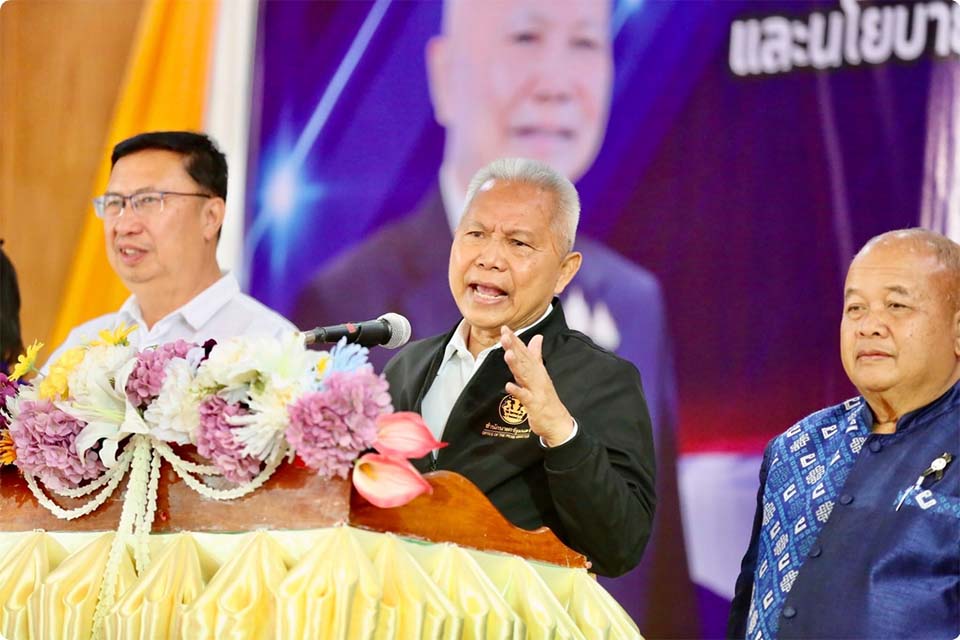
NAKHON PHANOM, Thailand – Deputy Prime Minister Sophon Zaram visited Renu Nakhon District in Nakhon Phanom Province to follow up on programs under the Quick Big Win initiative to integrate solutions to address drug problems.
During the visit, the Deputy Prime Minister received a briefing on the local situation and the prevention and suppression efforts by local authorities. He observed rehabilitation services for drug users and dependents at the Mini Thanyarak Hospital. He issued policy directives to guide and monitor regional administration, urging all agencies to accelerate drug-control measures in a tangible, sustainable manner.
The Deputy Prime Minister highlighted the Government’s determination to address drug issues by prioritizing intensive rehabilitation for drug dependents—an approach that has enabled a significant number of users to overcome addiction. He outlined economic policies to improve public well-being, including measures to raise rice prices and stimulate grassroots economic activity. He reiterated the Government’s readiness to provide additional funding to Nakhon Phanom Province to strengthen the effectiveness of rehabilitation programmes, while instructing all agencies to report data accurately and measure success based on public satisfaction.
Renu Nakhon District has actively advanced the Government’s urgent policy on drug prevention and suppression under the Quick Big Win initiative, “United Through Faith to Integrate Solutions to Drug Problems.” The district has established subdistrict-level operational teams comprising government agencies and community leaders to screen residents aged 12–65 years. A total of 19,060 individuals were screened, identifying 457 drug users who were subsequently enrolled in CBTx rehabilitation programmes. Meanwhile, suppression efforts led to 24 arrests, asset seizures exceeding 100,000 baht, and 7,358 methamphetamine pills confiscated.
The district also implemented community-based anti-drug campaigns, covering more than 93% of villages and identifying an additional 143 drug users. Proactive prevention measures included checkpoints, roadblocks, social-order enforcement, targeted raids, and continuous support for individuals completing rehabilitation, all aimed at enhancing safety and public order in the area. (NNT)