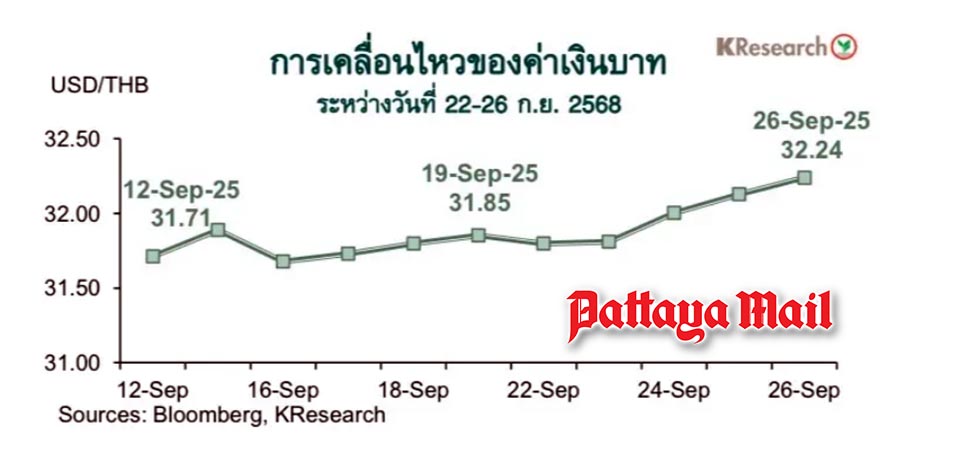
PATTAYA, Thailand – Kasikorn Research Center has highlighted several key factors that will influence Thailand’s markets this week, including the government’s policy statement to Parliament, ongoing discussions between the Bank of Thailand (BOT) and gold traders, Thailand’s August current account data, statements from the U.S. Federal Reserve, and trends in foreign capital flows. Analysts expect the Thai baht to trade in a range of 31.80–32.50 per U.S. dollar, while the Thai stock index (SET) is projected to find support at 1,270 and 1,245 points, with resistance at 1,300 and 1,315 points.
Last week, the baht weakened to 32.32 per dollar, the lowest level in over two weeks. This depreciation was influenced by slower-than-expected export growth and Fitch Ratings’ downgrade of Thailand’s outlook to “Negative.” Meanwhile, the U.S. dollar strengthened following stronger-than-expected economic data from the United States.
For the week of Sept 29–Oct 3, Kasikorn Bank projects the baht will fluctuate between 31.80–32.50 per dollar. Analysts point to key factors including August’s current account balance, developments from BOT discussions with gold traders, global gold prices, foreign fund flows, and significant U.S. economic data, such as PMI and ISM indices, employment reports, and unemployment claims. Additional international indicators include consumer and producer price indices for the Eurozone, manufacturing and services PMI for China, Japan, and the Eurozone, as well as Japan’s August retail and industrial production data.
Thai equities experienced volatility last week due to the lack of fresh market catalysts. The SET briefly rallied after reports of a special cabinet meeting from the new government, raising hopes for economic stimulus measures. However, the index softened toward the end of the week, reflecting broader regional market trends and concerns over U.S. import tariffs on pharmaceuticals, trucks, and furniture effective Oct 1. The market also faced downward pressure from Fitch’s negative outlook on Thailand.
Kasikorn Securities expects the SET to find support at 1,270 and 1,245 points, with resistance at 1,300 and 1,315 points. Key market drivers include the government’s upcoming policy statement to Parliament, Fed communications, and foreign capital movements, alongside critical U.S. economic indicators such as the manufacturing and services PMI/ISM, private employment reports from ADP, nonfarm payrolls, unemployment rates, and weekly jobless claims.
Other global factors include Eurozone CPI for September and producer prices for August, Japan’s and China’s manufacturing and services PMI, and Japan’s retail sales and industrial production for August.