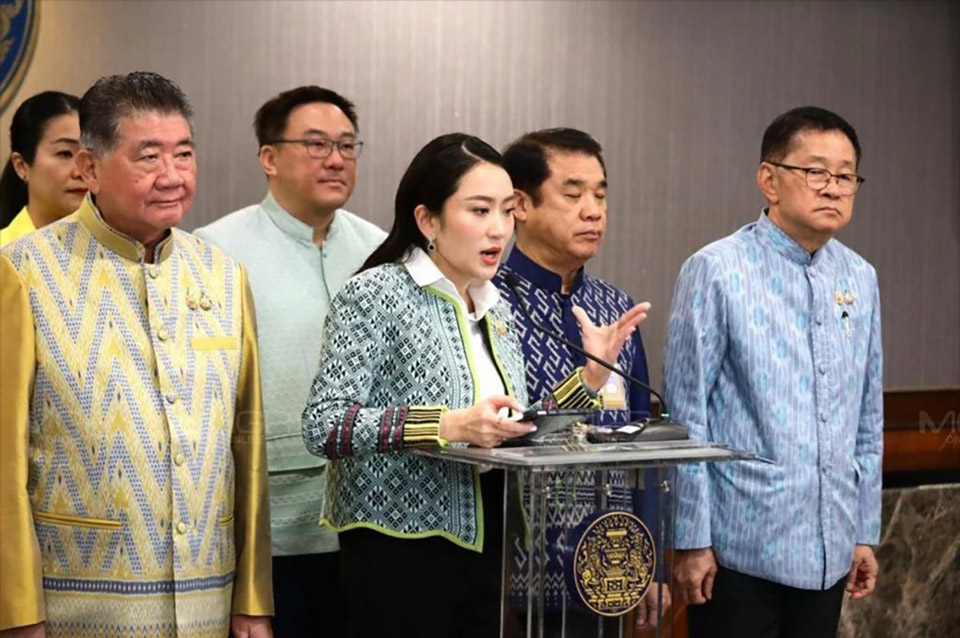
BANGKOK, Thailand – Following the appointment of Paetongtarn “Ung Ing” Shinawatra as Thailand’s Prime Minister, questions have been raised regarding her knowledge, competence, and experience. Many believe that the real power lies with her father, Thaksin Shinawatra, who recently returned to Thailand after fleeing corruption charges. Despite being sentenced, he served no actual jail time after receiving a royal pardon that reduced his sentence to just one year.
Thaksin’s influence in the government is evident, as ministers and officials treat him with the respect of a sitting Prime Minister. Though he is an ex-leader, his status was officially stripped due to corruption convictions, his royal decorations revoked, and a prison sentence imposed. Other former Prime Ministers do not receive the same treatment, which fuels speculation that Thaksin is the true decision-maker.
Paetongtarn is widely viewed as a mere “puppet” of her father, raising concerns about her ability to make independent decisions. This not only undermines her credibility domestically but also affects international perceptions. Her reliance on aides and ministers to answer complex policy questions—especially in economic matters—has raised doubts about her leadership. Critics point to her struggles in explaining key issues, such as her statement that a strong baht benefits exports, which contradicts economic fundamentals.
The Prime Minister’s Cabinet meetings also reflect her leadership challenges. Instead of summarizing decisions and offering insights, she reads meeting agendas from a tablet and defers tough questions to ministers. This dynamic fuels concerns that her government serves primarily to advance the Shinawatra family’s interests rather than the nation’s.
The opposition has seized on these weaknesses, filing a no-confidence motion accusing her of lacking leadership, maturity, and independent decision-making. The government’s decision to allow only a single day for debate further suggests an attempt to limit scrutiny, raising fears of a “majoritarian dictatorship.”
Economically, Thailand faces significant challenges. With one of the highest household debt levels in ASEAN—at 90-91% of GDP—domestic consumption remains weak. Private investment has also contracted, reflecting economic and political instability. The government’s much-touted digital wallet handout policy has been criticized for its limited economic impact, with analysts predicting it will boost GDP by only 0.4-1.0%.
Despite enjoying the prestige of being Prime Minister, Paetongtarn faces mounting pressure to prove she is more than just Thaksin’s daughter. If she cannot establish herself as a leader in her own right, her government risks being remembered as merely a tool for the Shinawatra family’s return to power rather than a force for meaningful change in Thailand.
Concerns Over Economic Stimulus Effectiveness as PM’s Policies Draw Criticism
Critics have raised alarms over the effectiveness of Thailand’s government stimulus plans, particularly the 10,000 Baht Digital Wallet Scheme introduced by Prime Minister Paetongtarn. While the government expects the scheme to boost the economy, economic analysts argue that the costs may outweigh the benefits.
The first phase of the stimulus, which totals 145 billion Baht, is predicted to have a modest effect on the country’s Gross Domestic Product (GDP). Experts estimate that the scheme could increase GDP by just 0.3% to 0.5%, translating to an additional 53.7 billion to 89.5 billion Baht in economic output. However, the financial return on investment is highly questionable.
If GDP increases by 53.7 billion Baht, the net loss will amount to 91.3 billion Baht, recovering only 37% of the initial investment.
If GDP rises by 89.5 billion Baht, the net loss would be 55.5 billion Baht, recovering 61% of the expenditure.
These figures suggest that the money spent on the stimulus is unlikely to generate value equal to or greater than the amount invested, leading some to argue that the scheme fails to meet expectations. Economists contend that the economic “spin” previously claimed by the government, promising a “turbulent economic storm”, is not materializing. Instead, the government’s actions have been described as producing little more than a “gentle breeze”, which critics claim only worsens the country’s economic situation.
From a political perspective, the program may serve the government’s interests by helping to maintain its voter base and boosting its public image. However, this strategy is seen as short-term and politically motivated, as it fails to address the structural weaknesses in Thailand’s economy, which remain under pressure due to slow recovery from the pandemic and growing economic challenges.
As a result, the latest NIDA poll shows that a majority of Thai citizens are dissatisfied with the performance of Paetongtarn’s administration, which has struggled to deliver meaningful economic results.
With over two years remaining in Paetongtarn’s term, the looming question for Thailand is whether the country can weather this economic turbulence under her leadership, and what the future holds for both the economy and the people of Thailand as political and economic challenges continue to unfold.