|
Thailand as hub of meetings and exhibitions in sub-Mekong region
The Thailand Convention and Exhibition Bureau (TCEB) has
resolved to promote Thailand as a hub of meetings and exhibitions in the
sub-Mekong region during the second half of this year.
Thongchai Sridama, Acting TCEB president has revealed
that in the rest of Fiscal 2012, the TCEB will focus on penetrating the
sub-Mekong market which includes Myanmar, Laos, Vietnam, Cambodia and Yunnan
province in China. Thongchai sees that Thailand still has a lot of room to
grow in the Mekong sub-region, which possess a population of approximately
320 million.
According to Thongchai, Thailand has a strong point in
its geographical advantage with easy access to South Asia, East Asia, and
Southeast Asia. He went on to say that the TCEB would focus its campaign on
seven sectors, namely energy, public utility construction, agriculture, food
safety, environment, tourism, and the information and communication
technology. (NNT)
AFG looks at the “perfect world”
The dynamic and rapidly growing Automotive Focus Group
(AFG) hosted a very interesting and provocative seminar and networking at
the Nova Platinum last weekend.
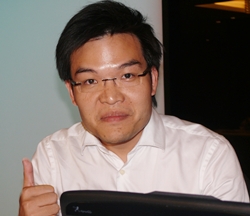
Hugh Vanijprabha
The principal speaker was Hugh Vanijprabha, the executive
director of TEBA (Thai European Business Association). His presentation was
an overview of the Thai Auto Industry with reference to the ASEAN Economic
Community (AEC) scheduled for 2015.
After joining TEBA in 2010, Hugh has continued to develop
industrial cooperation between Thailand and Europe with the key objective
being to help facilitate existing and future business growth between the two
regions, focusing on various industrial sectors including Automotive,
Aerospace, Food, Pharmaceutical and Green Technology.
To be able to become involved in those lofty ideals, Hugh
has had continual engagement with the government as a Senate sub-committee
and public offices and has developed a TEBA business platform for all
parties to share thoughts and business concepts among all stakeholders from
government, academia, individual firms and private organizations.
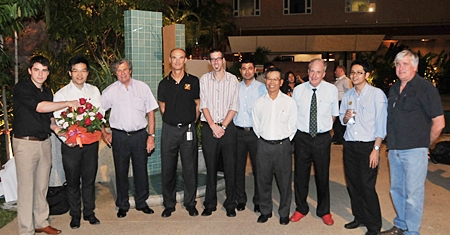
Members of the dynamic and
rapidly growing Automotive Focus Group.
Hugh was assisted by mini-presentations from many
speakers from different sections of the auto industry, including Alain
Deurwaerder (MD Ducati Thailand) who spoke on the urgent need for vocational
training in Thailand before the industry is stifled through lack of trained
personnel; Matt Cox (customs and duty manager Triumph) who referred to the
incredibly difficult situation with Thai Customs; and Uli Kaiser (president
of the AFG) who spoke on automation as the key to overcome the labor
shortages.
It became obvious, quite early in the piece, that Hugh
has a most unenviable job in pushing for Thailand to be a global automotive
hub, let alone be the leader in ASEAN. There are just so many government
ministries involved that he has a Hydra on his hands! He referred to
government policies being handed down as ‘position papers’, saying “these
just don’t work.”
Mention was made of Thailand’s chaotic fuel situation
where we have a choice of 10 different types of fuel, with no end in sight.
It was a most stimulating evening, and discussions went
long into the night, over liquid libations and some excellent choices in
food around the Nova Platinum pool.
As his closing remarks, Hugh warned that Thailand has to
look carefully at where it wants to be in the next 5-10 years. His final
words were “The government has to have the right mind-set.”
But does it?
|

|
20-baht pork powers new life for flood victim
Vittaya Yoondorn
Pattaya’s appetite for street food is helping some of
those displaced by last year’s floods in Bangkok build a new life.
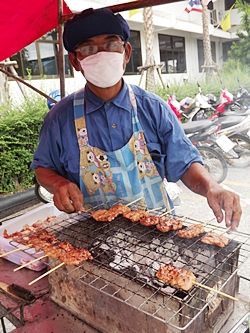
Almost ruined by last year’s
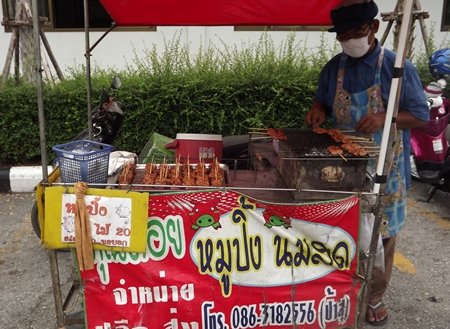
devastating floods, Sorn Pongkhan found a lifeline selling pork on a stick.
Sorn Pongkhan, who nearly went broke after the floods, is
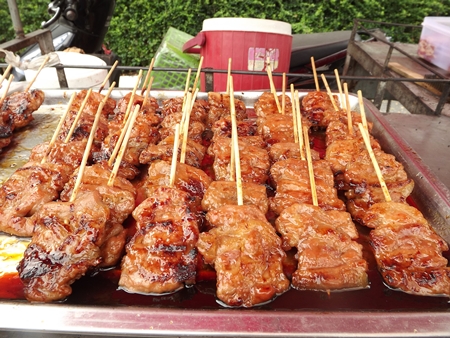
earning as much as 30,000 baht a month selling marinated, roasted pork on a
stick in North Pattaya.
He took what money he had left and spent it on a
motorbike-driven stand, pork and sticky rice and set up shop in front of
schools and busy shops. His bet paid off.
Now Sorn buys almost three kilograms of fatty pork a day,
mixes them up with his own secret blend of secret herbs and spices, a recipe
that has been handed down from generation to generation, then heads off to
the Banglamung District Office, where he opens each day at 8 a.m. before
moving to other locations after lunch.
His revenue surprises friends, considering each seven
skewers cost only 20 baht. But he has learned to never underestimate the
appetites of hungry school kids and bureaucrats.
Sorn also delivers orders over 300 baht. Customers can
call 090-130-4244.
|
|
Manufacturing Production Index contracts 9.6% in June
Thailand’s Manufacturing Production Index (MPI) in June
stood at 182.39, recording a contraction of 9.6 percent year-on-year after
showing growth in May, according to the Office of the Industrial Economics
(OIE).
Speeding production in hard disk drive and electric
circuit industries accounted for 15 percent of MPI growth.
OIE Director Sophon Pholprasit said that the
Manufacturing Production Index (MPI) in the second quarter of this year
contracted 1.6 percent, compared to the same period last year.
The capacity utilization rate stood at 69.2 percent,
resulting from continuing recovery in the industrial sector after last
year’s devastating flood.
As of the end of June, 658 plants or 78 percent of all
839 plants in seven industrial estates hit by the flood have resumed
production.
Exports in June rose 3.3 percent year-on-year, mainly
driven by auto exports. Electrical appliance exports in the second quarter
grew 12 percent year-on-year while electronic exports shrank 17 percent,
improved from 23 percent contraction in the first quarter of this year.
The food industry shrank 21 percent, contrary to normal
growth earlier due to decreased exports to the European Union countries and
the US.
The auto industry in the second quarter grew 46.59
percent year-on-year owing to rapidly rising production to meet overdue
orders.
Meanwhile, imports of raw material, excluding gold,
shrank 12.1 percent year-on-year, reflecting a possible drop of output in
the future while imports of capital goods grew 9.9 percent.
Regarding projections of the industrial growth rate, the
OIE sees a 4.5-5.5 percent GDP growth and a 6-7 percent expansion of the
MPI. This was attributed to the government’s income-generating policies,
including crop pledging scheme, raising the minimum wage and the Bt350
billion loan decree for water management.
On the industrial trend for July, Sophon said that the
International Monetary Fund lowered its world economic growth projection to
3.5 percent from its earlier projected 3.6 percent in April, indicating a
possible slowdown of Thai industry amid risks from a euro-zone debt crisis.
Thai industrial exports to European markets account for
an 11 percent share of the sector, while the export ratio to China, one of
Thailand’s major export markets, accounted for 12 percent.
China’s demand for Thai goods may drop after the slowdown
of its exports to Europe. (MCOT)
|
|
ASEAN chief advises Thailand to change trade, investment models to penetrate ASEAN markets
Secretary-General Surin Pitsuwan of the Association of
Southeast Asian Nations (ASEAN) advised Thailand this week to change its
trade and investment models in order to penetrate and invest more in ASEAN
markets and bring back revenue to the country.
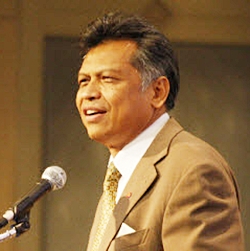
Speaking on the ‘New Dimension in ASEAN’ at a seminar
organized by the Judicial Training Institute for high-ranking Thai
officials, Dr Surin said Thai investors should be helped to invest overseas,
replacing the current situation where foreign investments are attracted to
the country.
Thailand must change itself to start focusing on the
industry of innovation, using technology to improve its economic potential
such as packaging development or trading online, he noted.
It would take Thailand many years to change and to trade
more in ASEAN, as the country has been dependent on low-wage labor and
natural resources like its neighbors.
Dr Surin also advised the government to increase its
research budget for this, tackle corruption, and have the Board of
Investment and the Bank of Thailand adjust to support Thai investors to
invest more abroad.
The 10-member ASEAN association has a total trade value
of US$2.6 trillion. However, only 25 percent is traded internally, according
to Dr Surin.
Meanwhile, Secretary-General Supachai Panitchpakdi of the
United Nations Conference on Trade and Development (UNCTAD) spoke on
‘Looking at Thailand in the World Arena’ at the same venue, saying that
ASEAN will be the hope and the stimulus of the world economy along with
China, Brazil and India, and that ASEAN nations must trade more among them
due to the declining purchasing power in the West.
However, clear regulations are needed in ASEAN countries
to deal with a higher capital flow coming into the region in order to
prevent a bubble economy, Supachai added.
Thailand, in particular, needs good governance along with
good public policy planning. The sufficiency economy, as previously
addressed by His Majesty King Bhumibol to the Thai people, was suggested by
the UNCTAD secretary-general as the best immunity for private companies and
policies run by the government.
Supachai said Thailand’s capability to compete ranked
39th last year, out of 142 countries worldwide, preceded by Malaysia at
20th, while Singapore ranked in the top ten along with the United States,
Finland, and Sweden.
Despite the fact that Thailand has continuously attracted
foreign investments, the nation has five remaining problems - political
instability, corruption, unstable government policies, an inefficient
bureaucracy, and the inefficient education of the labor sector. (MCOT)
|
|
|