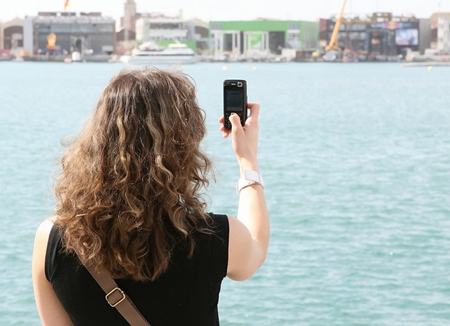
I was at a function the other day and noticed that everyone present was using
his or her camera phones to record the event. Now while I take my hat off to the
clever engineers who can make a phone also take a photo, for me, this is about
as useful as strapping your microwave on your wrist to have a device that will
tell you the time as well as cook your meals.
I have the more than sneaking suspicion that this
ambidextrous telephone device ends up being neither fish nor fowl. Brilliant at
being able to ring people in far of places and speak to them in real time, but
giving a very poor picture quality at best.
It stands to reason, that while the phone manufacturers are
attempting to impress you with the number of megapixels you have in your hand,
megapixels alone do not give you razor sharp photographs.
A reasonably new development in the early 21st century, now
the majority of cameras and of mobile phones in use are camera phones.
The physical make-up of camera phones is simpler than
separate digital cameras. Their usual fixed focus lenses and smaller sensors
limit their performance in poor lighting. Having no physical shutter, most have
a long shutter lag. Most have no flash or optical zoom or tripod screw. Many
lack a USB connection, removable memory card, or other way of transferring their
pictures more quickly than by the phone’s inherent communication feature, be
that 2G, 3G or 4G.
Some of the more expensive camera phones have only a few of
these technical disadvantages, which apply most acutely in low light conditions
but has not inhibited their widespread use. Most model lines improve in these
regards every year or two (as does just about every electronic gizmo). Some,
such as the iPhone, only have a menu choice to start an application program to
activate the camera. Whilst others, such as the BlackBerry Storm2, Droid X,
Motorola V980 and Nokia 5800 also have a separate camera button for quickness
and convenience. Some are designed to resemble separate low-end digital compact
cameras in appearance and to some extent in features and picture quality, and
are branded as both mobile phones and cameras, including certain Sony phones.
The principal advantages of camera phones are cost and
compactness; indeed for a user who carries a mobile phone anyway, the additional
size and cost are negligible. Smart phones that are camera phones may run mobile
applications to add capabilities such as geotagging and image stitching, but
most do not. A few high end phones can use their touch screen to direct their
camera to focus on a particular object in the field of view, giving even an
inexperienced user a degree of focus control exceeded only by ‘real’
photographers using a ‘real phone’ with manual focus.
There is no getting away from the fact that modern man likes
the concept of a camera phone. The J-Phone in Japan had more than half of its
subscribers using cell phone cameras in two years. The world soon followed. By
2003, more camera phones were sold worldwide than stand-alone digital cameras.
In 2005, Nokia became the world’s most sold digital camera brand. In 2006, half
of the world’s mobile phones had a built-in camera.
In 2008, Nokia sold more camera phones than Kodak sells film
based simple cameras, thus became the biggest manufacturer of any kind of
camera.
In 2010 the worldwide number of camera phones totaled more
than a billion and sales of separate cameras began to decline. Even inexpensive
mobile phones, were being sold with a camera. High end camera phones usually
have a good lens, high resolution, but once again picture quality is limited by
a small sensor.
What I have against camera phones (as well as the lack of
sharpness in the image) is the lack of creative control. You cannot isolate the
subject from the background by selecting the best focal length. Long
time-exposures are not possible. Slow shutter speeds cannot be selected to give
a speed blur effect. In fact, what you are getting is a very simple camera
image, where the Box Brownie was about 100 years ago.