There is always some doubt when you read of a police enquiry into the
police. How objective are the results? So when a book is written by a
journalist, looking critically at the work of journalists, how objective
would these opinions be?
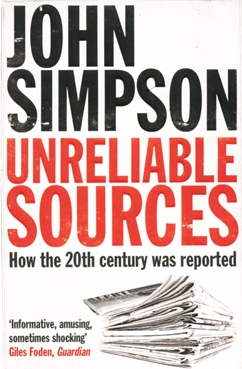
John Simpson, a journalist for over 40 years has written
a new book called Unreliable Sources (ISBN 978-0-330-43563-5, Pan
Books, 2010) which has the sub-title, How the 20th
century was reported.
The inherent ‘truth’ in this book is evident on the first
page of the introduction where author Simpson writes, “People who read the
news in a paper or on a website, who listen to a radio or watch television
news, usually imagine they are getting something approaching the truth.
Instead, they are merely getting a version of what has happened.” What a
damning concept to make public, and that’s just page 1 of the introduction.
The book proper begins with the Boer War and the young
Winston Churchill, who had already set himself apart from the journalist
van. This was a time when “war artists’ were still being used, as the
photographic coverage was not yet well developed. In those days, the
reporter was expected to further the national cause. Even to the point of
fawning!
Interestingly, he writes, “For the Daily Mail to question
the (Boer) war was a betrayal of the soldiers who were fighting and dying on
the frontline.” (Now fast forward to Iraq and Afghanistan, and make up your
own minds as to the veracity of some reports.)
The reporting by the BBC of the start of “the troubles”
in Northern Ireland in Londonderry, called “Bloody Sunday”, showed just how
stories could be glossed over and the truth hidden. Unfortunately it
reminded me of the red shirt riots in Bangkok, where the truth is still
clouded.
The ‘shock, horror’ headlines, so beloved of the Rupert
Murdoch tabloid press, were in fact not invented by R. Murdoch and the late
News of the World, but by the Daily Express in the early 1900’s with banner
headlines on the front page such as “Beaten to Death - Kills seven navies in
a few minutes.” Hmm, makes the Pattaya Mail very conservative, though
I do remember some years ago “Dolphin seen again in Pattaya Bay -
unfortunately the dolphin was deceased!”
With 560 pages, some photographic plates plus a
bibliography and an index, this is indeed a weighty tome. You will find you
can pick up and begin reading about any decade, to find sadly, that
falsehoods, being economical with the truth, to downright lies have been the
stock in trade of the mainstream press for more than a century.
At B. 430 on the Bookazine shelves, this is a disturbing
book. For those who would blindly believe everything that is published, the
realization that there are many pressures that can affect a ‘news’ item
before it goes to print, will be a shock. For those who have worked as
journalists, this book is totally factual, no matter how painful it is to
accept. Not only should the public read this book, but every cadet
journalist as well.