|
Family Money: Guaranteed
Products
By Leslie
Wright,
Managing director of Westminster Portfolio Services (Thailand) Ltd.
Major stock markets have experienced a long downslide
over the past two years, started by the collapse of the technology sector,
and continued by negative sentiment resulting from one crisis after
another. In all but a few, high-risk countries such as Russia and China,
the markets seem to have stagnated. In Europe, the US and particularly
Japan, economic uncertainty and weak fundamentals have turned people off
investing in equities, opting instead for either straightforward savings
and deposit accounts, or government or corporate bonds.
Despite the bond sector’s overall renaissance,
corporate bonds have grown more risky as wider problems impact on the
ability of companies to repay their debt - as seen in several telecoms
companies. And with interest rates in Europe, the UK, Japan and the US at
historic lows, deposit accounts are not offering investors satisfactory
returns.
The best offshore savings rate at the moment is a
4-year fixed term Sterling account offering 5.35% a year. The best instant
access account is paying only 4.1%. While deposit accounts offer safety
and security, many investors may feel they could do more with their money.
As a result, guaranteed products have become big business, and ‘flavour
of the month’ for some financial advisers.
Offshore providers
Several leading offshore institutions have launched
guaranteed investment products, all of which are closed-end funds (i.e.,
available only for a limited period). Coming in various guises, they all
offer some form of capital guarantee whereby your initial investment is
protected, and the capital growth or interest is linked to a stock market
index or a basket of equity funds. One typical example offers savers
38.25% return (6.65% p.a.) if the FTSE 100 stock market index rises or
stays the same over the five-year investment term - but if the FTSE drops
you get back only your initial investment.
Another links 50% of your deposit to the FTSE 100 index
and 50% to the HPI index (which is a measure of the UK property market),
over a five-year period. This product offers a return equal to 100% of the
growth in the FTSE 100 and HPI.
Yet another capital guaranteed product is linked to
five offshore funds from leading institutions: the Fidelity European
Growth fund; the Julius Baer Japan Leading Stock fund; the Credit Suisse
Equity fund (Lux) USA fund; the Merrill Lynch Mercury Offshore Sterling
Trust UK fund; and the JP Morgan USD Global fund. Your invested capital is
guaranteed, and the product pays out a maximum of 75% of the return from
this group of funds. Like most of this class of investment vehicle, the
capital must remain invested for five years without withdrawal.
This particular product also illustrates that capital
guarantees are rarely cheap. A normal fund-of-funds product would levy an
annual management fee of around 1.5~2%; this one effectively charges 23%,
since the product pays out only 75% of any rise. Thus investors need to
consider whether the cut taken by the provider is worth the capital
guarantee. The underlying funds are highly rated, relatively safe, and
fairly pedestrian: it could be argued that it would be difficult to lose
money on them in what should be a rising market over the next five years.
Choose the direct route
Guaranteed products fill the middle ground between
savers, who are happy with solid but low returns, and equity investors,
who are looking for a better return from their money.
If you think stock markets are going to rise over the
next five years, it may be better to put your money directly into an
equity fund or fund-of-funds product rather than a guaranteed product. If
markets rise, you will receive all the profits; of course, if markets fall
you can lose your money. This is the fear that guaranteed products operate
on - the balancing act any investor must make between risk and reward.
Most analysts agree that major stock markets are
currently a reasonable bet. The market adage that even a dead cat will
bounce means that even after last September’s outrages, rises did start
to happen across most markets. Even the high-tech sector shows some sparks
of life with former casualty Cisco Systems, once the world’s biggest
company, posting better-than-expected profits for the first quarter this
year.
Looking at an investment period of, say, more than 10
years, you should be prepared to ride the market downturns. Research has
shown that a low-risk portfolio of 70% bonds and 30% equities performs
well over the long term - better in fact than the net return of most
‘guaranteed’ products.
So if you’re a long-term investor, you should decide
whether you really need a rock-solid guarantee in the first place.
Another recent offering illustrates this neatly. If the
level of the FTSE 100 stock market index rises by 10% or more in a year,
7% interest is paid. But if the level of the index rises by less than 10%
in a year, or falls, a rate of only 3% is paid - less than you’d get
from a bank deposit. While this may appeal to risk-averse investors, if
you believe the FTSE 100 will bounce back by 10% a year over the next
three years, is it worth investing in a product that will pay out only 7%?
What if the FTSE 100 rises by 20%?
Popular with expatriates
Guaranteed products have proved popular with
expatriates during the past two years of stock market turmoil, lured by
their emphasis on safety and capital protection. But a capital guarantee
still means your capital is being eroded by inflation every year,
something that wouldn’t happen with a term deposit, which will
definitely pay you interest.
In the end, guaranteed products do make sense for
certain investors - for example, an unsophisticated retiree with only a
modest nest-egg who cannot afford to risk losing capital, or a nervous
investor looking for a safe haven in a period of economic volatility.
A younger investor thinking of a lifetime’s saving
should be prepared to take some risk, and should create a balanced
portfolio accordingly. Over the longer term, balanced portfolios perform
well, as do stock markets. Indeed, a study of all seven major stock market
falls (of 10% or more) since 1970 has shown that average annual returns in
the decade following the slump ranged from 8.25% a year at the low end, to
19.45% a year at the top. Given those figures, guaranteed products perhaps
don’t make so much sense for those prepared to keep their nerve and
stick with it.
Snap Shot: Shooting your
own catalogues!
by Harry Flashman
Harry Flashman has found that Pattaya seems to be
filled with entrepreneurs. Every second person, and especially the ladies,
has a scheme to export Thai artefacts to the thirsting throngs back in
their home countries. After all, such things as Thai silk, locally
produced cutlery, incense holders and costume jewellery are plentiful and
much cheaper than “back home” and why not make a little money on the
side as a small-time supplier?
 Photo
by Richard Sharabura Photo
by Richard Sharabura
Without wishing to get into the intricacies of
exporting, one area where many of these small ventures fall down is in the
production of a catalogue. And you do need one, or otherwise the importer
has no idea what the item actually looks like! Try describing Burmese
embroidered wall hangings, and see what I mean!
Realizing this, many have picked up the trusty family
Kodafujinikonolta camera, placed the items on the table, and belted off 36
exposures. The end result is 36 snaps of unexciting goods, lying on a
tabletop. Is this enough to interest a would-be purchaser? Unhappily not.
You see, you have to inject “visual appeal” into
these snaps. You have to show the importer what these things actually look
like. You have to indicate form, size and colour. Those blurry, almost
monochromatic shots just don’t cut it, I’m afraid. Catalogue shots
have to be good. This is why Harry could command $1,000 a day doing
catalogue photography 15 years ago!
Now I am not suggesting you ring me up with
irresistible offers, Harry has retired from active service, but I can show
you how to get some passable images yourself. The first thing to buy is a
large sheet of white thick paper or thin card, which you gently bend into
a right angled curve. Stick the top to a wall and move a table underneath
and stick the bottom to that. You now have a seamless “nothing”
background on which to place your stock items. No distractions in the shot
- just your individual items for sale. Place the first item on your
seamless background.
Next is the lighting. Flash is good, especially if you
have an “off camera” flash head, but even if you have not, all is not
lost. Shooting downwards at an angle of about 45 degrees, you want to
bounce the flash burst towards the back wall of the white curved
background. If you have a flash head that can be angled, then it is
simple, but otherwise, place a piece of card under the camera’s flash
head to stop the “spray” of light going directly on the product which
then directs the main burst towards the back wall. What you are doing is
to produce a small shadow line along the bottom of your items, all of
which gives them shape and form.
The “looking downwards” at 45 degrees is actually
very important too. This duplicates the angle you naturally use when
looking at most small items, so you see a cutlery item, for example, how
you expect to see it. No strange perspectives. If it looks like a fork,
then you’ll attract more people to buy the fork. Simple psychology.
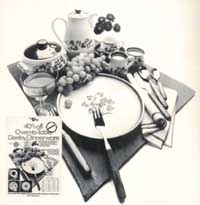
If needs be, you can show the size of items by
incorporating known smaller items in the shot. Coins, reading glasses, a
set of keys, and an egg cup can all show comparative size. Just remember
to make the item for sale the “hero” and not the egg cup! In other
words, make the size reference item the secondary item in the shot!
In general, try to use secondary items that have some
relationship to the feature item. A knife and spoon would naturally go
with an egg cup, for example, and to make a really good shot, you would
soft boil an egg, place it in the egg cup, slice the top off and place
that slightly to the right side of the cutlery items. See how a little
thought can take a boring catalogue shot and make it so much better.
Now do your own!
Modern Medicine: A bad attack of the Bronickles!
by Dr Iain Corness, Consultant
Now while many of you may smile at the title of this
week’s discourse, you have no idea just how many times patients have
regaled me with that phrase. There are also other classic quotes, such as,
“Appendicks? I’ve had them removed,” which of course is very
reassuring since you only have one appendix. But I digress, let’s look a
little at Bronchitis this week.
There has been a literal epidemic of Bronchitis in the
last couple of weeks. The hospital has been full of coughers, in my office
in town three people have been off and a friend’s children both ended up
in hospital barking madly. Even myself, the bionic plane jumping man, was
not immune, and after a week am still coughing so badly that the domestic
African Grey parrot now sounds definitely consumptive.
So what exactly is “Bronchitis”? Well, the first
thing to understand is that Bronchitis is not a disease, it is a
descriptive term. Remembering that anything ending in “-itis” means
inflammation/infection, this means that Bronchitis is a condition
affecting your “bronchi” which are your breathing tubes, leading into
the lungs. (They start off large and become smaller as they split and dive
deep into the lung tissue and when they become very small they are called
“bronchioles” and yes, you can have “Bronchiolitis” too!)
Now you can see why “Bronchitis” in different
people does not necessarily have the same “cause”. Generally it is
bacterial, and there are many that can infect the bronchi, but it may also
be caused by viruses and even irritative chemicals. So if you got over
your Bronchitis in a week, don’t scoff at someone who is still
struggling three weeks later - it was from a different cause.
The symptoms of Bronchitis are mainly deep seated
coughing, productive of sputum (that ikky stuff you spit into the hand
basin). Thick tenacious mucous is very difficult to bring up, and if you
are a smoker, it becomes even harder. Sorry to bring up smoking again, but
smoking reduces your resistance to bugs, lowers the body’s ability to
expel the mucous and lengthens recovery time.
If the infection does not remain in the bronchi, but
gets out into the lung tissue, you are reaching Broncho-pneumonia, even
more potentially serious as your respiratory capacity becomes increasingly
smaller.
So how do you tell if the infection is just in the
tubes, or spreading into the tissue? Quite easily - you go along and see
the doctor, who with his stethoscope can listen and determine whether it
is happening. Sorry, but you cannot do this on your own, unless, of
course, you have your own stethoscope and have undertaken 6 years of
intensive medical training!
Cure is not all that difficult. An appropriate
antibiotic in the case of a bacterial infection will work very quickly,
but choosing the correct antibiotic is not a case of “Give me a strip of
10 of the pink and green capsules.” Clinical suspicion plays a part,
experience too, and if necessary, sputum culture and antibiotic
sensitivity is needed to optimise the choice. If the cough lasts more than
a couple of days - get advice!
Finally, always remember that it’s not the cough that
carries you off, it’s the coffin they carry you off in!
Practical Thai Law: Laws on the Environment - Part
2
by Premprecha Dibbayawan - MCL Miami University
Chairman - International Swiss Siam Co., Ltd.
Last week we talked about the environment and the laws
on the books that affect it. This week we will take a look at more of
those laws.
Municipality Act 1953
Any municipality can enact its own ordinance to impose
penalties on the people who break such ordinances within the municipal
area, provided that the penalty does not exceed a fine of one thousand
baht.
Act on the
Administration Pattaya City, 1978
As with the Municipality Act, the council of Pattaya
City may enact any rule or regulation and impose penalties on those who
break the rules, but the penalty must not exceed imprisonment of six
months or a fine over ten thousand baht.
Constitution of Thailand
Starting with the constitution of 1974, the
constitution writers included a provision that the State must enhance and
preserve the beauty of the natural environment, including maintaining the
forests, creeks and rivers.
Enhancement and
Conservation of National Environmental Quality Act, 1992
Under the Anand administration the government enacted
the above law that covers all aspects of controlling the environment.
Three new offices were established under the act, being: the Pollution
Control Department; Department of Environmental Quality Promotion; and
Office of Environmental Quality Promotion; and Office of Environmental
Policy and Planning. All these departments are to promote awareness and
educate people about the environment, take charge of planning and policy
making and assess infrastructure projects - especially large government
projects. Both the government and the private sectors are required to
submit Environmental Impact Assessment Reports on each proposed project
for approval of these departments.
Prior to enactment of this act there were several other
acts that included provisions to control environmental problems such as
the Factory Act, Hospital Act, Food Act, etc. However, the Enhancement and
Conservation of National Environmental Quality Act 1993 revised the
provisions of all such acts and improved the means of enforcement, for
example the requirement that all industrial plants have to have competent
supervisors and machine operators and to submit toxic matter for analysis
to the Industrial Factories Department every three months. Penalties for
environment standard violations under this act are severe and include
fines ranging from 10,000 to 500,000 baht, closure of the factory and
imprisonment of the owner. In spite of this, enforcement remains
relatively lax and widespread evasion of regulatory standards allegedly
exists.
The Asia Pacific
Roundtable for Cleaner Production
The growing new economies within the Asia Pacific
region have raised concern about the environmental impacts generated from
industrialization and urbanization. Pollution has become one of the
pressing issues in the region. The introduction of the Cleaner Production
approach has been seen as a new and innovative strategy to overcome the
problem. In recent years, countries within the Asia Pacific region have
embraced and implemented Cleaner Production strategies.
In 1992, the first Asia Pacific regional conference on
CP was held in Bangkok, Thailand. The participants in the Bangkok
conference agreed that a mechanism to share information and technology,
training programs and regional events should be established. As a result a
new organization: the Asia Pacific Roundtable for Cleaner Production (ARPCP)
was established in 1998.
The mission of APRCP is to provide leadership and
support that will enhance information flow and human resource development,
and will strengthen public-private partnership to stimulate the promotion
and implementation of cleaner production strategies and technologies in
the region. The 2nd APRCP regional conference was held in Brisbane,
Australia in 1999, and then followed by the 3rd APRCP in Manila.
At the closing ceremony of the 3rd APRCP in Manila,
Indonesia was selected as the host for the 4th APRCP regional conference
in 2002, which will be held 21-24 October 2002.
Heart to Heart with Hillary
Dear Hillary,
With the traps for young players so clearly identified
every week in your column, I find it amazing that there are so many men
prepared to sacrifice themselves for the family buffalo, yet again. I
looked very carefully before making my choice and I am happy to say that
my girlfriend’s family does not have a buffalo, she has no previous
husband’s children living with her mother, the family farm has not been
mortgaged and both her parents are in perfect health. They live several
hundred kilometres away, so are not down every second weekend. All I am
saying, Hillary, is that if these men were to spend a little time looking
and carefully choosing there would be fewer agonized letters to your good
self. Don’t you agree?
Careful Charlie
Dear Careful Charlie,
Hillary would like to wager that you have a problem
buying hats and caps, Careful Charlie. I am sure they would not make one
large enough, my shy retiring Petal. I am glad too that you have not let
even one skerrick of emotion sway you from the quest for the perfect mate.
Choosing one’s life partner using the same parameters as choosing a maid
may get you out of the buffalo danger zone, but in return you get the
loveless life instead. But then it probably doesn’t worry you too much.
You don’t need anyone else’s love, you have enough for yourself and
then some.
Dear Hillary,
With your constant cries for champagne and chocolates,
you must be a fairly overweight lady by now. Unless nobody sends you any!
My friends and I would like to know and if you publish this letter we will
send you some by courier.
James
Dear James,
Just what was it you really wanted to know, Petal?
Am I poom-pooie or do I get the chocolates and champagne? Really, I
don’t know what your teachers ever taught some of you people in school,
but then, that supposes that you did go to school in the first place. Am I
overweight? No, I am not, but thank you for considering my health. Do I
get the chocolates and champagne? Yes, James, most people do honour their
commitments, other than Iggy, (Volume X Number 25) who wrote, “Hillary,
I swear I’ll give you the champagne and bon-bons if you print this -
ATTENTION SILLY FARANG MEN - YOU’RE NOT SPECIAL. YOU’RE A WALKING
WALLET.
Thank you, Hillary, MY petal. Iggy.” Well, Iggy,
not only did you make out that you know it all, but you have also shown
yourself to be less than precise with your promises. You did not send the
promised goods during the past month since your letter was printed (in its
entirety, too), so what value can anyone place on your words? So please,
my little Iggy Petal, if you are half the man you think you are, send the
champagne and bon-bons and I will even tell the world what a wonderful
chap you turned out to be. If you don’t, then I will have to tell your
teacher that you have been spreading untruths, and you wouldn’t like
that, would you Iggy darling.
Dear Hillary,
I am a successful Australian businessman who has worked
hard, accumulated a high level of wealth that provides me with a very
comfortable lifestyle. Despite my financial successes, I have failed
miserably in finding true love. I have commenced a worldwide trek to track
down that elusive female butterfly. One who will be able to fill that void
in my life, love me, marry me and produce our children. Australian women
are not suitable. I have always believed that any relationship is a 50 -
50 proposition, but Aussie women don’t understand fractions. I flew to
America. I met an attractive girl and took her to Disneyland to enjoy the
rides, but she took me for a ride. In Canada I met a beautiful librarian,
but she spent most of her time reading my bankbooks. In Paris I met a very
tender person, but she was only interested in legal tender. I am now here
in Pattaya, still searching for my butterfly. I have met a cute local girl
named Noi who works at a beer bar. She doesn’t seem interested in taking
my money for herself and only insists that I give her one thousand baht
every morning for her taxi ride home. It seems that both of her parents
are always ill as she needs additional money to send to them. Please tell
me about the local girls. Could Noi be my elusive butterfly? She wants me
to take her away from it all but could she take it all away from me? Could
the fact that her parents are always ill have any detrimental genetic
effect on any children we may have?
Awaiting your advice.
Mick
Dear Mick
My heart breaks for you, you seem to be hell bent on
being taken for a ride! Aren’t you a little dear! Or should I say a
little pricey? Be aware, perhaps Noi may be your elusive but not exclusive
butterfly. Don’t worry about Noi’s health though - she will only get
sick later in life when the daughter you have between you meets a rich
Australian who has worked hard and accumulated a high level of wealth and
is looking for an elusive butterfly. In the meantime, I suggest she takes
a cheaper taxi home, that Rolls-Royce is a little over the top. Give her
40 baht for a motorcycle taxi and see how she goes! Or should I say
“disappears”. Have you considered having yourself cloned? Us girls all
over the world need more of you!
A Slice of Thai History: Prince Mahidol of Songkhla, The Father of Modern Thai Medicine
by Duncan Stearn
Part One 1892-1920
The son of King Chulalongkorn (Rama V) and Queen Savang
Vadhana, Prince Mahidol Adulyadej was born on January 1, 1892. At 13, he
was ordained, like his brothers, as a Buddhist novice at Bovornnivet
Temple and received the title of Prince of Songkhla.
He was sent to England and completed his formal
education at the prestigious Harrow School.
His father and the German monarch Kaiser Wilhelm II had
struck up a friendship during a visit by the Thai ruler to Germany in
1897, and it was the wish of King Chulalongkorn that Prince Mahidol should
continue his education by going to the Royal Prussian Military Preparatory
College in Potsdam.
Apart from the military aspect of the college, there
were also courses available in humanities and science, and Prince Mahidol
took these up with enthusiasm, completing the preparatory college at the
age of 18.
Always physically frail, the Prince suffered from
problems with his back, but while at Potsdam these were cured. His
physical ailments were more than likely the catalysts that led to Prince
Mahidol’s future intense interest in health and medicine.
The strict rules and regulations at Potsdam apparently
suited the young Prince. He told a Thai colleague the discipline was
“...good. I like to be treated strictly. I was too comfortable in Siam,
with everyone giving me everything.”
From Potsdam he spent the next two years at the
Imperial Military Academy in Berlin. He graduated in 1912 and entered the
German Naval Academy at Flensburg, and at the same time was commissioned
as a lieutenant in the Royal Thai Navy by his elder brother King
Vajiravudh (Rama VI).
Prince Mahidol’s formal military education ended in
1914, but with the outbreak of the First World War he was instructed by
King Vajiravudh to return to (then) neutral Thailand.
It was while serving in the Thai Navy that Prince
Mahidol was invited on a canal tour by the chief of the Royal Medical
College, Prince Chainart-narenthorn. They stopped at a nearby hospital and
went for a stroll. Prince Mahidol saw people sitting and lying on the
ground underneath the trees growing in the compound and was told they were
patients for whom there were no rooms available.
Inside the hospital, the Prince later stated the rooms
looked more like unkempt stables and was made acutely aware that the
standard of public health and of medical practitioners was seriously
deficient in Thailand.
This tour proved to be a turning point in Prince
Mahidol’s life. He expressed a desire to gain the necessary medical
knowledge so he could help the sick and injured, and made application to
his brother the King asking permission to terminate his naval career.
The King acquiesced and Prince Mahidol enrolled at
Harvard University in the United States in 1916 to study public health and
medicine. His first choice had been Edinburgh University in Scotland, but
the effect of the weather on his poor health meant that Harvard was a
better option.
His correspondence from that time shows a man who had
clearly found his vocation in life. He stayed at a house in Boston,
Massachusetts, registering simply as Mr. Mahidol Songkhla.
One of his professors wrote he was a student who did
‘...not let details pass by.’
To commence the task of building a core of
well-educated and reliable medical staff, Prince Mahidol asked Prince
Chainart-narenthorn, the chief of the Royal Medical School, to send four
students to the United States on a scholarship with funds supplied by
himself and his mother Queen Savang Vadhana.
One of the students happened to be 18-year-old Sangwan
Talabhat, who was going to study nursing at Simmons College. Prince
Mahidol met the four students at the train station and was soon courting
Sangwan Talabhat. The pair were married in Bangkok on September 10, 1920.
Bits ‘n’ Bobs
|
CANNED LAUGHTER
Noticing that my beer fridge was in need of
urgent restocking, I bravely ventured off to the superstore situated
some three kilometers from my house. Having purchased two cases of
Heineken and a carton of Krong Thip Lights to smoke on the way home,
I returned to my car. Just as I dumped my home essentials on the
roof and began to search for my keys, a familiar voice rang out. It
was a friend of mine who had just returned from an overseas trip.
We chatted away for some twenty minutes before
heading off on our separate ways. I jumped in the car and off I
went, busily searching for the car park ticket, which I found under
the seat just before the exit.
I dutifully gave the ticket to the attendant,
ignoring the rather perplexed look on his face and crept into to the
slow-moving lane of traffic on the Sukhumvit Highway.
Turning left in the filter at the lights up
ahead, two girls illegally driving against the traffic waved at me.
I naturally waved back (stardom, irresistibility, etc, are hard
combatants for natural modesty).
The traffic was heavy indeed, so the journey home
was painfully slow. Several times I noticed other people waving at
me and I have to say I felt really good about it. It just goes to
show that driving slowly has its benefits: recognition is humbling.
I know Thai people are renowned for their smiles,
but this display was something else. What wonderfully happy people,
I thought to myself, as I wondered if it was some day of
celebration.
Reality struck as I reversed into the drive only
to be called ‘Dting Dtong’ by my maid. I got out of the car and
followed the direction of her pointing finger. There on the roof
were the two cases of Heineken, the carton of cigarettes
conspicuously absent.
Oh well, it was great to feel like a superstar
for a minute or three...
DID YOU KNOW ...
Armadillos have 4 babies at a time and they are
always the same sex.
A whale’s penis is called a dork.
Only one person in two billion will live to be
116 or older.
An ostrich’s eye is bigger than its brain.
The longest recorded flight of a chicken is 13
seconds.
A pregnant goldfish is called a twit (yes, with
an ‘i’).
111,111,111 x 111,111,111 =
12,345,678,987,654,321?
|
ON THE JOB IN PATTAYA
NO! This column is still in ‘Mary Poppins’
territory in respect of political correctitude. I refer of course to the
myriad of self-employed people who trudge the streets of Pattaya day after
day in an effort to make an honest bowl of rice. The variety is amazing,
and if anyone wants to question Thai work ethics, then I challenge them to
swap places with one of these individuals for a day.
I watch men or women pushing carts heavily laden with
their wares in searing temperatures, stifling humidity or drenching rain.
I particularly notice and look in awe if not sympathy at the ones who
carry their wares via a shoulder ‘yoke’, the wood bending under the
strain of the weight of their produce with every stride as they adopt a
Michael Jackson gait, blending in with the undulations of the rhythm of
each lurch.
This afternoon, I watched a chap with one of said
adorned shoulder yokes toting a heavy-looking wok upon which eggs were
cooking. He was also lugging countless bottles of whatever, cooked rice
and some produce that was doubtless scavenged at the dead of night from
Rentokil’s waste skip.
The ‘Bug Man’ seemed to be in a race with a chap
who was dragging along a large trolley laden with bamboo, or whatever,
handmade sun-loungers. At my gate, they were neck and neck, but my money
was on old Buggy as he was motoring. Two seconds later, it was as if the
umpire had called time out.
The Recliner Rep screeched to a burning flip-flop halt
and hastily untied two of his products. He proceeded to place them at the
side of the kerb under the shade of a large tree outside my house. Buggy
Boy swerved into the pits and carefully positioned his scales of
enterprise.
Within in seconds, plates had appeared and the pair
were happily tucking in to a feast fit for a non-fussy dog as they sat
astride the appropriately placed ‘dining suite’. They nattered away as
they devoured the rice, eggs and nasties, before both stretching out on
the loungers and falling asleep.
There the pair of entrepreneurs remained for the next
hour, old Buggy snoring away like a circular saw in need of maintenance as
the Lounger Rep expertly advertised the soporific excellence of his
product to passers-by. Their alarm call came via a local farang who woke
up the Lounger Rep to haggle for one of his chaises lounges. As he was
negotiating, the farang’s female partner bought two bagfuls of Buggy’s
culinary delight.
Now that is what I call Thai Wisdom and the road did
not have to be closed to traffic to make it happen. Food for thought...
WORD OF THE WEEK
Significant (adj.) Inability to smell cigarette smoke.
|
Animal Crackers: Marmots,
Woodchucks, Groundhogs
By Mirin E Mc Carthy
 Marmots are closely related to both large ground squirrels
and prairie dogs, and although they don’t appear to be rat like, are
classified as rodents. A familiar sight in the colder regions of America and
Eurasia, all marmots live in the northern hemisphere and there are14 currently
recognized species, including the woodchuck or groundhog. Marmots are closely related to both large ground squirrels
and prairie dogs, and although they don’t appear to be rat like, are
classified as rodents. A familiar sight in the colder regions of America and
Eurasia, all marmots live in the northern hemisphere and there are14 currently
recognized species, including the woodchuck or groundhog.
Different species and terrain
The North American species include the Alaskan, Hoary,
Yellow-bellied, Woodchuck or Groundhog, Olympic and Vancouver Island marmots.
The Eurasian marmots are the Grey, Black capped, Long-tailed, Himalayan, Alpine,
Steppe, Menzbier’s and Mongolian marmots. Marmots tend to have a highly
developed sense of place. Many species of marmots live in stunning alpine
settings. Vancouver Island marmots live on Vancouver Island in Canada and are
the largest and most photogenic with chocolate brown coats and a white spot on
their chest. Though with fewer than 100 of these remaining, they are one of the
most endangered species in the world. In Pakistan there is a species called the
golden marmot.
What do woodchucks chuck?
Woodchucks don’t “chuck” wood. According to professor
David Barash, of the University of Washington, “woodchuck” may be a
corruption of the Cree Indian name “otcheck” meant to refer to a
forest-dwelling weasel. At least 3 woodchucks/groundhogs are reputed to predict
the weather. In the US groundhogs are the only animal which have a holiday named
after them.
Cold climate creatures
All 14 species of marmots are true hibernators. During the
winter from approximately September through April their body temperature drops
to a few degrees Celsius. They don’t keep their body temperature down all
winter, rather they wake up every week or so, which is termed “arousal”, and
then go back into “deep torpor”.
Socialization
Marmots live in a variety of social systems ranging from the
mostly solitary groundhog to those highly social species, where offspring from
several years live together with their parents and in the case of alpine
marmots, help rear younger siblings. Woodchucks live pretty stoic and solitary
existences; both males and females live alone. Males mate with neighboring
females, and their offspring tend to leave home before their first hibernation.
All other species of marmots are much more family orientated. In some species,
adults live together in large five to ten + groups. They dig their burrows in
dry soil in fields and woods or rocky outcrops.
Sounding the alarm
When threatened by predators all marmots give a shrill
whistle or chirp alarm call. While woodchucks tend to be pretty silent, their
cousins are quite vocal and emit loud piercing whistles or chirps at the
slightest provocation. A common name of North America’s yellow-bellied marmot
is the “whistle pig”. Some species of Eurasian marmots vary the rate at
which they whistle as a function of terrain.
Marmot on the Menu
In the USA’s deep South, hunting “‘chucks” is a
popular past time and there are even recipes to cook “‘chucks”. Mongolians
have a rich culture of marmot hunting, prizing their high-protein meat. Some
hunters do a special dance and twirl a yak-tail to catch their prey’s
attention and get a better shot. Marmot meat is an acquired taste though, being
reputedly strong, stringy and tough.
Grazers
While marmots are an important source of summer food for
foxes, coyotes, wolves, bears, snow leopards, and eagles, marmots themselves are
predominately plant and alpine grass eaters. Being 99% vegetarian, with some
species preferring certain types of vegetation, they may eat the odd insect or
the occasional piece of road kill. Because of their fondness for tomatoes
marmots can be a real nuisance in country gardens. They will take a bite out of
each tomato in a patch instead of eating one and leaving the rest.
Uses in the alps
A medicine made from marmot fat is a prized remedy for
rheumatoid problems. In the former Soviet Union, marmots are used for fur,
medicine, food and just observational enjoyment. Central Asian marmots carry
plague, which inspired the great Russian interest in marmot biology.
Personal Directions: Step out of the Comfort Zone and Feel the Difference
by Christina Dodd, founder and managing director
of Incorp Training Associates
A couple of weeks ago we talked about change and
forming positive habits in order to improve our professional performance
and the way we personally behave towards others. This is something that we
all realize some time in our lives that we need to do. But when we come to
recognize this need and become aware of our negative habits, then why
don’t we change? What makes it so difficult?
In looking at this subject we firstly have to
understand that for we human beings, the pleasure of continuing in the
same old routine and pattern with the same old results is far greater than
the pain that we usually associate with change! And we are used to it, we
feel safe, we are familiar with it, it’s easy, we don’t have to think.
When you mention the idea of “change” to many
people, immediately a barrier appears in their minds. Fear raises its head
and the thought of the unknown and stepping out of the “comfort zone”
pushes the panic button and strengthens the already existing years of
resistance that has built-up. How many times have you heard excuses such
as: we have always (or never) done it that way, that’s not my job, I
don’t think it will make any difference, I’m too busy. They are the
most common explanations for not changing negative habits.
Attitudes and habits can be changed if we have the
desire to change, the discipline to change, and the belief that we can
change.
An example of this is the most recent performance of
the South Korean soccer team at the World Cup. The changes initiated by
Coach Hiddink incorporated breaking down hierarchies within the team,
shattering traditional conventions and structures, making radical changes
to the way each team member thought about and played the game! It was all
due to “changing negative habits.” And just look at the results - they
speak for themselves!
How do we begin to change? Start by making positive
auto-suggestions - positive statements - about yourself and the kind of
person you want to be. Auto-suggestions are like writing a commercial
about yourself, for yourself. They can be very powerful and influence both
your conscious and subconscious mind which in turn influence attitude and
behaviour.
We have all used positive auto-suggestions
unconsciously many times. For example, when you have to catch an early
morning flight and get up in the dark and before everyone else in the
whole world, or so it seems, you automatically tell yourself that you have
got to get up! And invariably, you do (even without an alarm clock).
Amazing isn’t it!
Accompanied by emotions and feelings (visualization),
auto-suggestion is a powerful character building tool. Visualization is
the process of creating and seeing a mental picture of the kind of thing
you want to have or do, or the kind of person you want to be. Both
auto-suggestion and visualization go hand in hand. Today many fields of
industry such as sports and medicine are using positive auto-suggestion
because the changes it creates are bringing unprecedented results.
It all sounds so simple but it is not easy. If you
really want to change your negative habits, attitudes and behaviour, then
you really have to work at it. Like most things in life it is self-driven
and you are doing the driving! Remember, you didn’t just pick these
habits up yesterday. They have been with you a long time and will take
some application on your part.
So the question is, are you willing to make some
changes in your life? If you are willing to do so, then make a list of
your positive auto-suggestions in the present tense. Repeat them quietly
to yourself or out loud at least twice in the morning and then at the end
of the day (this is when the mind is most fresh and receptive to ideas)
and do this for at least 21 days until it becomes a habit. Why 21 days?
Because it takes a minimum of 21 days of conscious and consecutive
practice to formulate a habit. Good luck and I’ll have more thoughts
next week.
Christina can be contacted by email at christina.dodd@
incorptraining.com or directly at Incorp Training Associates in Bangkok.
Tel: (02) 6521867-8 or Fax: (02) 6521870.
Social Commentary by Khai Khem
Who said Pattaya cornered the market on sex?
In truth, probably no one was stupid enough to actually
say that. Or even think it. I hope. Some of our readers are probably
wondering where on earth are all these publicized lewd shows being
featured (and how do they get to see one before the cops close them all
down).
The current rash of raids and busts on bars that
showcase objectionable entertainment is making some of our tourists itch.
Soon those with an itch will not have a way to scratch it. And yes, all
puns in this column are intended.
Apparently Chinese tourists don’t suffer from that
syndrome. Being dragged out of their hotels in the middle of the night to
see gorgeous unclad Thai women in the throws of a budding stage career
makes them cranky. They all came here to shop until they drop and need
their sleep. Besides, those hotel rooms are hard to come by - especially
when they are threatened with sleeping in the car park if they don’t
cough up extra charges before check-in time.
I understand their embarrassment about being lured into
nightspots that feature graphic displays of human behavior more
appropriately performed behind closed doors. I spent some time in
Singapore, Hong Kong and China and most nice Chinese families are
conservative about sex. For decades Singapore blacklisted all movies which
even suggested it. Eventually, box office hits that included racy scenes
were merely unceremoniously snipped out.
Hong Kong is a terrific place. Best food in the world.
It’s also famous for its miniscule living quarters. Hong Kong apartments
are small. I mean - itsy, bitsy. During an animated debate at a cocktail
party in a friend’s flat, I bent my new gold watch when I outstretched
my arms to make an impassioned point and hit both walls of the living room
with my wrists. Since the walls are paper thin, I put dents in each wall
as well.
My friend, his wife, three teenage children and his
aging parents were all living in space that Canadians would feel guilty
about kenneling their dogs in. I asked my friend how he finds privacy with
his wife for intimate moments. Shocked at the question he ignored it.
Chinese don’t discuss topics like that. The children are told they are
found under cabbages.
China doesn’t teach sex education in schools. At
least they didn’t use to. A visit to a Chinese school will make it
apparent why. When I visited schools in China, the noise was deafening.
They learned by rote. All the pupils were shouting at the top of their
lungs in unison, each lesson memorized. I often think that is why they win
international contests in mental math. But this teaching technique is not
conducive to a sexual education curriculum. The classroom would more
closely resemble a beer hall in Munich during October Fest. But since
China is the most populous nation on earth somebody must be doing
something right.
How about the USA? The sexual revolution in the
1960’s has been buried under three decades of political correctness.
They don’t smoke anymore. Big Brother surveillance cameras are hidden
under the merchandize to scan and record shopping behavior. Air travelers
are now profiled and strip-searched at security check-in points. Last time
I was in a US airport, most men still had their belts undone and their
trousers were slipping down around their ankles as they raced to catch a
flight.
So is sex out of vogue in America? Hardly. Without sex
the US would be without news. Remember Clinton?
Many publications would not exist without this human
interest slant. Celebrities are often as famous for their sexual
misadventures as they are for their talents and accomplishments.
At this writing most of the state of Colorado is
burning because an angry wife set fire to a photograph of her ex-husband.
And the Catholic Church is certainly in hot holy water because of it.
So where does Pattaya fit into this big picture?
Frankly it’s just a small piece of the puzzle where certain human
behavior is being scrutinized with an aim to create a little order out of
a lot of chaos. That’s not such a bad idea. We can tidy our house
without losing its user-friendly atmosphere. For the moment, perhaps we
had better hunker down and let it take its course. In other words; if you
got it, don’t flaunt it.
Roll over Rover: Telling
your dog NO
by C. Schloemer
NO is one of the voice commands that an owner of a very
young puppy will have to use first. But NO is a command that all dogs, no
matter what age, breed or temperament must obey. Dogs, just like humans,
forget, get distracted, make mistakes, get into mischief and act on
impulse. The command NO is also used for their safety. A dog about to bolt
across a busy street or chew a lamp wire plugged into a power point is
well served when his owner raps out a sharp NO. Excessive barking and
whining should be silenced with a firm SHHH.
Since all owners have different relationships with
their pooches, reasons for owning them and variable lifestyle, owners also
have their own ideas about what they want from their pets. Some owners
will put up with behavior from their animals that would drive other people
nuts. I have a friend who’s two dogs and two cats all sleep in his bed.
It’s a big bed, and every night there is some jockeying for position,
but eventually everyone finds a place, settles down and gets a good
night’s sleep. Especially the pets.
If owners are gone all day at work and their dog is
alone, the animal will be less anxious, obnoxious or destructive if he is
with his owner or family at night. However, I do realize that many people
would rather sleep in a tree than have their pets commandeer their beds
every evening. Most people do not even want them on the furniture.
Not everyone is a first time dog owner. Many of us have
grown up with dogs, and some people have many dogs of different breeds
living together. Owners know they all have different personalities. The
Perfect Sweet Peas will be the least hassle, but they are not necessarily
the most fun. Correcting irritating habits needs a little imagination and
flexibility.
One of my friends has a 9 month old Golden Retriever.
Doggie Greta constantly whines and barks now that her owner is busy with a
new-born baby. Greta’s owner lives in a large home set on a spacious
plot of land. Greta is housed in a well built kennel but gets plenty of
time with the family and is generally good natured and well behaved in the
house. But Greta often barks and whines for no good reason when she’s
kenneled. She barks when the children are outside playing, the mailman
comes to the gate, or other dogs pass by.
I advised the owner to go out and grab Greta by the
muzzle with the mouth closed, shake it gently, give the firm command, SHHH
with straight on eye contact. That worked for a while, but her owner spent
a lot of time running back and forth to the kennel to grab the dog’s
muzzle. This particular method was exhausting for the owner and Greta
delighted in the attention and hand contact. Naughty Greta.
A week later I brought over an aluminum coke can into
which I had dropped a handful of coins. I taped over the hole so the coins
couldn’t fall out. When Greta began her barking, the owner went to the
back door and shook the can close to Greta’s face and said SHHH. Greta
hated the pitch of the noise made by the coins clanking inside the metal
can. A dog’s hearing is very sensitive and this method will work with
most dogs.
Ten days of consistent action on the owner’s part
finally paid off. Now when Greta occasionally forgets her manners, the
owner can stop this nonsense by standing in her kitchen doorway with the
can in her hands so that Greta can see it. This stance means NO without
the voice command SHHH. Greta now swallows her bark before the owner
shakes the can full coins.
The Message In The Moon: Sun in Virgo/Moon in Libra
by Anchalee Kaewmanee
The Peacemaker
Peace loving, gentle and refined, this combination is
endowed with a calm manner and mild disposition. Natives born under this
sign are usually easy-going and much admired by everyone. Because of their
charm and tact, they have a special way with people. Virgo-Libras can make
even the grumpiest skeptics sit up and take their side. This terrific
talent for congeniality will ensure success and great achievement in all
endeavors. These individuals are born diplomats.
If there is a drawback here, it can often be shyness.
Virgo-Libras are not shrinking violets nor do they lack self confidence or
courage. The Libra Moon’s inner emotional make-up strives for harmony
and balance, and may not back down from an argument when a principle is at
stake. These individuals are not cowards. But they are also not the pushy
type, and more often than not prefer to get what they want through subtle
persuasion.
Natives of this sign are susceptible to other
people’s emotional turmoil because of their acute perception and
delicate sensitivity. They absorb other’s moods and if a professional or
domestic environment is tense, hostile or chaotic, Virgo-Libras will often
withdraw into themselves or escape into fantasies and daydreams as a way
for find peace and tranquility.
Very young children of this combination often have
secret hideaways where they go to seek solitude. The cave, tree house, a
space under the stairway or a corner in the attic is a common bolt-hole
into which these kids retreat from harsh home-lives or parents who either
abuse or show indifference toward their tender sensibilities. A bullied
Virgo-Libra child will rarely lash out aggressively or turn to anti-social
behavior in school. Childhood asthma can be a response to an unhappy
upbringing. Nightmares and bed-wetting are also common childhood problems
with these natives.
Once these individuals reach maturity they realize they
cannot run away from reality nor turn their unhappiness inward. This is
when the inherent talents of this combination begin to bloom. They are
blessed with great wisdom and find healthy and creative outlets to
preserve their inner peace. Meditation is often a great source of
rejuvenation for this Sun-Moon sign. A fine appreciation for the beauty of
nature will motivate the Virgo-Libra to seek serene surroundings. It is
vital for these people to find time to simplify their environment,
especially if they have demanding jobs. Long walks in the country or
hobbies like bird watching or fishing are great favorites with these
natives. Many are collectors of fine art, or other things of delicate
beauty.
Like all highly sensitive people, the Virgo-Libra may
be surrounded by people who so not sense their fears or notice their
reticence. Shyness is often an excuse for not facing up to life’s more
difficult challenges and interesting opportunities. The evolved native of
this sign comes to realize this reluctance and will eventually evoke more
will-power to change his or her destiny. Less reliance on others will
force these natives to develop their talents and find independence.
Typically analytical and extremely intelligent this
combo has the gift of insight and understanding into others which is
highly accurate and often profound. This group will do well in professions
which guide, protect and assist others.
Virgo-Librans make fine doctors, teachers, social
workers and counselors. They will excel in administrative positions and
are often found in the diplomatic corps and politics. Their mental acuity
also equips them for engineering. A talent for design and beauty makes
visual art or architecture a good choice of profession. They also make
fine salesmen since their quiet charm is hard to resist.
In love, this combination is romantic and sensual. A
heightened sense of aesthetics is a blessing when choosing a partner and
these natives will find mates for compatibility as well as physical
attraction. The Virgo-Libra does best in balanced partnerships. Stuck in a
relationship where he or she does all the giving and receives little in
return, this sign will first try reason, then withdraw into silence and
eventually give up trying. However, in a happy union, these individuals
make wonderful spouses and parents. Devoted and loyal they seek harmony
and are easy to live with.
PC Basics: Maintaining your hard drive
Bay Computer Services
All of your programs, personal documents, music files,
etc., are all held on your computer’s hard drive. Over time, files will
build up on the drive, making less space available for anything else that
you might want to add to your system. A lot of these files are ones that
are only used temporarily, or are ones that become unnecessary over time.
One program that loves to fill your drive up is your
Internet browser. All the web pages that you see, including all the text
and graphics, have to be downloaded onto your PC before you can see them.
Now your browser has settings which can restrict the amount of space on
your drive these files can take up. In Internet Explorer, got to Tools,
then select Internet Options. You will see a setting for Temporary
Internet Files. Clicking on Delete Files will remove the files currently
in the storage area. Clicking on Settings will enable you to change the
amount of space that these temporary files will take up.
A lot of programs will use your hard drive as a
temporary storage space when they install. They will often use a
sub-directory in Windows. The full path is normally C:\Windows\Temp. It is
normally safe to delete the contents of this directory, but it would
probably be best to move the contents into the recycle bin first. After a
few days, if your PC has not given you any unusual error messages, they
can be safely removed.
Don’t forget that when you remove a program from your
PC, it must be uninstalled, not just deleted. Otherwise fragments of it
will be left behind. A good way to get rid of these bits is to use a
cleaning program. Try something like McAfee’s Cleansweep or Norton’s
Uninstaller. These programs are capable of removing a lot of the clutter
that can build up on a system.
Personal files can accumulate on your drive as well.
Take a look at your My Documents folder, and ask yourself if you really
need to have on there all those JPEGS that you’ve been downloading. If
you have a lot of files on there that you really do need to have, try
compressing them into a smaller size.
A last point to remember is that over time your hard
drive will become fragmented. This means that your files and programs get
spread over your drive, so that when the PC tries to load something, it
may have to look at several areas of the drive in order to load the
complete file. De-fragmenting will correct this, and will not only result
in files and programs loading faster, it can also free up considerable
space on your drive. If you run the defrag utility (normally found on
Start-Programs-Accessories-System Tools) once a month, your PC will be a
lot happier for it.
If you have any PC related questions please send them
topcbasics@pattayamail .com
Women’s World: Yuk! Did someone mention spiders!-Part I
by lesley Warmer
I have never thought too much about varicose veins or
spider veins because I’m one of the lucky ones that do not suffer with
them. I can remember having a small thread vein that looked a bit like a
blue map under the skin. At the time, I was on my feet all day at work on
a very cold, hard concrete floor. I fussed about it but compared to some
of the photographs that I have looked at during the research for this
story I really needn’t have worried. It can be extremely upsetting for a
woman with varicose veins (or a man), as once again the media sets us
examples of what a woman’s legs should look like. With short skirts,
shimmering stockings and incredibly high heels, it must be upsetting, to
say the least, to look down at legs resembling the photograph.
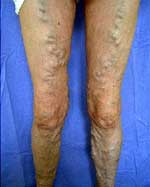 Varicose veins are not something that happens
overnight, it usually takes years for them to develop to a stage where
symptoms occur. Varicose veins are commonly inherited, although it is
important to note that anyone can get them. Often varicose veins are
common in people who have had certain types of injury to the leg or an
episode of deep vein clots. Varicose veins have become more frequent as
more people in society today work standing still or sitting down, which in
turn deprives their veins of a regular circulatory flow for the leg
muscles. Lack of exercise, restrictive clothing and weight gain can add to
the strain on the veins. Varicose veins are not something that happens
overnight, it usually takes years for them to develop to a stage where
symptoms occur. Varicose veins are commonly inherited, although it is
important to note that anyone can get them. Often varicose veins are
common in people who have had certain types of injury to the leg or an
episode of deep vein clots. Varicose veins have become more frequent as
more people in society today work standing still or sitting down, which in
turn deprives their veins of a regular circulatory flow for the leg
muscles. Lack of exercise, restrictive clothing and weight gain can add to
the strain on the veins.
We assume that if you have varicose veins you can see
them but this is not always so, therefore diagnostic techniques are
important tools in determining the cause and severity of the problem. In
addition to a physical examination, non-invasive ultrasound and
plethysmography tests are often used.
Thrombosis can be a more serious problem caused by
veins, it is normally treated conservatively with drugs, which although
they don’t necessarily dissolve the clot, prevent it from becoming
dangerous. The aims of the treatment is to prevent the clot getting worse
and thereby stop a large clot getting up into the lung arteries with
sometimes fatal results.
Some areas of research suggest that more than 40% of
women suffer with varicose veins or spider veins. Women are more likely to
suffer from these abnormal leg veins than men (what a surprise). Hormonal
factors including puberty, pregnancy, menopause, the use of birth control
pills, estrogen, and progesterone affect the disease. It is very common
for pregnant women to develop varicose veins during the first trimester.
Pregnancy causes increases in hormone levels and blood volume, which in
turn cause the veins to enlarge. In addition, the enlarged uterus causes
increased pressure on the veins. Varicose veins due to pregnancy often
improve within 3 months after delivery. However, with successive
pregnancies, these abnormal veins are more likely to remain. Other
predisposing factors include aging, standing occupations, obesity and leg
injury.
For those of you that don’t know what is going on
inside your body, veins, unlike arteries, contain one-way valves at
intervals, which are vital for the veins to function normally. The
arteries bring blood from the heart to the extremities; veins use the
valves to channel blood back to the heart. When one or more of the valves
fails to close properly, the veins conduct blood back into the leg instead
of up to the heart. Blood accumulates, the veins then become enlarged
because they are congested with blood, causing the veins to bulge and
become visible.
These enlarged veins are commonly called spider veins
or varicose veins. Spider veins are small red, blue or purple veins on the
surface of the skin. Varicose veins are larger distended veins that are
located somewhat deeper than spider veins.
(To be continued next week)
|