|
|
 |
|
Snap Shots: by Harry Flashman
|
|
|
B&W without the dip and dunk
 In
the days gone by (pre-digital) it was almost an apprenticeship for all budding
photographers to go through developing and printing their own black and white
photographs, known as D&P. In
the days gone by (pre-digital) it was almost an apprenticeship for all budding
photographers to go through developing and printing their own black and white
photographs, known as D&P.
The initial step was to develop the light sensitive film to produce negatives.
For many enthusiastic souls, this was done by locking themselves in the
bathroom, and sealing off all cracks where light might get in. It was never
possible to make this 100 percent light proof, so most D&P work would be done at
night. With the bath full of chemicals, the film was removed from its canister
and the dip and dunk procedure started, moving the film through the chemicals to
develop the negative.
After a period of time the developing was ceased with a ‘stop’ bath being used
to halt the process. Then there was rinsing and drying. At that stage, the
bathroom door could be opened to display a line of people with their legs
crossed.
The next stage, the P for printing, was probably the most satisfying. Once again
you could not let light to fall on the sensitized paper, but had to do
everything under the red ‘safelight’.
We would cut the film into six strips of six negatives, lay them on a sheet of
sensitized paper (this was called a ‘contact’ print) and turn on the light for a
few seconds, then develop the print in another set of chemicals, dry it and then
look at the 36 shots and work out which (if any) were worth printing.
Having made the selection, another sheet of light sensitive paper would be used,
and the selected negative projected onto it. Exact focusing was done by looking
at the grain in the negative, and then timing to get the best density was worked
out, and finally a print could be developed in the ‘soup’. There was also the
matter of ‘dodging’ and ‘burning’ where specific areas of the print could be
given less or more light, for example to bring out the clouds, in an almost
featureless sky.
And all this to produce a black and white print! And about B. 80 for an A4 size
print.
Those were the days of ‘real’ photography, where the photographer thought about
what the final image would be like, and then made that image happen.
What I would like the weekend photographers to do this weekend is to
deliberately go out and take black and white (B&W) images. You will be looking
at the subject matter in a different way. Without color contrasts of say a brown
dress in front of a blue boat, with B&W that would likely be a grey dress in
front of a grey boat.
Contrast in photographic composition is an effective means of directing the
viewer’s attention to the center of interest.
In B&W photography, contrast is the difference in subject tones from
white-to-gray-to-black or from the lightest tone to the darkest tone. Tonal
contrast is generally expressed as high contrast which has extreme black and
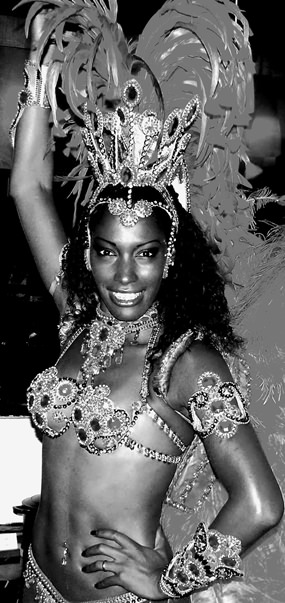
whites, or low contrast which has nothing but graduated greys. The photograph
used this week is an example of high contrast. This was not designed to be a
portrait, this was designed to be a photograph that hits you between the eyes.
Now you can manipulate a photograph to produce that image. If you have an
advanced digital camera, you can program it to record black and white only and
then go from there, but if not, fear not, your software will allow you to do
this post camera. First convert the color shot to grey scale, then play with the
brightness and contrast, and you will very quickly produce a shot like the one
used here.
Now high contrast should not be confused with high key. A high key black and
white shot is one where the photo shows mostly light tones. Conversely, a low
key shot is one that has mainly dark tones. Low key and high key pictures convey
mood and atmosphere. Low key suggests seriousness and mystery; high key creates
a feeling of delicacy and lightness. A portrait of a blonde in white against a
white background is an example of high key.
Try B&W this weekend.
|
|
 |
|
|
 |
|
|
|
E-mail:
[email protected]
Pattaya Mail Publishing Co.Ltd.
62/284-286 Thepprasit Road, (Between Soi 6 & 8) Moo 12, Pattaya City T. Nongprue, A. Banglamung,
Chonburi 20150 Thailand
Tel.66-38 411 240-1, 413 240-1, Fax:66-38 427 596
Copyright ? 2004 Pattaya Mail. All rights reserved.
This material may not be published, broadcast, rewritten, or
redistributed.
|