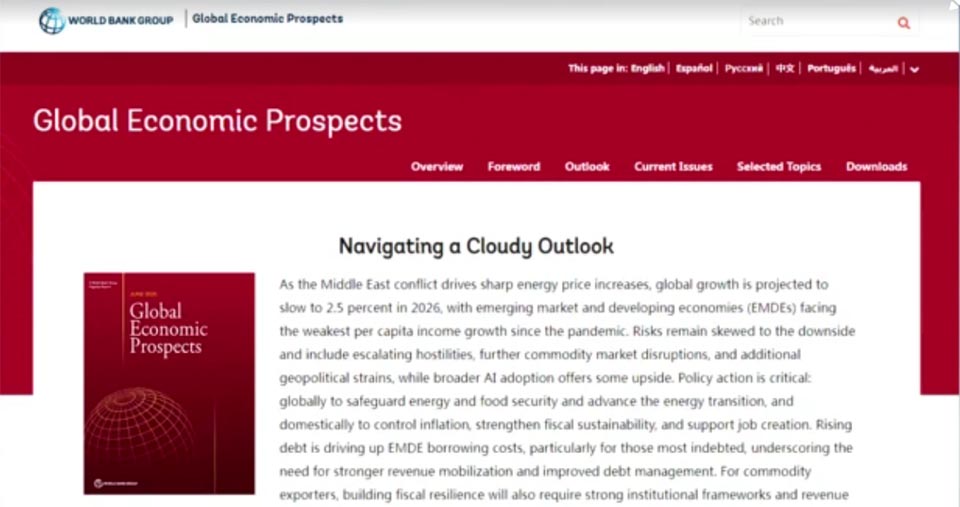
WASHINGTON, D.C. – The World Bank has warned that a potential conflict involving the United States, Israel, and Iran could significantly weaken the global economy, cutting growth in 2026 to 2.5%, the lowest level since the COVID-19 pandemic. In its latest Global Economic Prospects report, the World Bank said the forecast has been downgraded from its previous estimate of 2.9% in January. The institution cited rising geopolitical tensions as a key risk factor, warning that energy price shocks, higher inflation, and increased borrowing costs could further slow global economic activity. In a more severe scenario, the World Bank said global growth could fall as low as 1.3% if energy disruptions intensify and financial markets come under additional strain. The report highlighted concerns over potential escalation affecting key energy routes, including the Strait of Hormuz, a strategically important shipping corridor.
The bank also projected global inflation could rise to around 4% this year, compared to 3.3% last year, and warned it could climb further to as high as 4.4% if energy market conditions worsen.
The report noted that economic growth forecasts have been downgraded for two-thirds of countries worldwide, with particular concern for developing economies. It said many of these nations have made little progress in closing income gaps with wealthier countries over the past decade, while facing rising public debt levels averaging above 70% of GDP.
According to the World Bank, this debt burden limits governments’ ability to stimulate growth or provide financial support during crises, raising the risk of what it described as a “lost decade” for parts of the developing world. Despite this, the bank said China and India remain exceptions to the broader slowdown trend, continuing to show relatively stronger growth compared to other developing economies. The World Bank also announced plans to mobilize $50–60 billion in emergency support for social assistance programs in developing countries, with the possibility of expanding funding up to $100 billion if global conditions deteriorate further over the next 15 months. (TNA)