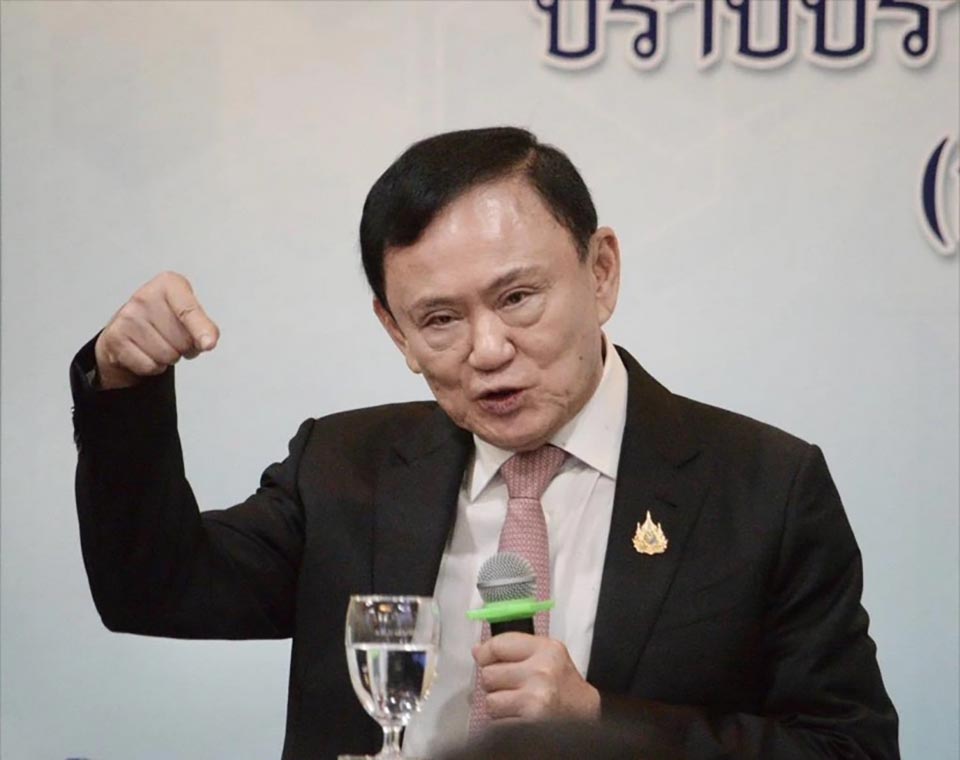
BANGKOK, Thailand – Former Prime Minister and current advisor to the ASEAN chair, Thaksin Shinawatra, delivered a powerful lecture at the Office of the Narcotics Control Board (ONCB) titled “Narcotics and Transnational Crime: Perspectives and Challenges for Sustainable Solutions.”
The lecture was part of the third national meeting on accelerating drug suppression for 2025, and it drew high-level attention, with senior cabinet ministers, top police officials, and journalists in attendance under tight security.
Thaksin opened by stating that drugs are a grave threat to both Thailand’s present and future. He voiced strong concern over the nation’s youth, saying their lives were being destroyed, and criticized the current fragmented and ineffective efforts by state agencies to suppress drug trafficking and abuse. According to him, the main source of drug production now lies in Wa State, located in Myanmar’s Shan State within the infamous Golden Triangle. He firmly declared that if drug production there continues, those involved must be considered enemies of Thailand—and that Thailand should not show mercy to such enemies.
To address this, Thaksin proposed deploying the Thai Foreign Minister to hold talks with neighboring countries to pressure Wa State to stop manufacturing drugs. He emphasized that if the Myanmar government cannot control the Wa region, which is run by ethnic militias, Thailand may need to consider direct measures to deal with the threat.
Thaksin also revealed that Thailand has become the biggest drug market in the region, largely due to its economic wealth. Drugs are now smuggled via sea in shipping containers. He criticized Thailand’s customs enforcement, pointing out that out of six million containers entering annually, only a small fraction are inspected due to a lack of X-ray machines—some of which, he added, are conveniently broken or ignored when illicit shipments are suspected.
Turning to institutional inefficiency, Thaksin highlighted the problem of overlapping responsibilities, stating that at least 29 agencies are working on narcotics issues, many of which seem drawn more by the associated budgets than by a real desire to solve the problem. He argued for better integration, clear responsibilities, and measurable results through proper key performance indicators (KPIs).
Thaksin also addressed drug issues at the community level. He insisted that known dealers must be removed and jailed, and local police must work closely with district administrators, comparing their relationship to the inseparable Thai street snack “deep-fried dough sticks.” He even offered to personally travel to provinces to assess the drug problem in villages, saying, “I have nothing to do now that I’m old. Let me help.”
He urged close collaboration between Interior Minister Anutin Charnvirakul and National Police Chief Kitrat Panphet, suggesting that if key positions cannot cooperate effectively, then reshuffling may be needed.
One of his most notable proposals was to reallocate part of the 157-billion-baht digital wallet budget to fight drug abuse. He suggested that the money could instead fund the establishment of drug rehabilitation centers in every district—at least in those where communities volunteer. Thaksin argued that the public would not be overly upset by a delay in the digital wallet program if the funds were redirected toward solving Thailand’s drug crisis, especially if clear results could be shown by the end of 2025.
Finally, Thaksin questioned the role of the Internal Security Operations Command (ISOC), which receives over seven billion baht annually. He pointed out that more than three billion is spent in the southern provinces, with the rest used across the country. Thaksin said ISOC must be deployed more effectively in drug suppression, or else it risks becoming an unnecessary expense in the eyes of the public.
In his forceful and urgent address, Thaksin made it clear that he considers the fight against narcotics a matter of national survival, and he called for immediate, coordinated, and uncompromising action.