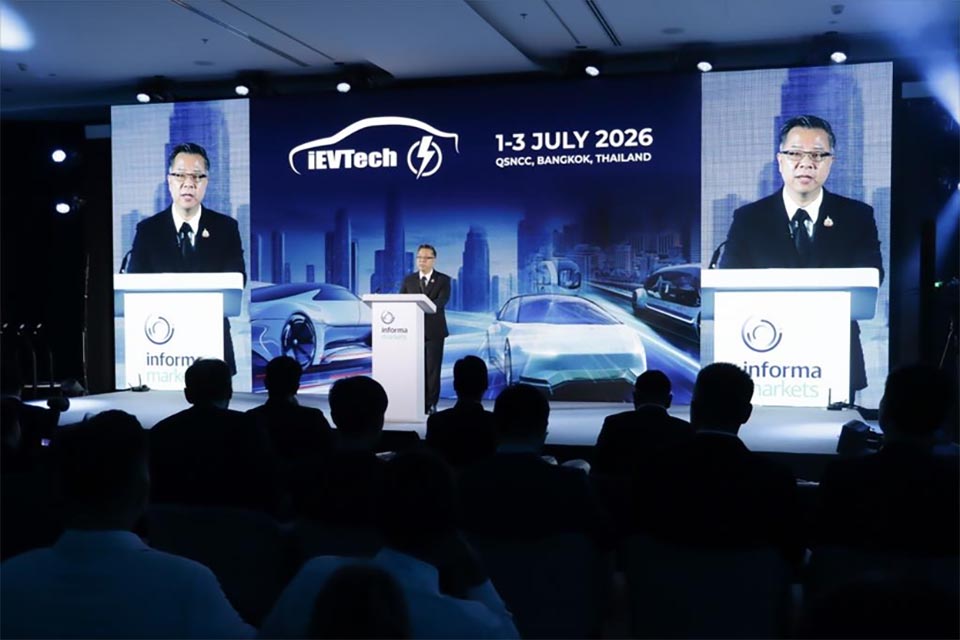
BANGKOK, Thailand – Thailand has approved more than 137 billion baht (US$4.2 billion) in electric vehicle (EV) investment across 198 projects, reinforcing its ambition to become ASEAN’s leading manufacturing and export hub for next-generation vehicles. Speaking at the International Electric Vehicle Technology Conference and Exhibition (iEVTech) 2026 in Bangkok on July 1, Narit Therdsteerasukdi, Secretary General of the Thailand Board of Investment (BOI), said the kingdom is building a comprehensive EV ecosystem covering every major technology—from mild hybrid electric vehicles (MHEVs) and hybrid electric vehicles (HEVs) to plug-in hybrid electric vehicles (PHEVs) and battery electric vehicles (BEVs). Held under the theme “Driving Thailand’s EV Future: Powering a Competitive & Connected Supply Chain,” the conference brought together EV organizations and industry leaders from across Asia, underlining Thailand’s growing role as a regional center for electric vehicle manufacturing, investment and policy cooperation.
Narit said Thailand has successfully evolved from becoming a global leader in one-ton pickup truck production and eco cars to positioning itself at the forefront of clean-energy and smart vehicle manufacturing. To support that transition, the BOI has expanded investment incentives to cover every major EV technology, allowing manufacturers to invest and grow together while developing a fully integrated supply chain that includes batteries, key components, intelligent systems, software, research and development facilities, and testing centers. Consumer demand has also accelerated rapidly. In 2025, electric vehicles of all types accounted for 44% of new vehicle registrations in Thailand, compared with just 3% five years earlier. Hybrid electric vehicles led the market with a 21.8% share, followed by battery electric vehicles at 19.6%, while plug-in hybrids represented 2.9%, indicating that multiple technologies are expected to coexist during the country’s transition toward cleaner mobility. As of May 2026, the BOI had approved 198 EV-related projects worth more than 137 billion baht. The investments span the entire EV value chain, including vehicle assembly, battery manufacturing, energy storage systems, drive motors, battery management systems, charging infrastructure and battery-swapping technology.
Investment approvals include 39.5 billion baht for battery electric vehicle manufacturing, 29.9 billion baht for hybrid vehicle production and 9.4 billion baht for plug-in hybrid projects. Additional investment has flowed into electric buses, motorcycles and other electric vehicles, while more than 33.5 billion baht has been committed to battery production and energy storage. Another 12.5 billion baht has been invested in critical EV components, alongside 9.8 billion baht for charging infrastructure that will deliver more than 22,900 charging points nationwide, including over 10,000 fast chargers. Most international automakers that received BOI incentives over the past three to four years have now begun manufacturing EVs in Thailand. Early investors included Mercedes-Benz, Great Wall Motor, SAIC Motor-CP, BYD, Aion, Changan and EV Primus. They have since been joined by BMW, Hyundai Mobility and Omoda & Jaecoo, all of which launched local battery electric vehicle production during 2026.
Together, these manufacturers now employ more than 16,000 Thai workers, demonstrating that investment incentives are translating into new factories, jobs and technology transfer. The BOI has also stepped up efforts to integrate Thai suppliers into global supply chains through joint venture incentives and business-matching programs such as Subcon Thailand and Sourcing Day. During the past two years, these initiatives have generated more than 1,200 business matches involving over 800 Thai parts manufacturers, with expected domestic procurement exceeding 60 billion baht.
Narit said the global shift toward electric vehicles represents one of the biggest transformations the automotive industry has ever faced, but also one of Thailand’s greatest economic opportunities.
“Our goal is to make Thailand the regional hub for the EV supply chain and ecosystem while creating opportunities for Thai businesses and workers through investment, technology transfer, skills development and participation in the new global automotive supply chain,” he said.