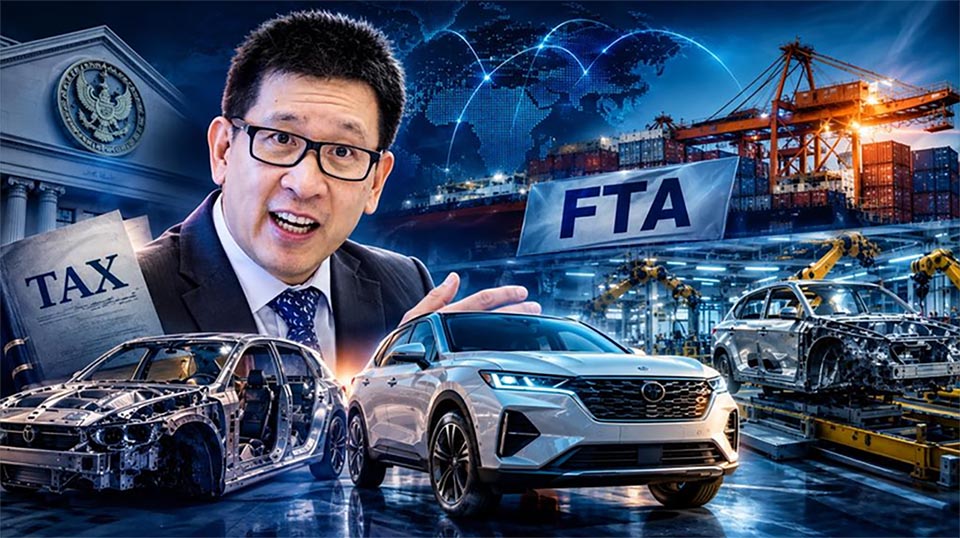
BANGKOK, Thailand – Deputy Prime Minister and Finance Minister Ekniti Nitithanprapas has ordered the Finance Ministry and Excise Department to accelerate work on a new vehicle tax structure, with the government aiming to reach a conclusion by September 2026. The proposed changes would create a clearer tax difference between electric vehicles imported fully built from overseas and EVs manufactured in Thailand. Fully imported EVs could face a higher tax burden, while vehicles produced domestically could receive more favorable treatment. The government has not yet announced the new tax rates, with the structure still being designed. The main objective is to make manufacturing in Thailand more attractive than simply importing completed vehicles for sale. The government hopes the changes will encourage automakers to invest in factories, create jobs and increase the use of Thai-made parts.
Excise tax seen as a way to address FTA advantage
Another factor behind the proposed changes is the competitive advantage enjoyed by vehicles imported from countries that have free-trade agreements with Thailand. FTA arrangements can reduce customs duties on imported vehicles, potentially giving imported cars a cost advantage over companies that have invested in production facilities in Thailand. The government is therefore considering the use of excise tax to create a greater difference between imported vehicles and those manufactured domestically. Under the approach being considered, fully imported EVs could face higher taxes, while EVs produced in Thailand would receive more favorable treatment.
Imported EVs could face higher costs
If the new structure creates a significant tax difference, imported EVs could become more expensive.
Importers and automakers would then have to decide whether to increase prices, accept lower margins, reduce promotional offers or consider moving production of popular models to Thailand.
For manufacturers already operating factories in the country, the proposed changes could provide a stronger advantage.
The government is also looking beyond vehicle assembly, with the aim of bringing more investment, employment and parts production into Thailand.
EV investment reaches 137 billion baht
The policy comes after substantial investment has already entered Thailand’s EV industry.
According to the information provided by the government, around 198 EV-related projects have attracted investment worth approximately 137 billion baht. There are 18 BEV production projects worth about 39.5 billion baht, with combined production capacity of more than 370,000 vehicles a year. Battery and energy-storage investment accounts for around 57 projects worth 33.5 billion baht, while another 49 projects involving key components such as motors, battery-management systems and power-control units represent about 12.5 billion baht. The BOI also estimates that links between automakers and more than 800 Thai parts manufacturers could generate around 60 billion baht in domestic parts purchases.
From encouraging EV purchases to encouraging production
The proposed tax changes could mark a shift in Thailand’s EV strategy from encouraging consumers to buy electric vehicles toward encouraging manufacturers to produce them in Thailand.
The government wants the country’s EV transition to generate wider economic benefits through factories, employment and local suppliers. For automakers still relying heavily on completely built-up imports, the new tax structure could therefore become an important factor in deciding whether to expand production in Thailand. For companies already investing locally, greater tax advantages could strengthen the case for further investment and increased domestic sourcing.
September decision in focus
The Finance Ministry and Excise Department are expected to continue working on the details before a conclusion is targeted for September 2026. The government is seeking a structure that can reduce the disadvantage faced by manufacturers investing in Thailand while encouraging automakers to deepen their local production and supply chains. With EV investment already exceeding 137 billion baht and domestic BEV production capacity above 370,000 vehicles a year, the proposed tax changes could help determine whether Thailand’s next phase of EV growth is driven mainly by selling imported vehicles or producing more of them at home.