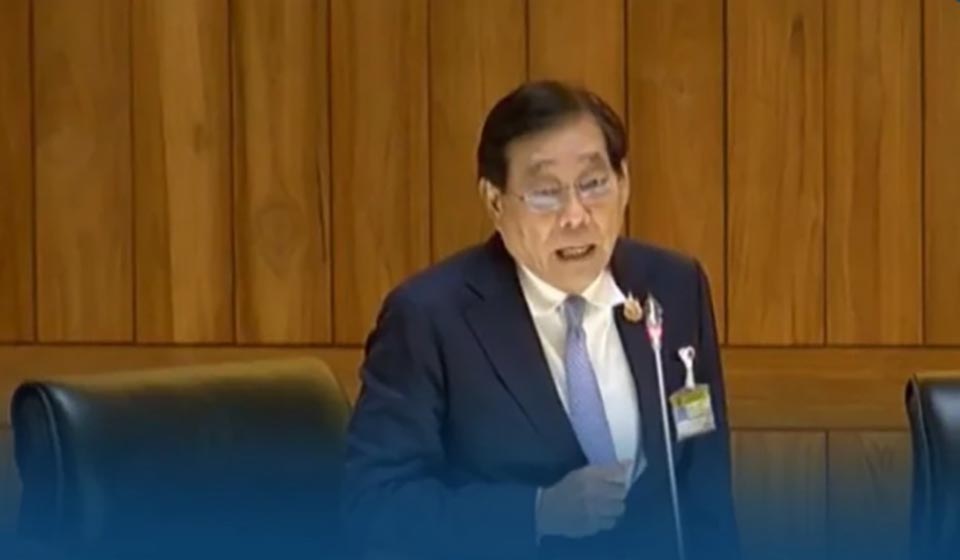
BANGKOK, Thailand – Thailand’s Deputy Prime Minister and Finance Minister, Pichai Chunhavajira, has laid out an ambitious economic strategy aimed at revitalizing growth and restoring investor confidence, as he defended the government’s proposed 3.78 trillion baht national budget for fiscal year 2026 during a parliamentary session on Friday.
At the heart of the proposal is a substantial push toward economic restructuring through investment, with the government earmarking 864 billion baht—approximately 22.9% of the total budget—for capital expenditures in infrastructure, water management, energy, and regulatory reforms.
Despite projecting a budget deficit of 860 billion baht, or 4.3% of GDP, Pichai emphasized that the net deficit—after debt repayments—stands at a more modest 3.5% of GDP, and will be gradually reduced to 3.1% by 2029. He assured lawmakers and international observers that the government’s fiscal approach adheres to the Fiscal Discipline Act, balancing growth stimulus with long-term financial stability.
Private Investment: The Engine of Recovery
In a speech framed by both domestic priorities and rising global uncertainty—including the potential return of U.S. protectionist policies under a second Donald Trump presidency—Pichai reaffirmed the need to urgently build trust among foreign investors, who have remained cautious amid shifting geopolitical dynamics and internal bureaucratic inertia.
“In the past, when GDP grew 6–7%, public and private investments together accounted for 40% of GDP,” he noted. “We must regain that momentum.”
To achieve this, the minister called for collaboration with both state-owned enterprises and private investors, who he said are essential to amplifying the impact of the government’s capital spending.
Four Investment Pillars
Pichai outlined four major policy directions aimed at drawing investment and delivering tangible economic transformation:
- Infrastructure Expansion:
Major projects include highways, deep-sea ports, and airport upgrades, with 200 billion baht allocated to support logistics and regional connectivity.
- Water Resource Development:
The government plans to spend 134 billion baht to improve irrigation and water distribution systems—critical for boosting agricultural productivity and climate resilience.
- Non-Budget Energy Investments:
Recognizing energy security as a pillar of industrial growth, the government is facilitating investment in power infrastructure without relying on direct state expenditure.
- Regulatory Reforms:
Easing restrictions on land use and simplifying regulations for business operations, especially regarding the use of state-owned land for industrial expansion, will be a priority.
Reassurances Amid Global Volatility
Pichai acknowledged that foreign economic institutions have broadly accepted Thailand’s short-term fiscal deficits as necessary and responsible under the current global conditions. However, he insisted that future budgets would continue on a path of fiscal consolidation.
“Our capital budget may seem small compared to Thailand’s 19 trillion baht economy,” he said, “but by leveraging state enterprise investments and improving spending efficiency, we can significantly boost our economic engine.”
To that end, the government is also reducing recurrent spending by 28 billion baht, addressing concerns that the bureaucracy is overly bloated and inefficient. Pichai revealed that actual disbursement of regular budget allocations tends to reach only 70%, pointing to a clear opportunity to reallocate funds toward productive investment.
GDP Growth Targets and Inflation Outlook
The government expects the Thai economy to grow by 4–4.5% in FY2026 under this plan, assuming inflation remains stable at around 1.5%. Pichai noted that this would represent a clear recovery from the sluggish post-pandemic years and would send a strong message to global investors that Thailand remains open for business. (TNA)