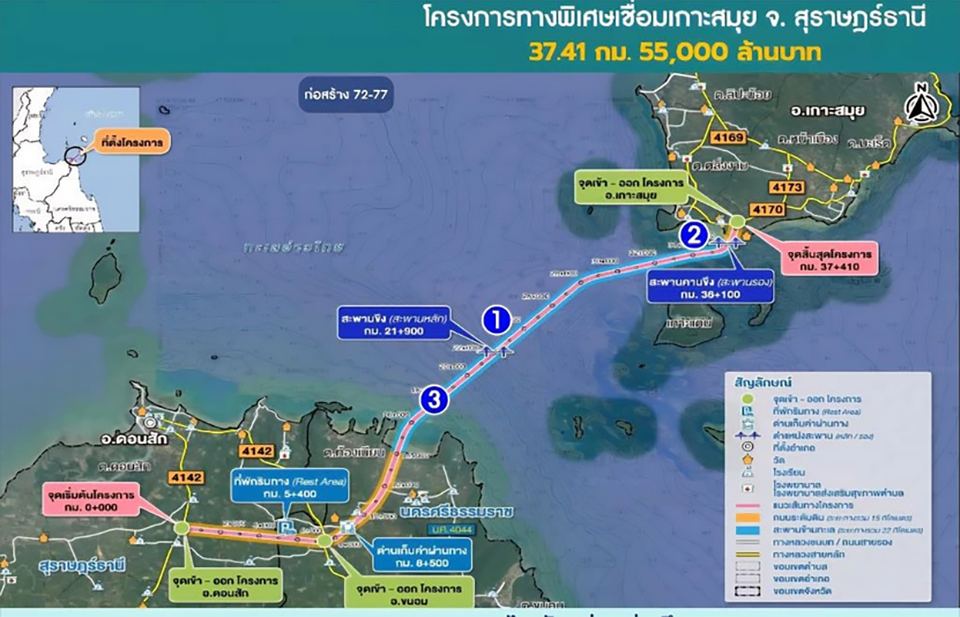
SURAT THANI, Thailand – The Expressway Authority of Thailand (EXAT) is moving forward with its ambitious plan to construct the “Samui Expressway,” a 37.41-kilometer toll road connecting Don Sak on the mainland to Koh Samui. With an estimated investment of 55 billion baht, the project will feature Thailand’s longest sea-crossing bridge, designed to improve tourism access, facilitate local mobility, and generate significant economic benefits.
EXAT Governor Surachet Laopulsuk led a site visit with board members and the media across Surat Thani and Nakhon Si Thammarat provinces, explaining that the feasibility study is 89.5% complete. The final alignment has been selected, and detailed design work, along with the environmental impact assessment (EIA), is expected to finish by early 2026. The project is slated for Cabinet approval in 2027, with construction anticipated to start in 2029 and completion by 2034—a five-year build period.
Three Types of Bridges to Address Local Conditions
The expressway includes three distinct bridge designs to accommodate environmental and operational requirements:
-Main Cable-Stayed Bridge: Spanning 250–300 meters, this section allows naval vessels to pass under, with a clearance of approximately 50 meters for warships.
-Secondary Extradosed Bridge: Stretching 220–250 meters over coral reef zones near Samui, providing a 200-meter-wide navigable channel.
-Conventional Concrete Box Girder Bridges: Short spans of around 60 meters with multiple piers, accommodating local fishing boats under 12 meters tall.
Traffic and Toll Considerations
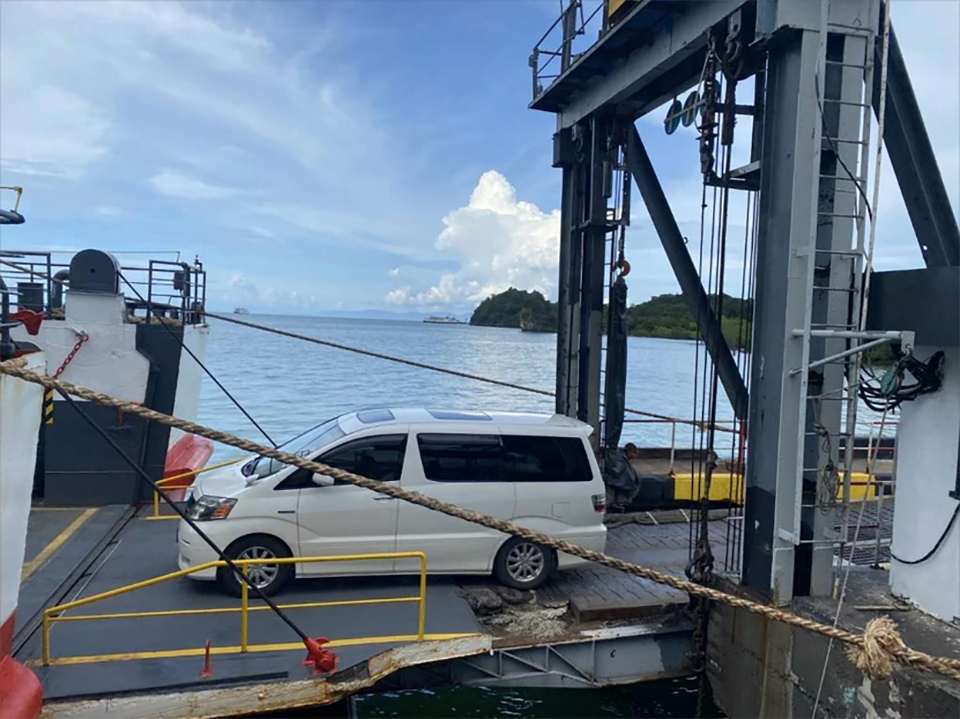
The expressway is projected to carry 7,000–8,000 vehicles per day, relatively moderate traffic. Due to the high construction costs, tolls are expected to be higher than typical expressways, roughly equivalent to current ferry fares—approximately 1,800 baht for a van carrying passengers.
Economic and Tourism Impact
The Samui Expressway is anticipated to bolster tourism to Koh Samui, Thailand’s second-highest-grossing tourist destination, generating an estimated 120 billion baht annually. Long-term projections suggest the project could contribute up to 400 billion baht to the national economy over a 30-year period. EXAT emphasized that the infrastructure will also enhance local access for emergencies, providing faster transit to the mainland for medical and other urgent needs.
Integration of Utilities
In a forward-thinking design, the expressway bridges will carry electricity, water, and communications networks, reducing the need for undersea cables that are vulnerable to storm damage and anchor strikes. Public utility agencies may participate through investment or leasing arrangements for space on the bridge.
Public Support and Environmental Safeguards
A recent survey indicates 95% of local residents support the project. Concerns remain about environmental impacts on coral reefs, waste management, traffic congestion, and changes to local lifestyles. EXAT confirmed that all construction will comply with Thai environmental laws, and the Environmental Impact Assessment must be approved before work begins. The bridge design accounts for strong winds, storms, and seismic activity, ensuring resilience against natural hazards.
Route Overview
The expressway starts at kilometer 0+000 connecting to Highway 4142 in Don Sak, Surat Thani, and ends at kilometer 37+410 connecting to Highway 4170 in Taling Ngam, Koh Samui.
Governor Surachet concluded, “Beyond facilitating tourism and local travel, this expressway will provide substantial economic benefits to residents and the nation. It will enable faster access for emergencies, support local livelihoods, and strengthen the country’s infrastructure for the long term.”