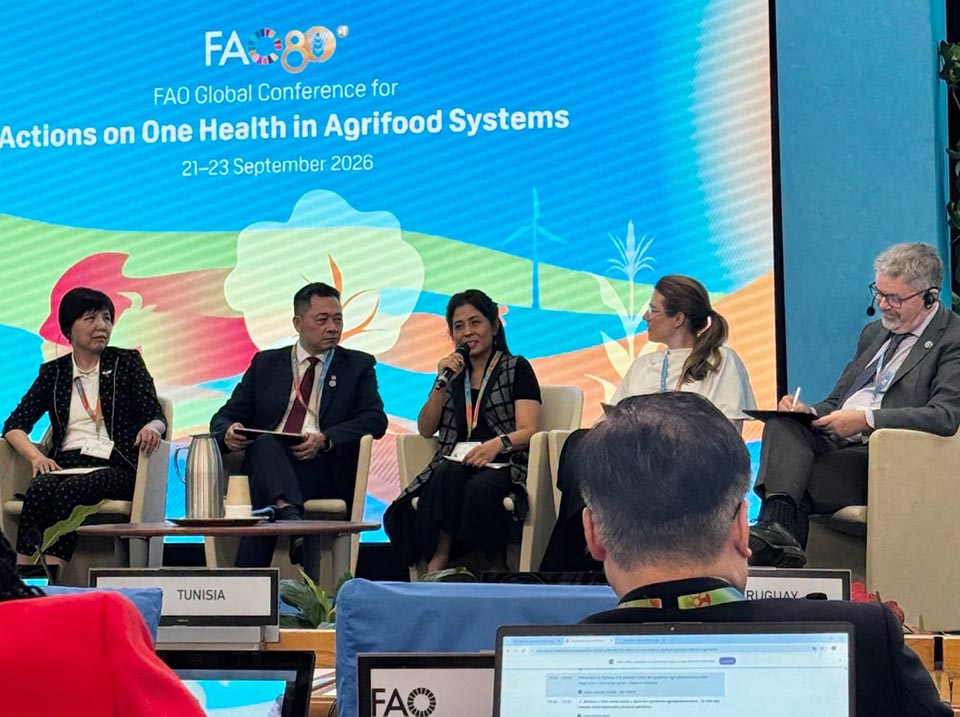
ROME, Italy – Dr. Saowapak Hinjoy, President of the PREZODE General Assembly, presented Thailand’s experience at the Food and Agriculture Organization of the United Nations (FAO). She advocated for integrating human, animal, and environmental data to support joint risk assessments and coordinated action plans to prevent infectious diseases at their source. At the same conference, FAO recognized Thailand’s “One Health for Safe Pork” initiative as a Good Practice and Innovation in One Health in Agrifood Systems.
Since her election as President of the PREZODE General Assembly in December 2025, Dr. Saowapak, Senior Veterinary Expert at the Department of Disease Control of the Ministry of Public Health, has linked global collaboration with practical implementation in Thailand to prevent zoonotic and emerging infectious diseases through the One Health approach.
Most recently, Dr. Saowapak served as a speaker and panelist at the FAO Global Conference for Actions on One Health in Agrifood Systems, held from 21 to 23 September 2026 at FAO Headquarters in Rome, Italy.
During the session “Beyond Data: The One Health Decision Challenge in a Complex World,” she emphasized that sharing data alone is insufficient. Turning data into action requires all sectors to develop a shared understanding, set common priorities, and establish a joint action plan.
Collaboration among PREZODE, PREACTS, and ASAMCO demonstrates a practical pathway from global frameworks to local action. PREZODE sets the overall direction for prevention, PREACTS translates the framework into implementation, and ASAMCO applies and tests the approach in local settings.
During the “From Science to Action” session, Dr. Saowapak presented a case study from Nan Province in northern Thailand, where the risk of Streptococcus suis was assessed across the entire pork value chain, including farms, slaughterhouses, markets, food preparation, and consumers.
The team translated the findings into community-level interventions and policies to improve slaughterhouse standards. The approach emphasized practical, safer alternatives and engaged young people to communicate health information through short, accessible videos for the public.
Dr. Saowapak also contributed to discussions on strengthening the wildlife and environmental health workforce. She highlighted surveillance for Nipah virus, Plasmodium knowlesi, and Herpes B virus as examples of how wildlife and environmental data can help identify health risks before human cases occur. She proposed stronger links between FTP-WEBE, the public health Field Epidemiology Training Program (FETP), and FETPV for the animal health sector.
During the conference, Thailand’s Department of Disease Control, the Department of Disease Control Foundation, and ASAMCO/PREZODE partners received FAO recognition for Good Practices and Innovations in One Health in Agrifood Systems for the “One Health for Safe Pork: A Community-Based Innovation to Prevent Streptococcus suis in a Hmong Village in Northern Thailand.”
The initiative was implemented in Ban Nam Tuang, Mae Charim District, Nan Province. This achievement resulted from collaboration among public health and livestock authorities, hospitals, schools, local government organizations, community leaders, young people, and academic institutions.
Representing the team, Dr. Saowapak received the FAO Certificate of Recognition on September 22, 2026. This recognition shows how One Health can begin with a real community health challenge and develop into practical, effective prevention measures by combining scientific evidence, cultural understanding, and meaningful local participation. (NNT)