

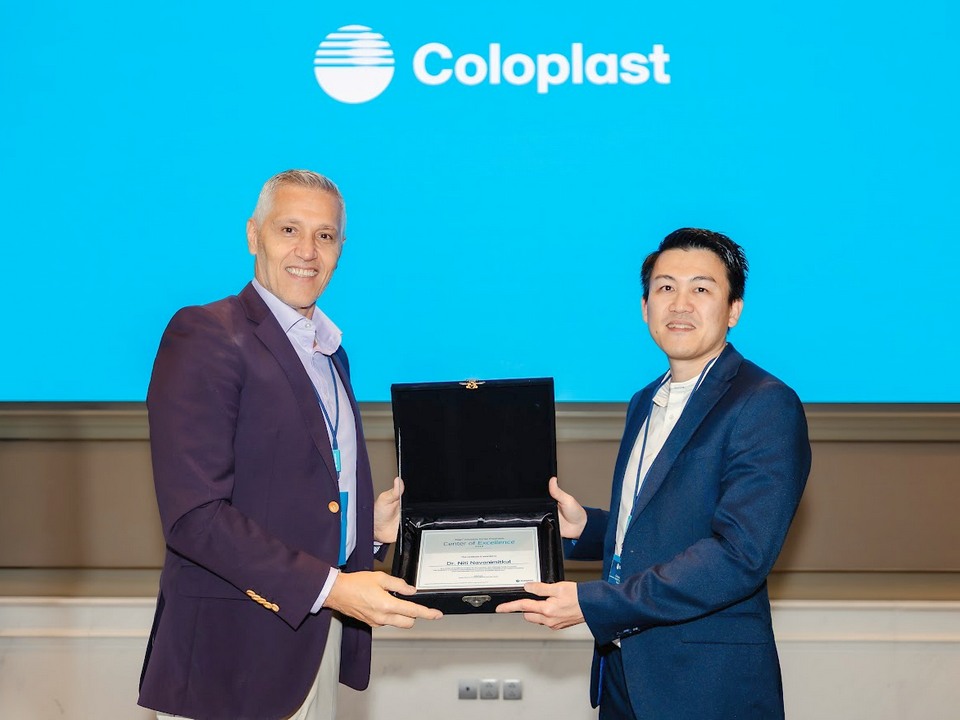
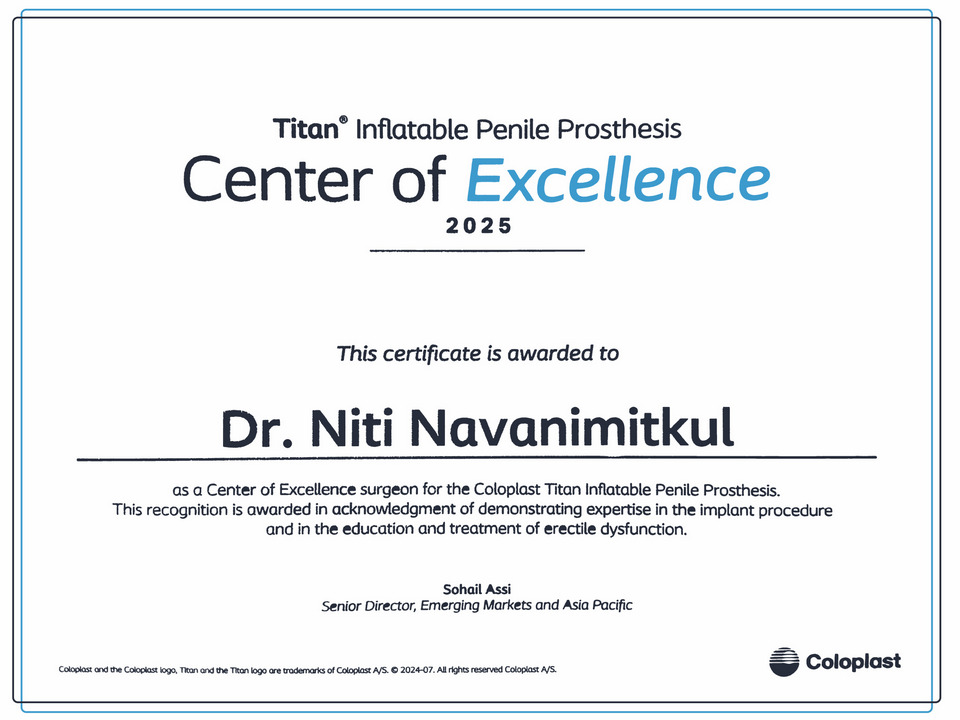
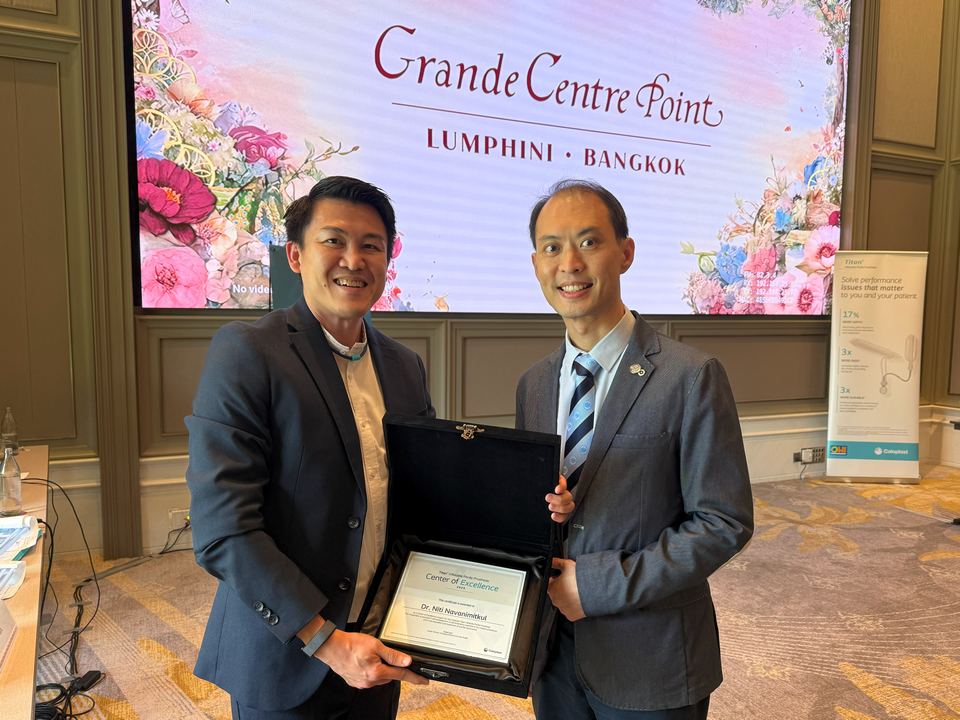
Dr. Niti Navanimitkul has been recognized by Coloplast as a Center of Excellence Surgeon 2025 for his expertise in Titan® Inflatable Penile Prosthesis (IPP) surgery, becoming the first Thai urologist to receive this prestigious recognition.
The recognition
Coloplast is a Danish medical-device company and the maker of the Titan implant. The certificate names Dr. Niti and cites “expertise in the implant procedure and in the education and treatment of erectile dysfunction”. It is signed by Sohail Assi, the company’s senior director for emerging markets and Asia Pacific.
The recognition is awarded by the manufacturer, which sets its own criteria, and is not a medical or academic qualification.
Training
Dr. Niti graduated in medicine from Chiang Mai University in 2003 and was certified by the Thai Board of Urology in 2010. In 2014 he was a visiting clinical fellow in urology and andrology (men’s sexual and reproductive health) at MD Anderson Cancer Center and the University of Texas Medical School in Houston.
His first formal training in implant surgery was a workshop at Ramathibodi Hospital in Bangkok in 2018. In May 2023 he attended a Coloplast education programme at the prosthetic urology centre of Professor Sung Hun Park in Seoul, and returned to the centre in October.
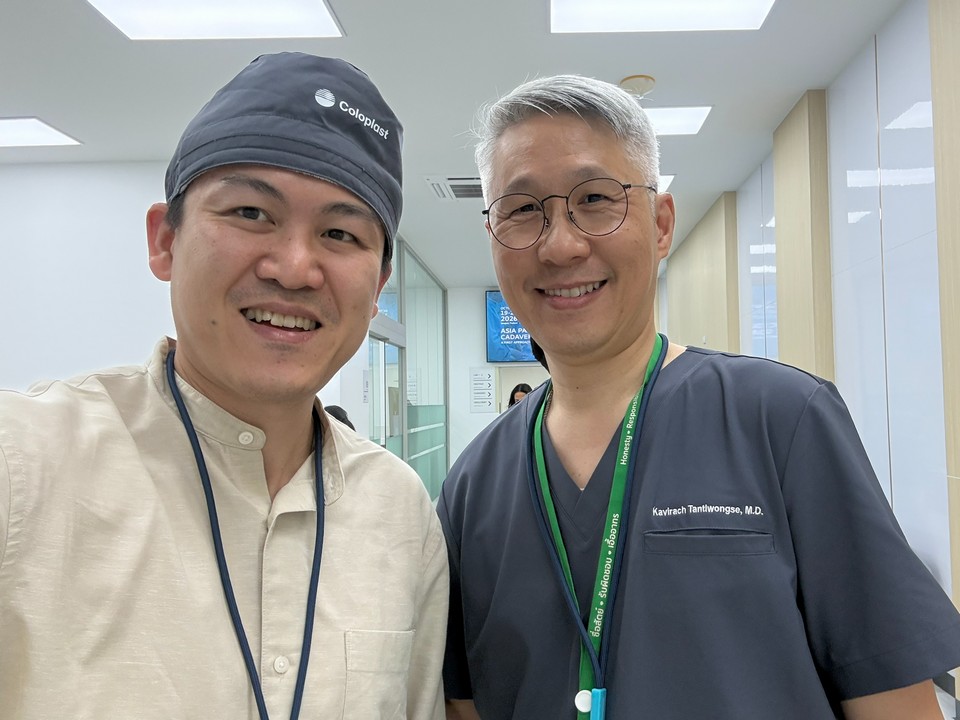
In November 2023 he attended the fourth Asia Pacific Coloplast cadaveric course at Chulalongkorn University, where his teachers included Dr. Christopher Love, an implant surgeon from Australia. His recognition was presented at a later edition of the same course.
By his own records, he had performed more than 70 penile implant operations by early 2024 and more than 100 by the end of 2025.
Erectile dysfunction and its treatment
Erectile dysfunction (ED) becomes more common with age. It is often linked to diabetes, heart and blood-vessel disease and smoking, and frequently follows surgery or radiotherapy for prostate cancer. Because weak erections can be an early warning sign of heart disease or diabetes, assessment starts with a medical check-up.
Guidelines from the American Urological Association (2018) and the European Association of Urology (2026) both include a penile prosthesis among the established treatments for ED [1, 2]. The American guideline asks doctors to discuss every suitable option with the patient rather than follow a fixed sequence. The European guideline recommends an implant when other treatments have failed or when the patient prefers it.
Tablets such as sildenafil and tadalafil are the usual first treatment and work for many men. When they do not, Dr. Niti discusses the options with the patient and usually tries low-intensity shockwave therapy, then a vacuum device, then injections into the penis, with a penile Doppler ultrasound scan of blood flow to guide the choice. The evidence for shockwave therapy is still developing. Most men who choose an implant have found other treatments ineffective, unsuitable or unacceptable.
The device
The Titan has three parts. Two cylinders are placed inside the penis, a small pump in the scrotum and a fluid reservoir behind the lower abdominal wall. Squeezing the pump fills the cylinders and produces an erection; a release button returns the fluid to the reservoir. All the parts are inside the body. There is a small scar, and the pump can be felt in the scrotum.
The shaft becomes firm while the head of the penis stays softer. Sensation and orgasm are usually unchanged, although some men find the erection shorter than they remember. Men who have had a radical prostatectomy (removal of the whole prostate for cancer) no longer ejaculate, and an implant does not change that.
Other companies make inflatable implants, and a simpler malleable (bendable) type is also available. The choice depends on factors such as hand dexterity, previous surgery and the patient’s preference.

Risks and results
The operation cannot be reversed. Inserting the cylinders permanently alters the erectile tissue, so any remaining natural erections are usually lost, and if the device is later removed, tablets and injections are unlikely to work.
Infection is the most serious complication. The European guideline reports it in about 2 to 3 per cent of first-time implants in low-risk patients, and 1 to 2 per cent with antibiotic-coated devices [2, 3]. Diabetes and repeat surgery raise the risk. An infected implant usually has to be removed, although in selected cases a new one can be placed in the same operation.
The device can also fail mechanically. In pooled data, about 87 per cent of implants were still working without further surgery at five years and about 77 per cent at ten [2]. Published studies report high satisfaction among men with an implant, and slightly lower but still high satisfaction among their partners [2].
The operation is usually done through one small incision, and patients generally go home the same day or the next. Soreness and swelling last several weeks, and intercourse is usually possible after four to six weeks.
References
- Burnett AL, Nehra A, Breau RH, et al. Erectile Dysfunction: AUA Guideline. J Urol. 2018;200(3):633–641.
- European Association of Urology. EAU Guidelines on Sexual and Reproductive Health, 2026 edition.
- Serefoglu EC, Mandava SH, Gokce A, et al. Long-term revision rate due to infection in hydrophilic-coated inflatable penile prostheses: 11-year follow-up. J Sex Med. 2012;9(8):2182–2186.
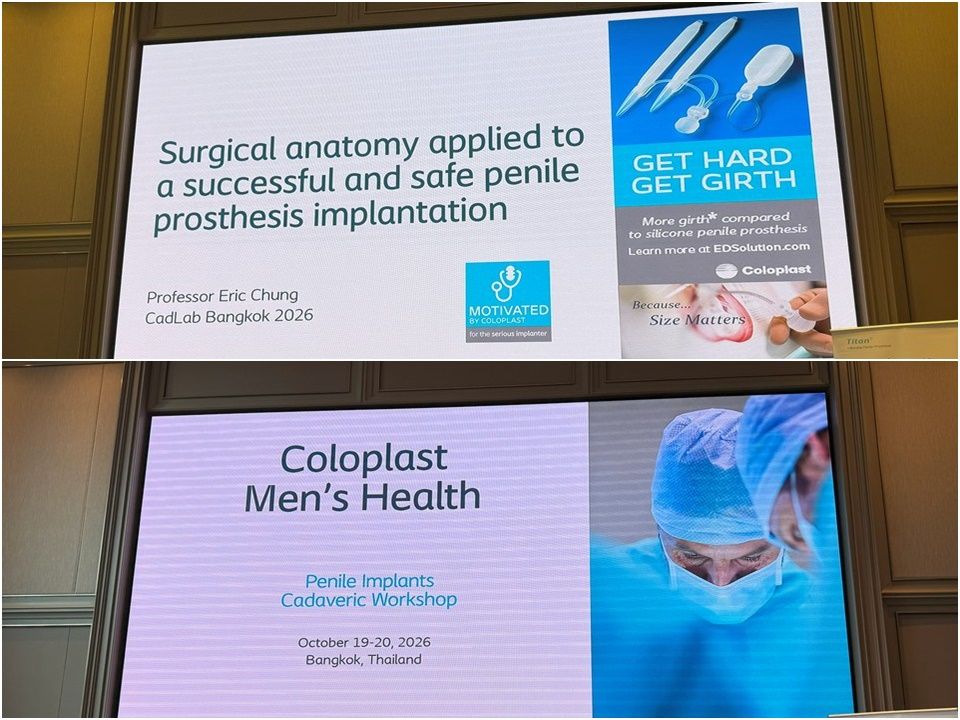
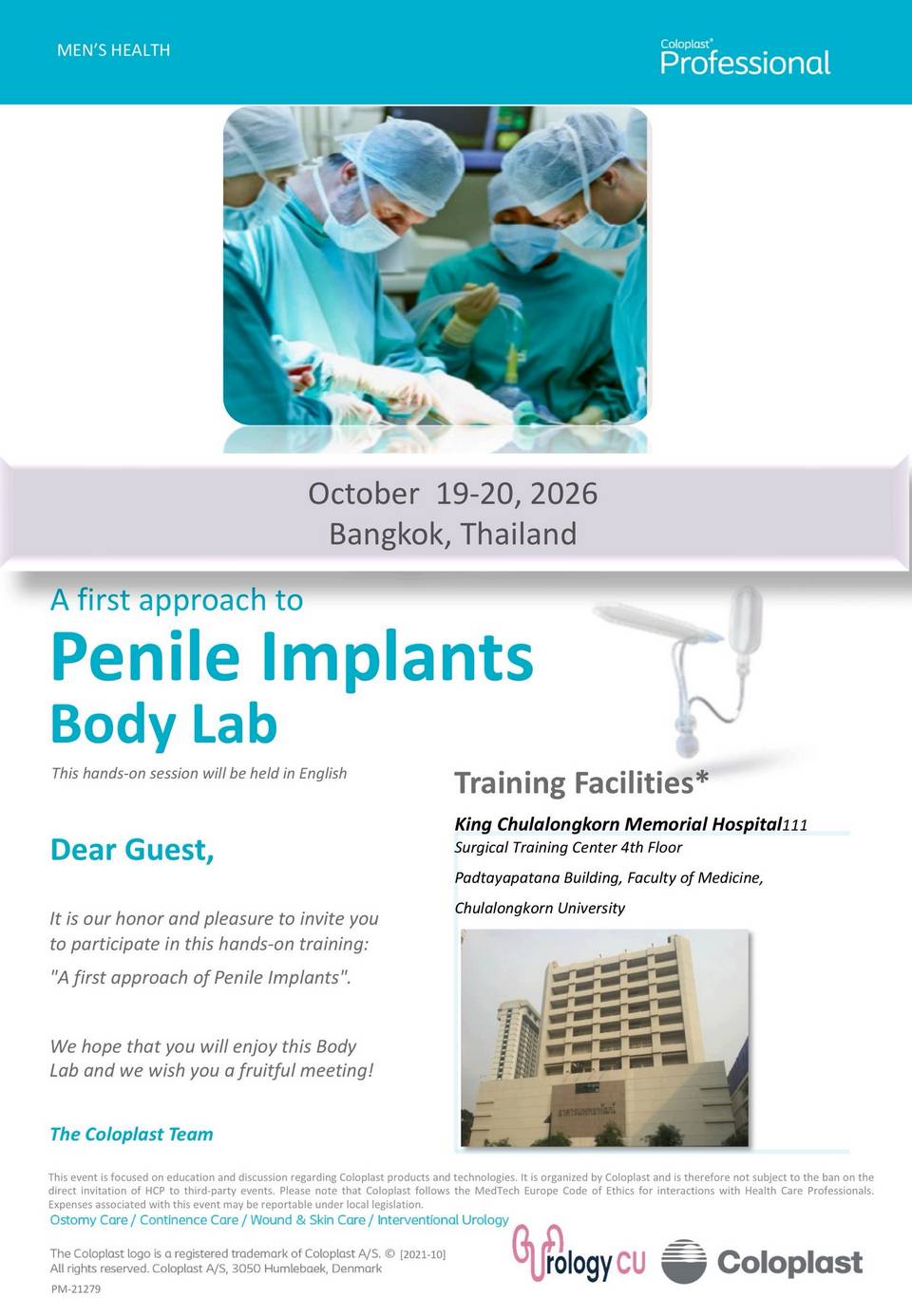
Presentation slides from Coloplast’s Penile Implants Cadaveric Workshop in Bangkok on October 19–20, 2026, including Professor Eric Chung’s session on surgical anatomy for safe and successful penile prosthesis implantation.