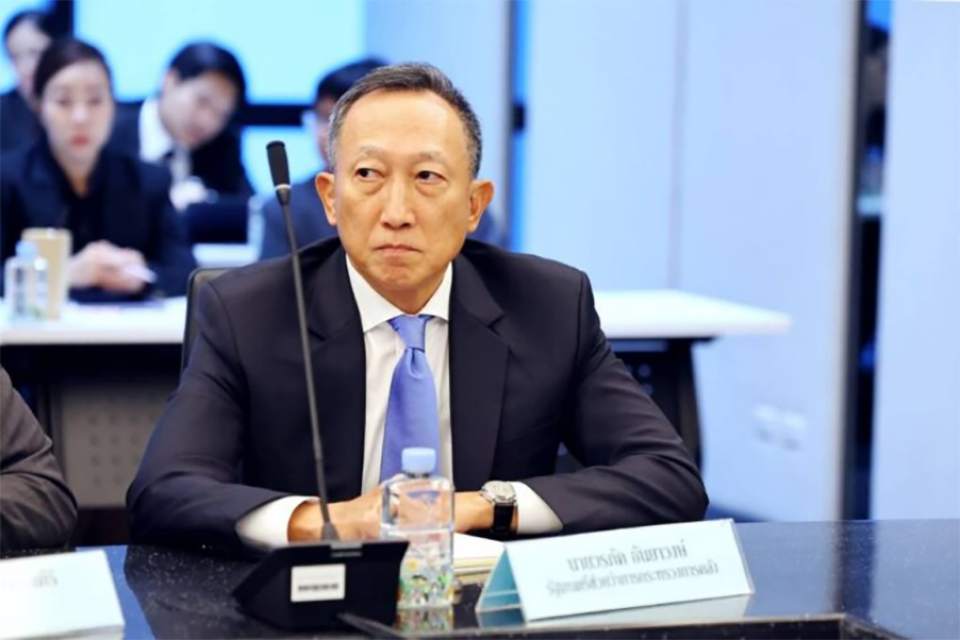
BANGKOK, Thailand – Deputy Finance Minister Woraphak Thanyavong has expressed concern that former U.S. President Donald Trump’s announcement of a 100% import tariff on Chinese goods could trigger a new round of the U.S.–China trade war, with far-reaching consequences for global markets and supply chains.
In a Facebook post, Woraphak outlined six key points:
- U.S. Retaliation Measures: Trump declared plans to impose a 100% tariff on imports from China and implement new export controls on key software and critical goods by Nov 1, 2025, or sooner if Beijing fails to alter its trade stance. The move follows China’s restrictions on rare earth exports—critical materials for high-tech and defense industries—causing immediate tension across global supply chains.
- Rare Earths as Strategic Leverage: China, which controls over 70% of the world’s rare earth supply, is now weaponizing these resources as a geopolitical tool. The move mirrors Washington’s previous semiconductor export controls, highlighting the “weaponization of resources” era.
- Market Reaction: Financial markets responded sharply.
• S&P 500 dropped 2.7%
• Nasdaq Composite fell 3.6%, the steepest decline since April
• U.S. 2-year Treasury yields hit a three-week low
• The U.S. dollar weakened 0.7% against major currencies
This volatility reflects fears of a full-scale “Trade War 2.0” that could heavily disrupt global commerce.
- Diplomatic Uncertainty: Trump also hinted he might cancel his upcoming APEC meeting with Chinese President Xi Jinping in South Korea, though later suggested he “might still attend.” The mixed signals underscore renewed instability in U.S.–China relations after prior attempts at trade détente.
- Return of the Tariff War:
• The U.S. had previously raised tariffs on Chinese imports to 145%, prompting China’s 125% counter-tariff.
• Current average tariffs stand at 58% for the U.S. and 37% for China.
• The 90-day truce maintaining these levels expires mid-November, raising fears of renewed escalation.
- Strategic Implications:
• China is using natural resources as political and economic leverage.
• The U.S. is responding through tariffs and tech export controls.
• The conflict could expand to allies including the EU, Japan, and ASEAN, further straining global supply chains in the EV, semiconductor, and clean energy sectors.
Policy Outlook:
Woraphak urged ASEAN nations, including Thailand, to assess potential impacts on their EV, electronics, and export industries, and to prepare risk-mitigation measures to safeguard supply chain resilience. He emphasized that rare earths have now become a strategic resource central to global power competition. (TNA)