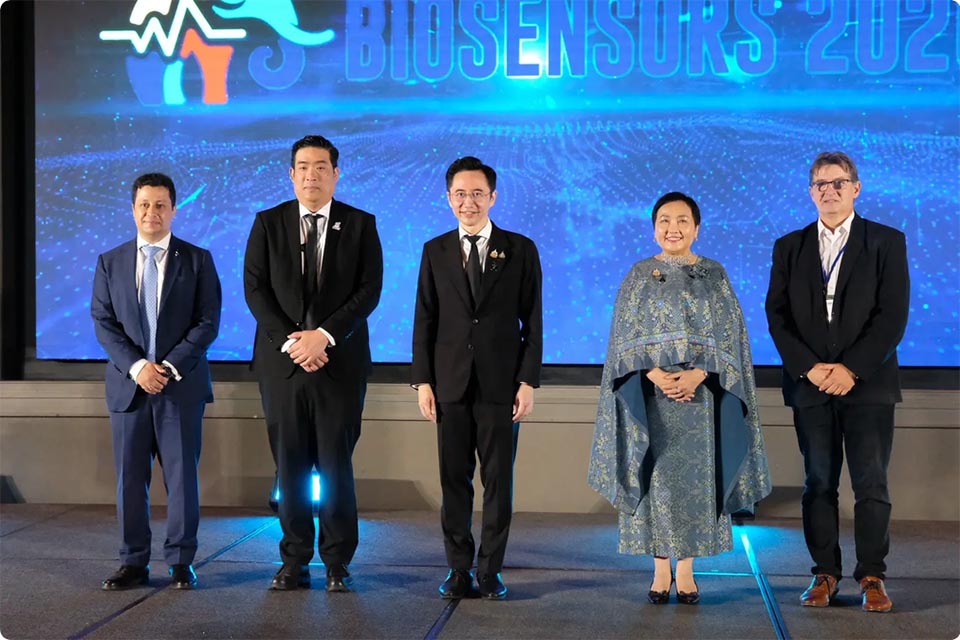
BANGKOK, Thailand – Mahanakorn University of Technology (MUT), in collaboration with Imperial College London, is hosting IEEE BioSensors 2026 in Bangkok, bringing together leading researchers, healthcare professionals, industry experts, entrepreneurs, and investors from around the world to advance biosensor technologies and accelerate their journey from laboratory research to real-world applications.
Held from August 2 to 4 under the support of the IEEE Sensors Council, the conference serves as an international platform for presenting the latest advances in biosensors while fostering collaboration between academia, industry, and the medical sector. The event also reflects the growing partnership between MUT and Imperial College London in strengthening Thailand’s research and innovation ecosystem.
Deputy Prime Minister and Minister of Higher Education, Science, Research and Innovation, Professor Yodchanan Wongsawat, officially opened the conference. He said biosensor technologies have become increasingly important across sectors including healthcare, agriculture, environmental management, and advanced manufacturing. He added that translating research into practical applications requires close collaboration among universities, research institutes, industry, and entrepreneurs. The Ministry will continue supporting the entire innovation pipeline—from fundamental research and product development to clinical testing, standardization, commercialization, and workforce development—to help Thailand strengthen its competitiveness in advanced technologies.
Professor Pantelis Georgiou, General Conference Chair of IEEE BioSensors 2026 from Imperial College London, said establishing a local IEEE BioSensors chapter in Thailand would allow collaboration to continue beyond the annual conference through academic activities, knowledge exchange, and support for technology startups. He added that the partnership between Imperial College London and MUT, including the SABER Laboratory, aims to develop talent in semiconductors, artificial intelligence, and biosensors while creating opportunities for future entrepreneurs in high-tech industries.
Associate Professor Panavy Pookaiyaudom, President of Mahanakorn University of Technology and Co-Chair of the conference, said IEEE BioSensors 2026 connects biosensor researchers with the medical community, industry, entrepreneurs, and investors to develop innovations that address healthcare, environmental, and economic challenges. He noted that Bangkok’s selection as host demonstrates Thailand’s readiness to support world-class scientific collaboration and its emergence as a regional hub for biotechnology, medical technology, and digital health innovation.
The conference features 226 research submissions from 28 countries, alongside keynote presentations, workshops, live technology demonstrations, industry forums, and exhibitions. Topics range from wearable and implantable biosensors to lab-on-chip technologies, artificial intelligence, and machine learning applications. A dedicated industry session explores how electrochemical point-of-care biosensors can progress from laboratory prototypes to commercially viable products, reinforcing the conference’s goal of bridging scientific research with real-world innovation. (NNT)