PATTAYA, Thailand – The Bank of Thailand (BoT) has warned that Thailand’s economy is facing deep structural challenges and weakening competitiveness, with exports and tourism no longer able to function as reliable engines of growth, prompting the central bank to cut its policy interest rate to support the economic recovery.
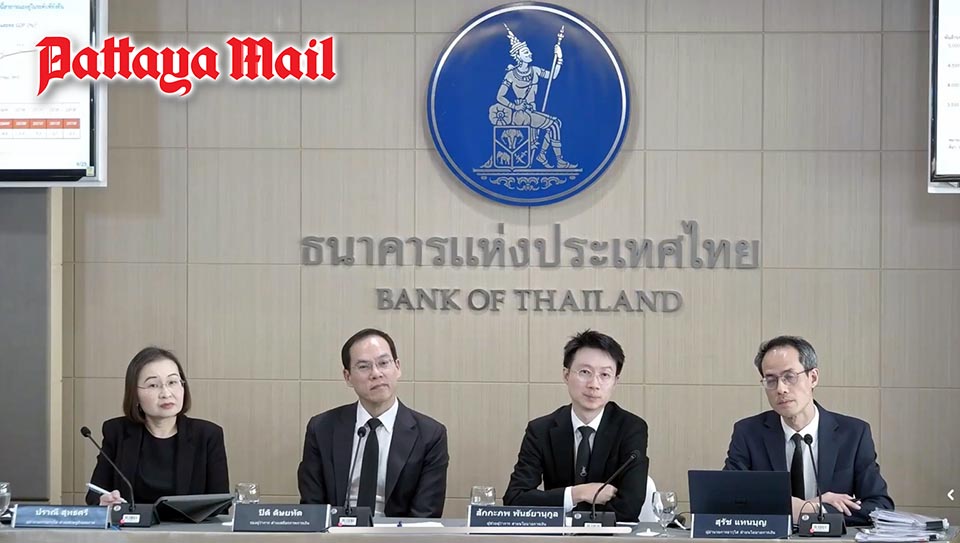
Mr. Sakkapop Panyanukul, Assistant Governor for Monetary Policy at the BoT, said the latest Monetary Policy Committee (MPC) meeting confirmed that Thailand’s economy slowed in the past year and is expected to remain sluggish this year. Both cyclical and structural factors are weighing on growth, resulting in below-potential expansion through 2025–2027.
Inflation remains persistently low, largely due to supply-side price factors, while demand-driven inflationary pressure is limited as economic activity continues to grow below potential. Financial conditions remain tight, with weak loan demand reflecting slow economic momentum. The MPC is particularly concerned about vulnerable business groups, especially small and medium-sized enterprises (SMEs), which are under pressure from intense domestic and external competition, as well as the recent rapid appreciation of the baht.
Against this backdrop, the MPC decided to cut the policy rate to 1.25 percent, a level seen only during the COVID-19 period and considered low compared with global peers. The move aims to ease monetary conditions and support economic recovery, while also complementing other policy measures.
However, Mr. Sakkapop cautioned that maintaining low interest rates for an extended period could create medium-term risks, including the buildup of financial imbalances and reduced policy space to respond to future shocks.
Ms. Pranee Suthisri, Senior Director of the BoT’s Macroeconomic Department, said Thailand’s economy is projected to grow 2.2 percent in 2025, slow sharply to 1.5 percent in 2026, and recover slightly to 2.3 percent in 2027 — all below the country’s potential growth rate. She pointed to structural dependence on external sectors, with exports accounting for around 60 percent of GDP and tourism about 8 percent.
Despite strong export growth of around 12 percent in 2025, she said exports no longer generate broad-based economic momentum. Industrial production remains weak, competition from imported goods has intensified, and many export products, particularly electronics, rely heavily on imported components, limiting domestic value creation.
Tourism, once a key pillar of growth, has also lost momentum. While countries such as Japan, South Korea, and Vietnam have surpassed pre-COVID tourist numbers, Thailand is the only major regional destination still seeing a decline in arrivals.
As competitiveness in exports and tourism weakens, recent economic growth has increasingly come from the services sector. However, much of this expansion is concentrated in traditional, low-wage services, leading to labor migration into lower-productivity jobs and further constraining long-term growth potential.
Ms. Pranee added that economic expansion this year is expected to slow in line with weaker private consumption, softer export growth due to a high base effect, and delayed government budget disbursement of around two to three months following the dissolution of parliament and upcoming elections.
Mr. Surach Tanboon, Senior Director of the Monetary Policy Department, said headline inflation remains low due to supply-side factors, while deflation risks are limited. Inflation is expected to return to the target range in the first half of 2027.
Financial conditions have eased following the rate cut, but overall credit continues to contract due to elevated credit risk. The BoT has introduced the SME Credit Boost program to help share credit risk and encourage new lending to viable small businesses.
Regarding the baht’s recent strength, Mr. Surach said it reflects U.S. monetary easing and Thailand-specific factors, posing challenges for exporters, particularly SMEs. The central bank has stepped up monitoring of foreign exchange transactions and is considering measures to address activities that place significant pressure on the currency.
The BoT reiterated that while the latest rate cut is intended to support economic recovery, future policy decisions will carefully weigh medium-term trade-offs, warning that keeping rates too low for too long could undermine financial stability and weaken Thailand’s ability to respond to unforeseen economic shocks. (TNA)