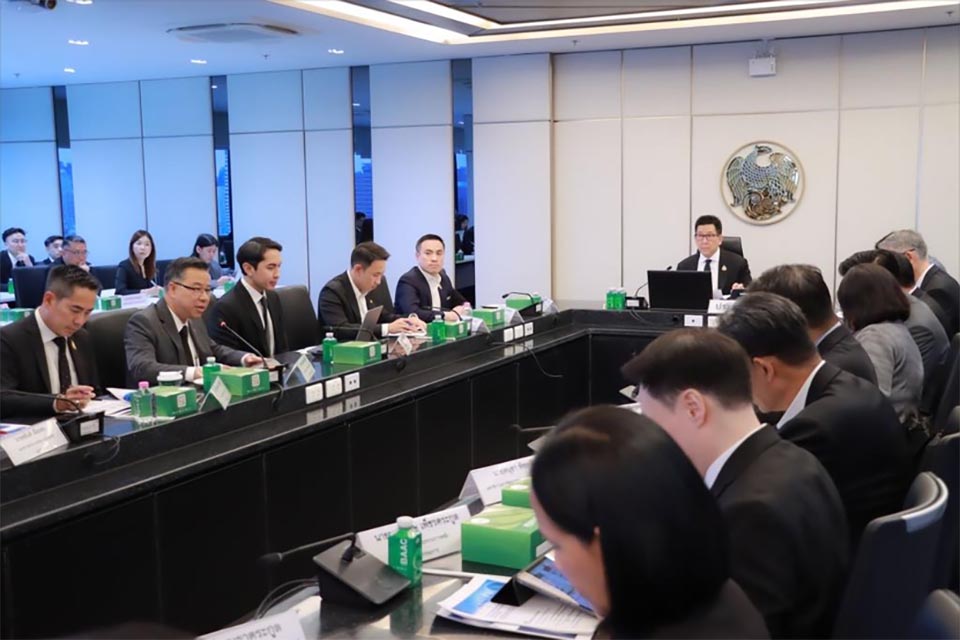
BANGKOK, Thailand – Thailand has approved an ambitious five-pronged strategy to transform its economy, with the government aiming to boost annual economic growth above 3%, raise investment to 30% of GDP, and position the country among the world’s top 20 most competitive economies. Deputy Prime Minister and Finance Minister Ekniti Nitithanprapas chaired a meeting of the Subcommittee on New National Investment Development under the Joint Public-Private Committee on Economic Problem Solving (JSCCIB), where members approved a new framework designed to reshape Thailand into a leading regional investment hub.
The strategy comes as governments worldwide compete to attract investment amid rapid advances in artificial intelligence, digital technology, clean energy and shifting global supply chains driven by geopolitical tensions and demographic changes. Ekniti said Thailand must seize the opportunity to overhaul its economic structure, remove investment barriers and strengthen investor confidence if it is to secure long-term growth and become a key destination for international investment.
The roadmap is built around five strategic pillars:
- Investment and Industry Transformation Hub to modernize traditional industries while accelerating investment in sectors including electric vehicles, semiconductors, advanced electronics, AI, robotics, biotechnology, green industries, healthcare and future food production.
- AI and Digital Hub to attract 100 billion baht in AI, semiconductor and chip-design investment by 2027 while expanding digital infrastructure, research, skilled talent and commercial AI adoption.
- Green Hub to promote clean energy investment, smart power grids, EV infrastructure, carbon accounting systems, emissions trading and green finance.
- Financial Hub to strengthen Thailand as a regional center for banking, capital markets, insurance and wealth management while improving funding opportunities for startups and innovative businesses.
- Medical Investment Hub to develop Thailand into a regional center for high-value medical innovation, pharmaceuticals, medical devices and healthcare manufacturing.
The government also plans to introduce Thailand FastPass, a new mechanism aimed at significantly reducing approval times for business licenses while improving infrastructure, utilities and investment-ready industrial areas. Supporting measures include low-interest financing, tax incentives, workforce development program and initiatives to increase the participation of Thai businesses in global supply chains.
According to BOI Secretary-General Narit Therdsteerasukdi, the plan seeks to achieve three major national objectives: increasing economic growth beyond 3%, lifting Thailand into the world’s top 20 for competitiveness, and raising total investment to nearly 30% of GDP through stronger public and private sector investment. Officials stressed that the strategy is intended to create new long-term economic engines powered by technology, clean energy and financial innovation rather than relying solely on traditional industries.
The government said implementation will include both short-term “Quick Win” measures to remove immediate investment obstacles and broader structural reforms covering regulations, infrastructure and the country’s investment ecosystem. Five dedicated working groups will now be established to drive each strategic pillar and monitor progress through clearly defined targets, timelines and performance indicators.