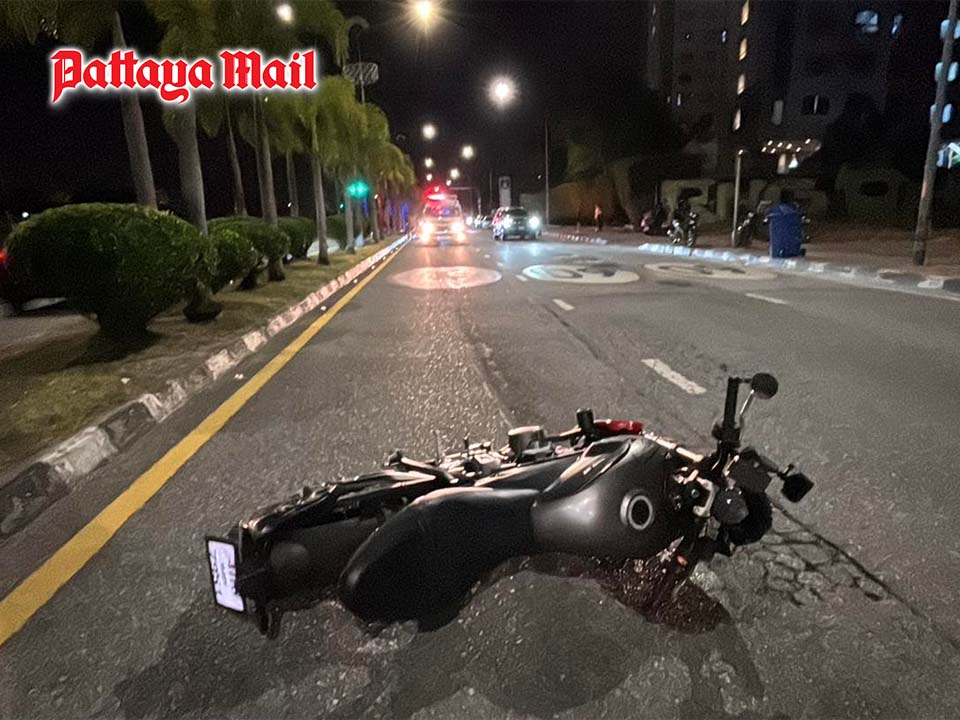
PATTAYA, Thailand — A serious nighttime collision involving a food delivery rider, a Russian tourist, and a foreign big bike rider has once again highlighted the hazardous and often unpredictable conditions of Pattaya’s roads. Following the incident, city authorities are urging residents and tourists alike to exercise increased caution on local streets.
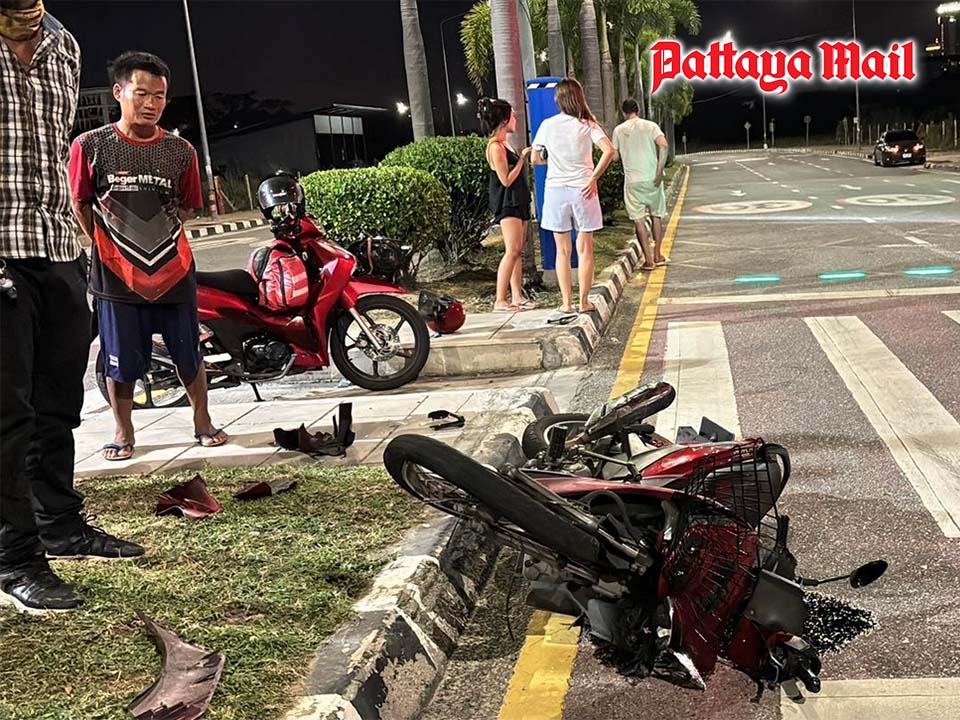
The accident occurred at night on August 6 along Jomtien Second Road, near a zebra crossing. According to eyewitnesses, a motorbike rider—working for a popular ride-hailing app—attempted a sudden U-turn by cutting across a pedestrian-only crossing. A Russian tourist was riding as a passenger. Before they could clear the road, a large-capacity motorcycle, reportedly traveling at high speed, struck them with full force.
Emergency responders quickly arrived and transported all three injured individuals to nearby hospitals. The delivery rider and his passenger sustained serious injuries, while the big bike rider—believed to be a foreign national—was listed in critical condition. Police are currently reviewing CCTV footage from the scene and interviewing witnesses to determine legal responsibility and evaluate the road layout at the site.
While the investigation remains ongoing, the incident has sparked renewed attention to Pattaya’s worsening road safety situation. City streets, especially in high-traffic tourist zones like Beach Road, Thepprasit Road, and parts of Jomtien, are increasingly difficult to navigate due to a combination of reckless driving behavior and flawed infrastructure. Dangerous U-turns near crosswalks, poor lighting, unmarked street entrances, and broken road surfaces all contribute to an environment where accidents are not just possible—they’re frequent.
Tourists are especially vulnerable. Many are unfamiliar with Thailand’s road rules, and what may seem like a routine action—crossing the street or renting a scooter—can become risky if other drivers behave unpredictably or ignore signage. Local officials are particularly concerned about motorcyclists ignoring traffic lights, riding against traffic, or using pedestrian areas to make illegal shortcuts.
Pol. Capt. Chainaret Phengkan, the investigating officer on the case, emphasized that enforcement alone is not enough. “We’re reviewing surveillance footage and assessing the design of the intersection,” he said. “But in the end, it comes down to the decisions made by road users. Infrastructure helps, but behavior is what saves lives.”
City Hall has promised to push for better road markings, upgraded lighting, and clearer signage in problem areas. However, officials stress that community awareness and vigilance remain the most immediate tools for improving safety.
Residents and tourists are encouraged to report dangerous intersections, broken streetlights, and other road hazards directly to Pattaya City Hall’s 1337 hotline. For situations involving distressed individuals, accidents, or welfare-related emergencies, calls can also be made to the national social support line at 1300.
As Pattaya continues to welcome millions of domestic and international visitors, authorities hope that both city planning and public behavior will rise to meet the growing demand for safer, more predictable streets.