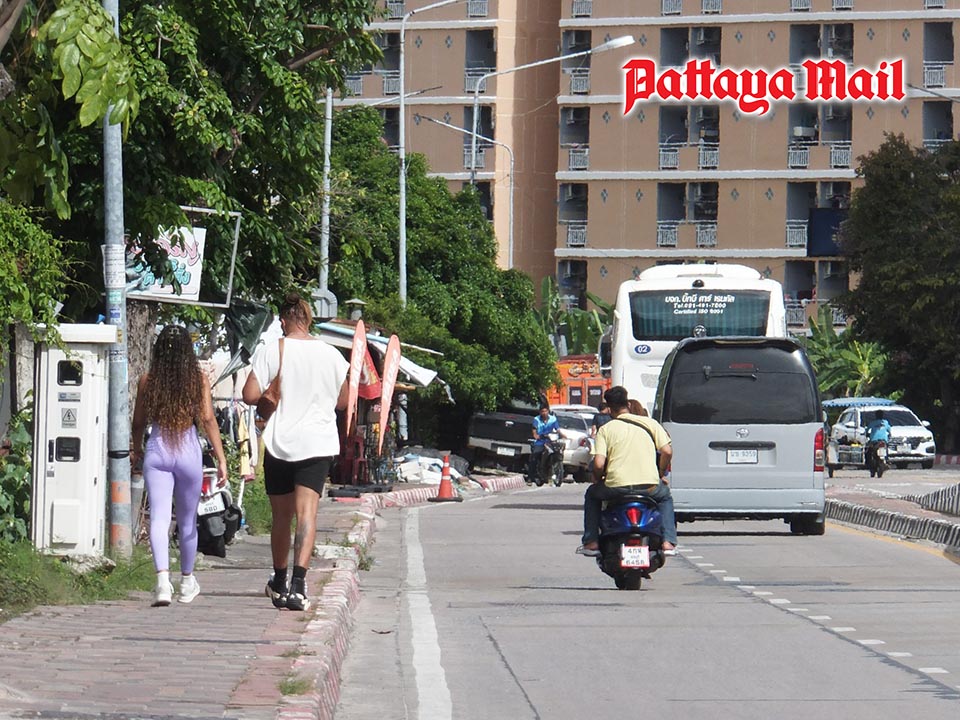
PATTAYA, Thailand — Pattaya has long billed itself as a tourist-friendly city, but the reality on the ground tells a different story. Sidewalks across the city are uneven, broken, and in many areas, downright dangerous, leaving both residents and visitors constantly on alert.
From Rung Ruang Bus Station on North Pattaya Road to the streets of South Pattaya, pedestrians must navigate cracked pavers, deep potholes, and raised drains. Loose slabs twist ankles, electrical boxes block walking paths, and motorbikes frequently encroach on the footpaths, making sidewalks barely usable. “You have to continually look down where you are walking,” says one local expat. “I’ve sprained my ankle already from a loose paver.”
Even supposedly safe routes, like those near shopping malls, are compromised by poorly maintained concrete or slabs laid over sand, which wash away during the rainy season. Pedestrian crossings are half-painted or incomplete, and infrastructure standards lag far behind neighboring cities like Phnom Penh or even Patong in Thailand.
Disabled residents face particular challenges. Operating wheelchairs on the city’s uneven sidewalks is often impossible, forcing them into traffic where the risk of accidents is high. The city’s reliance on contractors who repeatedly deliver shoddy work has created a cycle of constant repairs without long-term solutions.
The problem isn’t new. Locals note that sidewalks and roads have been in disrepair for decades, with patchwork fixes that leave the city looking chaotic. In some areas, the “sidewalk” is little more than a loose brick path, riddled with holes that could easily break a leg. Meanwhile, motorbikes and cars continue to encroach, further limiting pedestrian safety.
Tourists and locals alike are frustrated. “If the footpath is usable, it’s partially blocked by signposts or electrical boxes. Almost impossible to walk along Soi Baukhao,” one expat remarked. Others point out that enforcement is lax; motorbikes still ride freely on footpaths, creating hazards for everyone.
Some suggest the city focus on durable solutions: solid concrete walkways instead of individual pavers, proper pedestrian crossings, and strict enforcement against sidewalk encroachment. Others say the city could benefit from consulting local expats and residents to prioritize real pedestrian needs.
Without immediate action, Pattaya risks undermining its reputation as a family-friendly, international tourist destination. Visitors may enjoy the beaches and malls, but navigating the city streets often resembles a game of obstacle course survival.