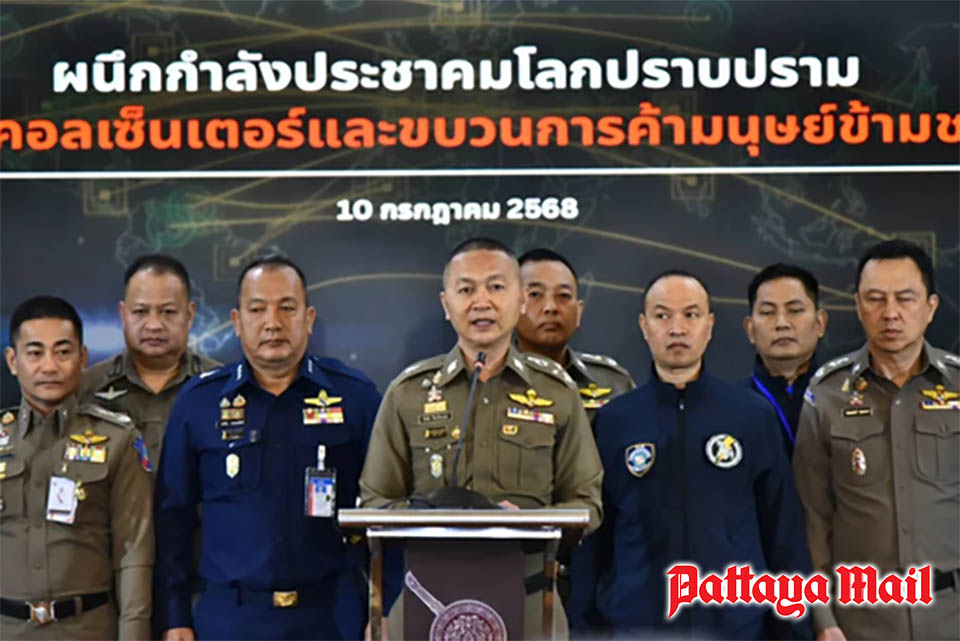
PATTAYA, Thailand – The Royal Thai Police revealed the persistent threat posed by call center gangs operating from neighboring countries, and announced a new strategic plan called “I2LAI” aimed at intensifying global cooperation to dismantle these criminal networks within three months. The focus is on aggressively pursuing the “Gok An” gang network.
At the National Police Headquarters, Pol. Gen. Thatchai Pitanilabut, Chief of the Technology Crime Suppression Division and head of the UNODC task force against call center crime and human trafficking, detailed the ongoing situation. Call center gangs remain entrenched in neighboring Cambodia, Myanmar, and Laos, using Thailand as a strategic transit hub to traffic and deceive both Thai citizens and foreigners into working for these criminal operations.
In Myanmar, recent crackdowns cutting off electricity, internet, and fuel supplies in regions such as Shwekokko and KK Park have led to large-scale sweeps identifying nearly 8,900 victims of 36 nationalities. However, some gangs remain hidden in southern Myawaddy. Cambodia has seen rapid expansion of call center gangs, with 52 identified hotspots across 10 provinces, especially near Poipet and the Vietnam border, often controlled by Chinese criminals protected by local influencers. Some gangs have even moved operations into Thailand to defraud foreigners, including Australians, Vietnamese, Koreans, and Chinese, with Thai authorities actively arresting suspects.
The Royal Thai Police, in partnership with Task Force 88 and the UNODC, have launched the “I2LAI” strategy, built around five key pillars:
- Disrupting infrastructure by cutting off electricity and internet to operation bases.
- Blocking networks by shutting down recruitment pages, fake job ads, mule accounts, crypto-related channels, and cross-border facilitation groups.
- Law enforcement and asset seizure targeting building owners, masterminds, managers, and protectors.
- Employing AI technology to monitor, prevent, and block the use of Thailand as a transit or scam hub.
- Global cooperation by establishing a rapid response “War Room” at the Thai Police Headquarters, integrating international agencies such as UNODC, INTERPOL, and the FBI to share intelligence and coordinate actions. The strategy aims to show measurable results within three months.
Pol. Gen. Thatchai also updated progress on the “Gok An” network case. Police raided 20 locations in Bangkok, Samut Prakan, and Chonburi provinces, seizing assets valued at over 1.1 billion baht, including 27 million baht in cash and luxury vehicles. Arrest warrants are being prepared for all involved parties, with further asset seizures planned domestically and abroad.
He confirmed that Thai police possess strong evidence, including FBI data, linking “Gok An” as the owner of several buildings used for call center scams. The suspects remain at large outside Thailand, with INTERPOL issuing Red Notices for their arrest. Investigations continue into potential involvement of Thai officials and political connections.
Regarding the crypto exchange company Hui One, implicated as a money laundering front for call center gangs and blacklisted by the U.S., Pol. Gen. Thatchai noted this as a crucial lead in ongoing investigations.
Discussions with INTERPOL earlier this month resulted in a global coordinated crackdown strategy involving 196 member countries. Pol. Gen. Thatchai expressed confidence that Cambodian authorities will intensify their own crackdowns, driven by social pressure and international cooperation.
He concluded by emphasizing that the persistence of scams targeting Thai citizens is rooted in systemic factors that require cooperation from the Thai public as well to be fully addressed. (TNA)