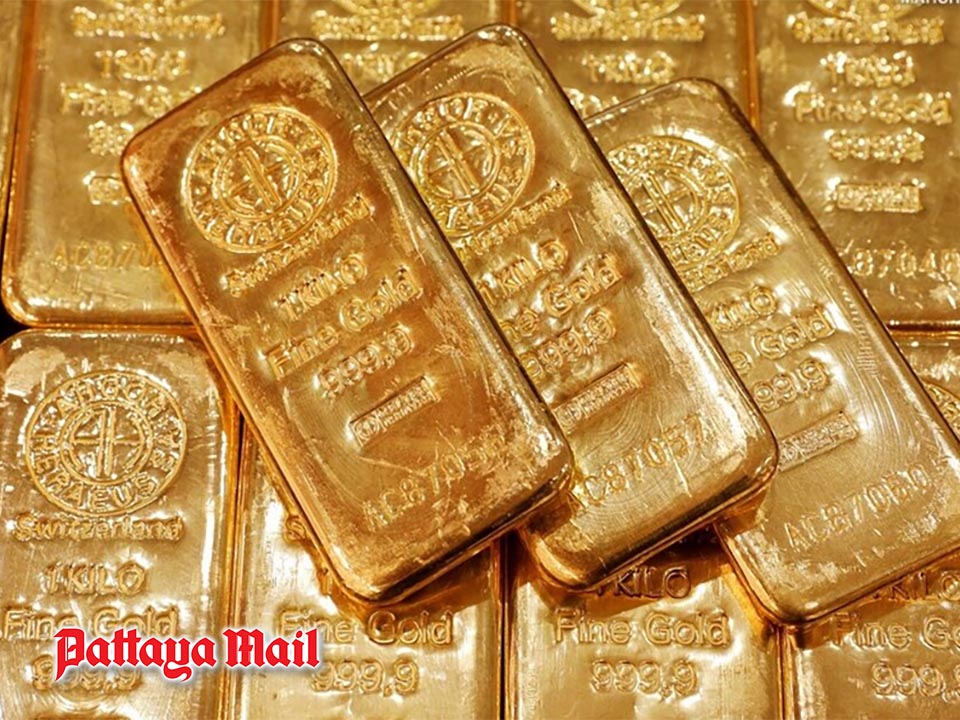
PATTAYA, Thailand – For decades, gold has been a safe haven for Thai savers. From Yaowarat shopfronts in Bangkok to family-run gold stores in provincial markets, buying a baht of gold has been less about speculation and more about security. But with international banks like Goldman Sachs now predicting gold could surge to $4,000 an ounce by mid-2026, Thais may soon find themselves in a new, uncomfortable reality: gold prices at 70,000–80,000 baht per baht-weight.
A New Record Already in Sight
On October 1, COMEX gold futures hit $3,897.50 per ounce, the highest in history. The rally was fueled by a weakening U.S. dollar, a government shutdown in Washington, and weaker-than-expected U.S. jobs data—factors that make investors rush back into “safe haven” assets like gold.
Goldman Sachs has long held a positive view of gold, and analysts note that the surge is being driven by significant inflows from retail investors into gold ETFs. The bank now sees gold rising even faster than its prior projections, potentially reaching $4,300 per ounce by the end of 2026.
Interestingly, in September Goldman Sachs also suggested that gold could climb as high as $5,000 per ounce if just 1% of U.S. bond capital flows into gold markets. While this is a less likely scenario, it underscores how sensitive gold is to shifts in global capital flows—and how quickly prices can spike in extreme conditions.
Winners and Losers in Thailand
For long-term holders of gold, this is a dream come true. Families that bought when gold was 30,000 or even 40,000 baht per baht-weight are sitting on handsome profits. Thai exporters of jewelry may also benefit, as strong global prices lift margins on finished products.
But there is a darker side. New buyers are being priced out. If gold surges beyond 70,000 baht, many lower- and middle-income Thais who rely on gold as a safe savings vehicle will struggle to participate. Gold, once considered a “people’s asset,” risks becoming a luxury item.
There’s also the risk of a bubble mentality. With Goldman Sachs and others throwing out four- and even five-thousand-dollar targets, smaller Thai investors may rush in at exactly the wrong time. This is a familiar story: during the last major gold run-up in 2011, many latecomers bought at the top, only to watch prices collapse for years.
The Global Push and Thai Implications
Gold’s momentum is being driven by central banks returning to purchases, weaker U.S. data reinforcing the likelihood of Federal Reserve rate cuts, and global distrust of paper currencies. In Thailand, the impact is filtered through the baht.
If the baht strengthens—as it has been in 2025—domestic gold prices will not rise as quickly as global charts suggest. A baht at 40 per U.S. dollar could cushion local prices somewhat. Conversely, if the baht weakens sharply due to capital outflows or political risk, gold in Thailand could rocket even higher than Goldman’s dollar-based forecast.
A Critical Juncture for Thai Savers
The question is not whether gold will remain strong—it likely will—but who in Thailand can still afford to buy it. Wealthier investors will treat it as a hedge and store of value. Ordinary Thais may be forced to watch from the sidelines, unable to participate in a market that has long been their cultural and financial safety net.
If gold touches 80,000 baht per baht-weight, Thailand may witness a fundamental shift: gold moving from being a mass-market savings tool into an elite asset class. That would be as profound for Thai society as it is for global markets.