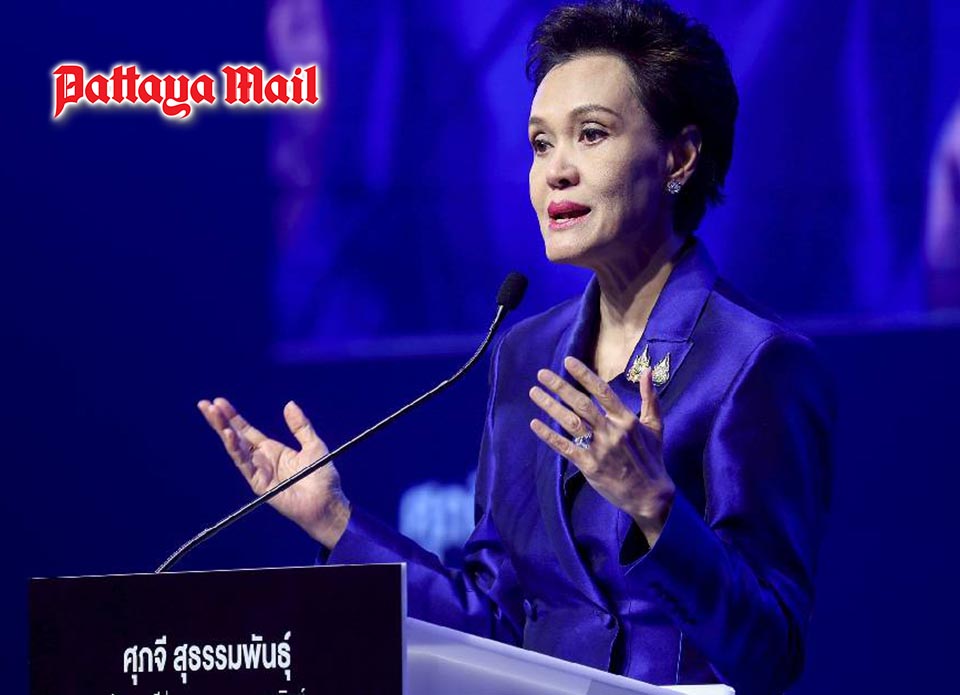
PATTAYA, Thailand – Thailand’s Ministry of Commerce, led by Minister Suphajee Suthumpun, has unveiled a plan to steer the economy out of the “development trap” and into a Value-Based Economy. The strategy focuses on three pillars and seven policies aimed at boosting grassroots income, opening new markets, and reducing living costs for citizens.
Minister Suphajee stressed that Thailand must adapt quickly to global economic shifts through a Value-Based Economy, leveraging three main strategies under the “Quick Big Win” approach:
- Boosting Income, Especially for Agriculture:
-Thailand produces around 25.8 million tons of rice, including 6.8 million tons of jasmine rice, which remains in strong demand.
-The Ministry manages 1.8 million tons of rice stock to secure the best prices.
Initiatives such as the “Green Flag” program reduce farmers’ costs, including fertilizer.
Supply-demand balancing measures aim to absorb surplus production and stabilize rice prices.
- Creating and Expanding New Markets:
-Thailand currently has 14 Free Trade Agreements (FTAs) covering 18 countries.
-A recent FTA with the EFTA group (Switzerland, Iceland, Norway, Liechtenstein) serves as a model for EU negotiations.
-Progress continues on the Thailand–South Korea FTA, expected to yield tangible results by early next year.
-Trade missions target high-potential markets, including India, Saudi Arabia, the Middle East, Africa, and Latin America.
-The Ministry coordinates with the private sector to ensure products meet target-market demands in quality, size, and packaging.
- Reducing the Cost of Living:
-The “Blue Flag” program has been expanded over 1,300 times nationwide.
-Efforts focus on border areas in seven provinces affected by regional tensions.
-Cooperation with private hospital associations improves transparency in medicine pricing.
-Citizens can now compare and purchase medicines outside hospitals at standard prices, expected to reduce annual medicine costs by over 30 billion baht.
Additionally, the Ministry partners with Thailand Post and provincial commerce offices to promote border and community products for the year-end gift market, improving packaging, raising grassroots economic value, and encouraging domestic consumption.
Minister Suphajee highlighted Thailand’s strategic location and FTA network as key advantages to attract trade and investment. The Ministry will also integrate digital technology and AI into its operations, particularly via the “MOC+” platform, to streamline permits, complaints, and other government services efficiently and transparently.
“We must restructure the economy to escape the middle-income trap and advance toward a Value-Based Economy driven by innovation and economic value. Success depends on government building trust, the private sector seizing opportunities, and citizens benefiting collectively,” said Minister Suphajee. (TNA)