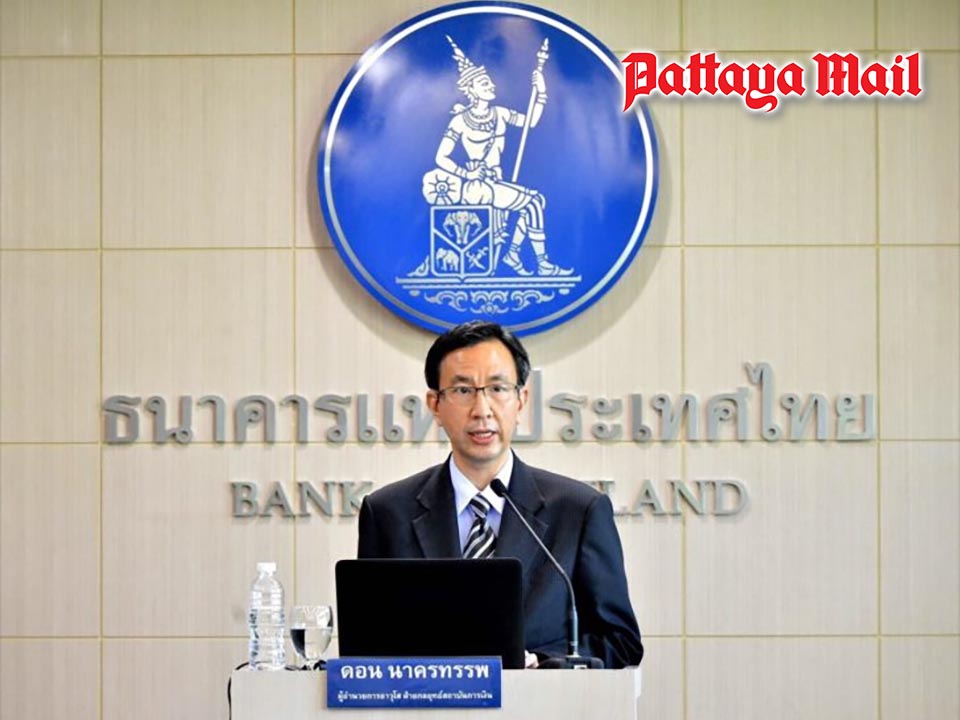
PATTAYA, Thailand – A senior Bank of Thailand (BOT) official has said Thailand is in a relatively favourable position after being able to ease monetary policy to support the economy amid global geopolitical risks, while pointing to growing uncertainty within the US Federal Reserve.
Don Nakornthab, Assistant Governor of the Monetary Policy Group and Secretary of the Monetary Policy Committee (MPC), said in a social media post that the past week was a “central bank bonanza,” with multiple major central banks—including those of Thailand, the United States, Japan, the Eurozone, and the United Kingdom—holding policy meetings almost simultaneously.
He noted that Thailand’s MPC and several major central banks opted to keep interest rates unchanged, while highlighting differences in decision-making styles, particularly between Thailand’s unanimous vote and the US Federal Reserve’s divided stance.
According to Don, the Fed’s latest meeting showed significant internal disagreement, with an 8–4 split vote—the widest divergence since the early 1990s. While most members voted to hold rates steady, differing opinions emerged regarding future policy direction and whether rate cuts should be signalled.
He added that only one dissenting vote supported an immediate rate cut, while others opposed the language suggesting future easing due to concerns that US inflation remains persistent and slow to decline once it accelerates.
Market expectations have shifted sharply, with investors now reassessing whether the Fed will deliver any rate cuts this year, compared to earlier projections of two cuts.
Don also said Thailand may have benefited from timing, noting that if geopolitical tensions—particularly conflicts involving major global powers—had escalated earlier, the MPC’s recent decision to cut interest rates might not have taken place.
He added that Thailand’s inflation forecasts for 2026 and 2027 have moved back within the target range, supported by higher energy prices, allowing some monetary policy flexibility to cushion external shocks.
On the US side, he noted growing speculation about future leadership changes at the Fed, including potential shifts in policy direction under incoming leadership. He also pointed to concerns about institutional dynamics within the Fed, as outgoing leadership arrangements and ongoing investigations may affect the central bank’s internal cohesion.
Analysts, he said, view recent dissent within the Fed as a signal of underlying policy tension, particularly as markets prepare for a possible transition in leadership.
Don concluded that while Thailand currently benefits from relatively accommodative monetary conditions, global financial uncertainty—driven by geopolitical risks, inflation dynamics, and central bank leadership transitions—remains a key factor to watch in the period ahead.