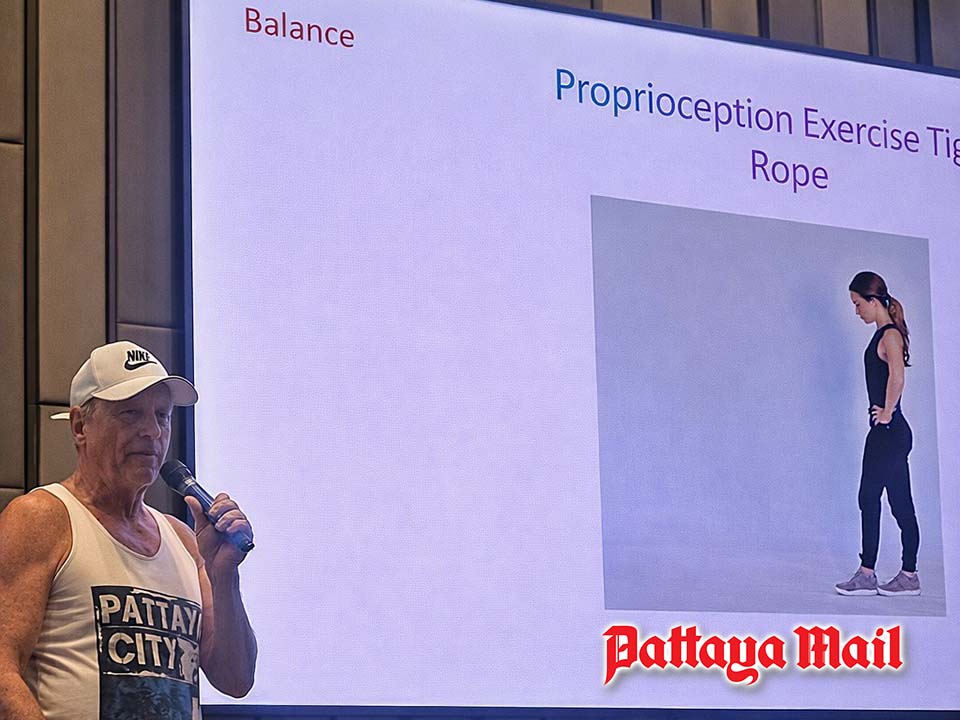
PATTAYA, Thailand – Curtis Arnold delivered a forceful message at the April 1 meeting of the Pattaya City Expats Club (PCEC) that aging is not a smooth, inevitable slide, and exercise more than diet, supplements, or medications may be the single most powerful tool to slow it down and extend healthy life. He was followed by Darryl Reeves on the topic “Intuitive vs Analytical Decision-Making.”
Curtis opened with a sobering reality. Biological aging, he explained, does not progress gradually year by year. Instead, it accelerates in sharp bursts, with major spikes occurring around ages 34, 60, and 78. For many people, especially baby boomers, that means decline can feel sudden and steep. But Arnold was quick to add that decline is not destiny.
At the core of Curtis’s presentation was mitochondria, the tiny structures inside cells that produce ATP, the energy required for every bodily function. According to Curtis, mitochondrial dysfunction, combined with an accumulation of senescent (non‑dividing) cells, underlies most chronic disease and age‑related decline, including heart disease, diabetes, cancer, and Alzheimer’s.
“When mitochondria fail,” Curtis said, “cells lose their ability to function properly, leading to what we call metabolic disease.” He emphasized that metabolic dysfunction is not a niche problem but a root cause behind most premature deaths in modern society.
The encouraging news is that mitochondria are highly responsive to one’s lifestyle especially exercise. Curtis repeatedly framed exercise not as a fitness choice, but as a form of medicine. Citing large population studies and meta‑analyses, he pointed to research showing that regular physical activity can reduce mortality by more than 30 percent. Even modest habits matter: a daily brisk walk, he noted, has been associated with an average increase of about four and a half years of life expectancy.
Exercise benefits nearly every system in the body, he explained from cardiovascular health and immune function to cognition, mood, and sleep. But its most profound effects occur at the cellular level, where exercise stimulates mitochondrial biogenesis (creating more mitochondria) and improves mitochondrial efficiency (making existing ones work better).
He introduced the audience to REHIT (Reduced‑Exertion High‑Intensity Training), a protocol requiring just two 20‑second all‑out sprints, twice per week, separated by recovery periods. Total high‑effort time: 40 seconds per session. Despite its brevity, Arnold explained, REHIT has been shown to improve insulin sensitivity, fat metabolism, mitochondrial efficiency, and cardiovascular fitness.
Cardio alone, Arnold warned, is not enough. Aging brings sarcopenia, which is the gradual loss of muscle power, strength, and eventually muscle mass. Strength training, whether with weights, resistance bands, or body‑weight exercises, plays a critical role in preserving independence.
Curtis emphasized practical, at‑home movements such as sit‑to‑stands, wall sits, hip hinges, balance drills, and simple mobility exercises. These movements, he said, reduce fall risk, increase bone density, improve metabolic health, and support cognitive function. Falls, he noted, are one of the leading causes of injury and hospitalization among older adults, making balance and strength training essential components of healthy aging.
By the end of his presentation, Curtis’s message was unmistakable: exercise is not optional if the goal is long‑term health. Protecting and training mitochondria through regular movement, he argued, can dramatically reduce disease risk, delay aging, and add years of vitality—starting at any age.
Following Curtis, Darryl Reeves delivered an insightful and often entertaining presentation on decision‑making, emphasizing how everyday choices shape personal success, health, and happiness. Drawing on decades of experience in ministry, counseling, public speaking, and business, Reeves challenged the audience to become more deliberate and self‑aware in how they make decisions.
Central to his talk was the idea that “almost everything in life flows from decisions,” whether made consciously or unconsciously. He argued that improved decision‑making is fundamental to long‑term wellbeing and happiness, noting that even areas such as health, relationships, and finances are largely outcomes of repeated choices over time.
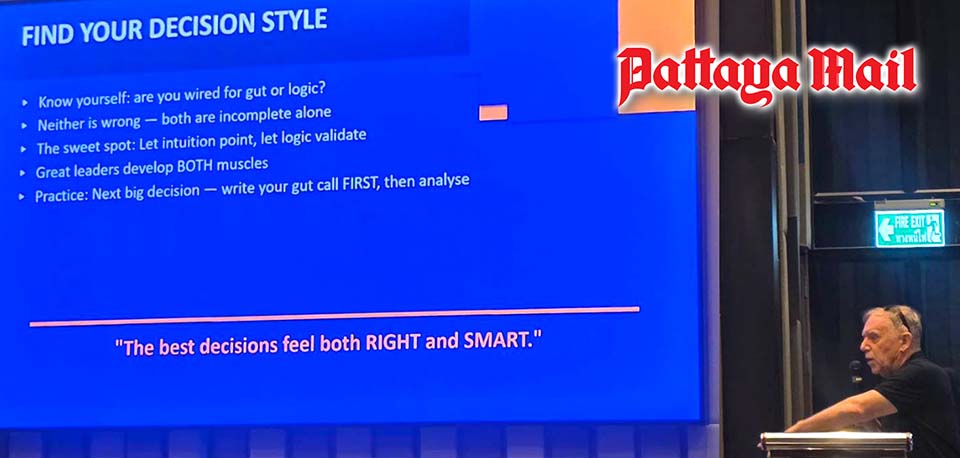
He outlined two primary ways people make decisions: trusting intuition and relying on logic and data. He described “gut decisions” as fast and automatic, often produced by experience rather than conscious reasoning. In contrast, logic‑driven decisions are those grounded in data, research, and analysis and are most valuable when individuals are in unfamiliar territory, when significant money is involved, or when consequences are difficult or impossible to reverse.
Throughout his presentation, Darryl used personal stories to illustrate how experience sharpens intuition. From counseling individuals and families to assessing property investments, he explained how repeated exposure allows people to recognize patterns and make accurate judgments quickly.
As a practical takeaway, he shared a simple set of questions designed to improve everyday decisions. These included assessing how a choice feels intuitively, evaluating whether sufficient experience and reliable data are available, and considering whether emotions or external pressure are influencing the moment. He also urged participants to think about who else would be affected by the decision and whether they could live with the consequences if it went wrong.
Darryl has previously spoken to the PCEC about the use of Artificial Intelligence (AI). He addressed the growing role of AI as a decision‑support tool. He noted that AI has dramatically lowered the cost of accessing information and research, making data‑driven decisions easier than ever. While he personally uses multiple AI platforms for research, writing, and organization, he emphasized that technology cannot replace human experience, emotional intelligence, or contextual judgment.
In conclusion, Darryl encouraged attendees to understand their own decision‑making style and to practice greater self‑awareness. By learning when to trust intuition, when to slow down and research, and how to integrate both, he argued that people can make choices that better align with their values and long‑term goals.
After the presentations, MC Ren Lexander brought everyone up to date on upcoming Club events. This was followed by the Open Forum where questions are asked and comments made about Expat living in Thailand. To learn more about the PCEC, visit their website at https:/pcec.club. Videos of the presentations will be uploaded to the PCEC’s YouTube Channel at https://www.youtube.com/@pcecclub6255/videos.