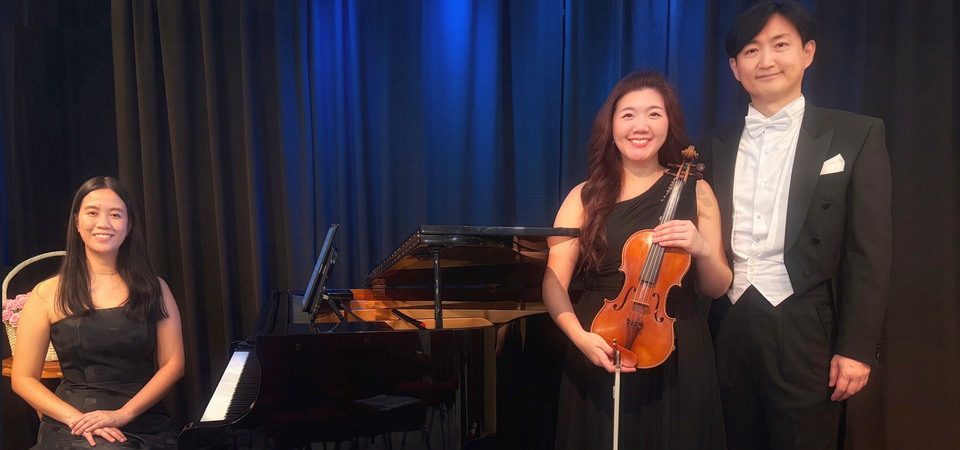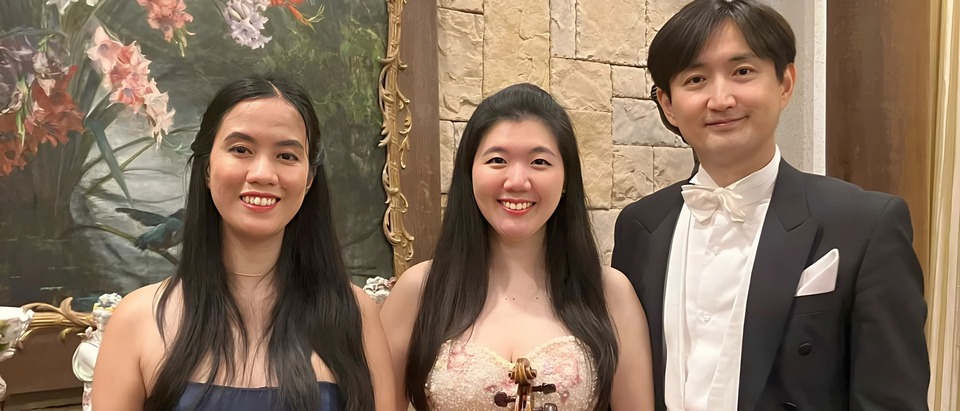
PATTAYA, Thailand – As the house lights dimmed at Ben’s Theater and the audience fell silent, the first luminous notes from the piano brought a sense of magic. The music was the charming Nocturne, Op. 6 No. 2 by the nineteenth-century piano virtuoso Clara Schumann. At the time, she was one of most influential musical figures in Germany. She was born Clara Wieck in 1819 into a middle-class family in Leipzig, where both her father Friedrich and her mother Mariane were pianists and piano teachers. History paints her father as an unpleasant, unyielding and domineering individual who trained the young Clara in piano, violin, voice and composition, as well as in religion and languages.
She received daily, hour-long lessons with her father and was commanded to practice for two hours every day. But this strict routine paid off, for when she was just nine years old, she made her concert debut at the famous Gewandhaus concert hall in Leipzig. She was considered a child prodigy and toured the cities of Europe. Clara also composed many solo piano pieces, a piano concerto, chamber music, choral pieces and songs. She was one of the few pianists of her time who always performed from memory. In 1840 Clara married the composer, Robert Schumann but it was to be a short and tragic marriage, for only fourteen years later Robert had a mental collapse and attempted suicide. He spent the last two years of his life in a sanitorium.

Clara Schumann’s music is often rich in melancholy and the Nocturne, Op. 6 No. 2 is the second piece in a suite of six, collectively known as Soirées Musicales. Written in 1836, it’s a wistful piece with rippling arpeggios in the left hand supporting a delicate, fragile melody. The piece has technical challenges too, but pianist Rasikamon Siyapong really caught the thoughtful mood of the music, bringing out the melody beautifully from the accompaniment. There was effective use of rubato too, the technique that musicians employ to vary the tempo slightly and bring a more fluid feel to the music.
Throughout the evening, Rasikamon was to prove that she is a pianist of exceptional ability, technical prowess and most important, someone with a clear sense of musical awareness. In 2014, she graduated with a first-class honours degree in piano from the College of Music at Mahidol University. She continued her studies at the Mozarteum University in Salzburg and later completed her Master’s Degree at the University of Music and Performing Arts in Graz. She has collaborated with leading international vocalists, giving concerts in various European cities such as Munich, Graz, Vienna, Salzburg and Athens.

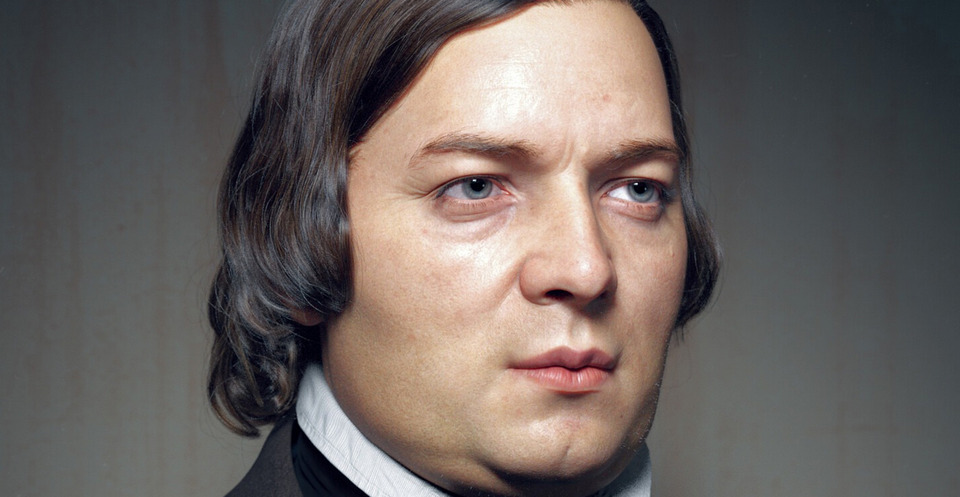
Robert Schumann composed Dichterliebe (“A Poet’s Love”) in 1840. It’s described as a song cycle: a group of songs intended for performance in sequence as a single entity. Song cycles usually have a central, unifying theme or mood, such as love or nature. The sixteen songs that make up Dichterliebe use poems written in the early 1820s by that other depressive and suicidal German, Heinrich Heine who was thirteen years older than Schumann. Heine wrote extensively about his depression, how it affected his life and how it left him feeling empty, hopeless and often suicidal. Schumann must have felt more than a little empathy with these sentiments.

The literary theme of Dichterliebe revolves around the emotional journey of a young man grappling with unrequited love. There is an inevitable “woe-is-me” feeling to most of the lyrics as they reflect emotions that shift from passionate love to sorrow and ultimately to acceptance. But there is also a sense of forgiveness and understanding and Heine draws on rich imagery with references to nature, flowers and dreams. Schumann’s setting of these poems is at times extraordinary, for his music mirrors the delicate and nuanced language of Heine’s eloquent poetry. Sometimes, he writes a piano part that seems to convey a different mood to that of the vocal line, as though the parts reflect the thoughts of two separate individuals. This is a typical Schumann technique that may have reflected, intentionally or otherwise, his unstable mental condition.
Dichterliebe was performed by the talented Japanese tenor Waku Nakazawa who has a light tenor voice well-suited to these Schumann songs. Many of them present technical vocal difficulties, which he executed with considerable confidence and accuracy. He also sang with excellent intonation, something that I wish every singer would learn to do. The piano part too has technical challenges. It is not a mere accompaniment, but really an independent musical element in the music, like Schumann’s “second voice”. Rasikamon Siyapong provided a compelling performance throughout the song cycle and I was impressed with how she not only supported the voice, but brought the piano part into the spotlight when needed.
In the first song, Im wunderschönen Monat Mai, Schumann creates an attractive melody but adds a slightly dark and mysterious feeling with a chromatic piano part. It was a beautifully controlled performance, with sensitive vocal phrasing from Waku Nakazawa and sympathetic piano playing from Rasikamon. The second song, Aus meinen Tränen sprießen has a charming simple quality and at the end Schumann leaves the vocal part slightly in the air, leaving the piano to complete the piece.
The fourth song, Wenn ich in deine Augen seh showed Waku’s tenor voice to be quite strong in the top register and this was supported by some excellent piano work from Rasikamon and a fine sense of ensemble. She also excelled in the seventh song Ich grolle nicht, with its relentless repeated chords in right hand and octaves deep in the bass. It’s an angry song with restive music and a sense of foreboding, with sharp contrasts of dynamics which were performed most effectively.
The eleventh song, Ein Jüngling liebt ein Mädchen begins with almost a joyful Schubert-like quality, but the mood soon begins to feel uneasy, an emotion clearly reflected in the vocal and piano parts. Rasikamon provided a splendid performance, with compelling rubato and Waku captured the intense emotions of the song. Am leuchtenden Sommermorgen opens with a charming melody over piano arpeggios and Schumann creates a subtle harmonic tension between the vocal and piano parts. I enjoyed Waku’s competent phrasing and sense of line. As so often with Schumann, the singer only half-completes the song and it is left to the piano to finish the chromatic wandering and bring us back to the home key. The piano playing from Rasikamon was exceptionally sensitive and thoughtful.
The song Ich hab’ im Traum geweinet begins with a solo voice (in G flat, of all keys) and threatening staccato chords from the piano. In this song, there is probably more silence than sound. The two performers gave a telling performance with an excellent sense of ensemble. The penultimate song is a comparatively jolly affair though it travels through challenging keys for the performers. Waku and Rasikamon performed it with confidence and brought out the musical qualities, especially in the lovely lyrical section which leads to the close with dark, ominous chords on the piano.
The final song of the cycle has a somewhat funereal quality and is charged with self-pity. It contains difficult vocal leaps and frequent changes of key making it something of a challenge for both singer and pianist. Both musicians gave a confident and compelling performance, with Rasikamon giving an expressive reading of the long thoughtful section on the piano that brings this paradox-filled work to its close.

Waku Nakazawa was born in Tokyo and studied voice in Japan. In 2008, he graduated with a Diploma with Distinction in Voice Performance in Austria and completed his Master’s degree at the Mozarteum University Salzburg. Besides singing, Waku Nakazawa is also a conductor and made his conducting debut in 2014 with Mozart’s The Magic Flute at the Oper im Berg Festival in Austria. He has since conducted many well-known operas.
The second half of the programme opened with another emotionally-revealing work by Robert Schumann, his Violin Sonata No. 1 in A minor, Op. 105. As the high opus number reveals, it’s a late work and was written in just a few days in September 1851. The work has been described as “one of the most direct mirrors of Schumann’s inner life”. It was performed by the distinguished Thai violinist Visanee Vongvirulh with Rasikamon Siyapong at the piano. Again, the piano plays a much more dominant role than merely being an accompaniment. In the first movement, a dark and feverish violin melody is contrasted with an agitated piano part which breaks into a dramatic passage suggesting profound unrest.
I was most impressed with the rich, warm violin tone from Visanee Vongvirulh. Her intonation was excellent throughout the work and I appreciated her sense of phrase and the way she created contrasts of mood in her playing. This really seems like the music of a troubled mind and the two performers seemed to capture the curious dichotomy that haunts the work.
The slow, second movement was brilliantly performed and the two musicians caught the almost sacred opening quality of the music. Visanee’s lovely soft pianissimo tone quality came to the fore, heightened with beautifully expressive piano playing from Rasikamon. The last movement has an almost demonic quality, perhaps influenced by the demons that were haunting the composer’s mind at the time. It has been suggested by one historian that “the feeling of irresolution at the end of the sonata… must be seen as Schumann’s effort to honestly explore the depths of his own increasingly agitated and complex mind.” This final movement is difficult and challenging, yet Visanee and Rasikamon played with faultless ensemble and superb precision. It was a brilliant performance which seemed to emphasise the gentler aspects of the music.
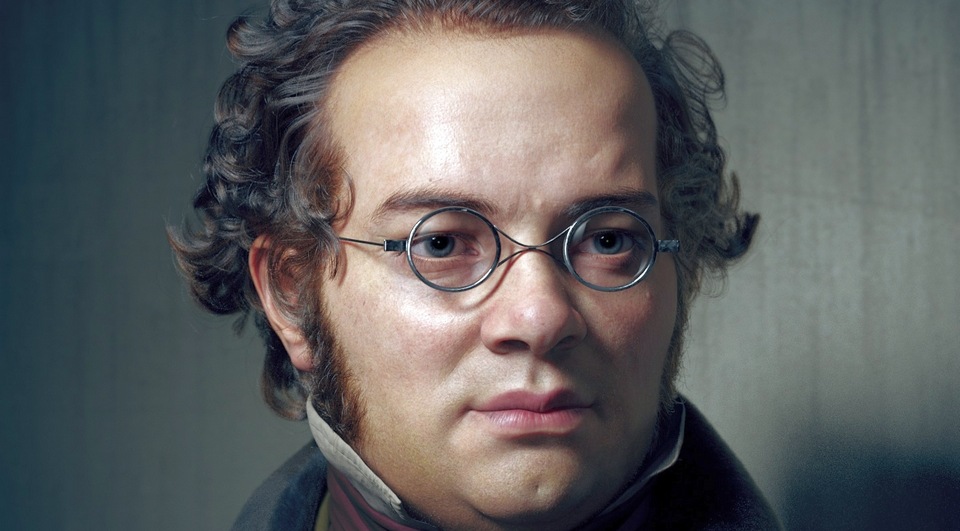
After listening to Schumann’s personal storm and stress, this typically light and charming song by Franz Schubert entitled Der Einsame was a clever piece of programming, for it brought a welcome contrast. The title is translated as “The Lonely” or sometimes “The Loner” but it is not remotely melancholic in mood. Quite the opposite, even though it was written during a hospital stay in 1825. The piano part consists mostly of repeated chords in the right-hand, while the left-hand provides occasional “twiddles”, perhaps representing the sound of the crickets mentioned in the song. On the face of it, this is a simple song but it contains masterful touches that only Schubert could bring off. As usual, Rasikamon provided a superb piano accompaniment and captured the spirit of the music. Waku gave a relaxed and enjoyable performance, though sometimes he sang so quietly that only those in the front row could have heard. Both performers helped to create an excellent contrast of moods.
Violinist Visanee Vongvirulh returned to the stage for the performance of Edward Elgar’s much-loved Salut d’Amour. Her warm and bright violin tone shone through again and I enjoyed the dynamic contrast that the players brought to the music. The piece was written in 1888 and dedicated to Elgar’s fiancée. It has become one of the composer’s most famous pieces and over the years, it should have earned him a fortune in performing and recording royalties. However, perhaps being a bit short of money at the time, Elgar sold it outright to the publisher and received only a modest one-off payment for the piece.
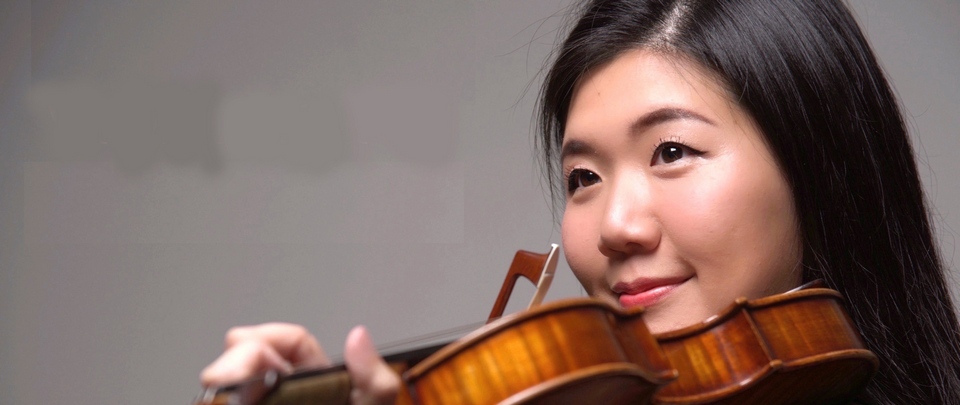
Even in this deceptively simple piece, Visanee Vongvirulh displayed her fine musicianship. In 2010, she won 1st Prize at the 4th Beethoven Competition in Thailand for Young String Players and was invited to perform at the Beethovenfest in Bonn. She also won first place at the International Youth Chamber Music Competition at Interlaken in 2005. In 2012, Visanee graduated with a bachelor’s degree (First Class Honors) in Music Performance (Violin) from the College of Music, Mahidol University and from 2014 to 2021, she received a scholarship from the Royal Thai Government for further studies in Austria where she earned her second bachelor’s degree at the Mozarteum University, Salzburg. While living in Austria, Visanee performed actively as a violinist and orchestral musician in various symphony orchestras and opera productions. She is currently a full-time Violin Instructor at the College of Music, Mahidol University and a member of the Thailand Philharmonic Orchestra.
She was joined by Waku and Rasikamon for a performance of the popular nostalgic song Non ti scordar di me by the curiously-named Italian composer, Ernesto De Curtis. Composed around 1935, it has since become a staple in the Italian music repertoire and encapsulates themes of love, longing and the desire for remembrance. Waku Nakazawa seemed to feel more at home in this operatic-style number and he gave a passionate performance with some expressive violin playing from Visanee Vongvirulh and supportive piano accompaniment from the ever-reliable Rasikamon Siyapong. It made an enjoyable and enriching ending to a varied and emotionally-charged programme.