XINJIANG, China – The Eastern Economic Corridor (EEC) is strengthening strategic cooperation with China’s Xinjiang Uyghur Autonomous Region, with U-Tapao International Airport positioned as a potential gateway linking Thailand with Xinjiang, Central Asia and Europe. Dr. Chula Sukmanop, Secretary-General of the Eastern Economic Corridor Policy Committee (EECO), led a delegation to Urumqi in August 2026 with Ethaitat International (Hong Kong) Limited (ETIT) under the “EECO – Xinjiang: Strategic Innovation, Green Growth and Digital Silk Road Mission.”
The mission focused on developing an ecosystem-to-ecosystem partnership between the EEC and Xinjiang while exploring investment and technology cooperation in logistics, infrastructure, digital economy, clean energy, advanced manufacturing, finance and innovation. The EECO delegation met Zhu Lifan, Vice Governor of the Xinjiang Uyghur Autonomous Region, and senior officials to discuss opportunities for closer economic links, particularly connecting U-Tapao International Airport with Urumqi to create new trade, transport and investment routes between Thailand and Central Asia.
Air connectivity was identified as a key opportunity. Urumqi Tianshan International Airport is a major aviation hub in western China and Central Asia, handling more than 25 million passengers annually and undergoing expansion to accommodate up to 63 million passengers. The two sides discussed potential direct point-to-point flights between Xinjiang and U-Tapao, as well as Xinjiang and Bangkok, serving both tourism and cargo markets. Air cargo and cold-chain logistics could provide particular opportunities for premium agricultural products, e-commerce goods and temperature-controlled shipments.
For the EEC, stronger links between U-Tapao and Urumqi could further establish the airport as a key piece of EEC infrastructure and support its development as a regional aviation and logistics hub. The delegation also explored opportunities through the Urumqi International Land Port Area, a major rail transportation centre connecting 19 countries and 26 cities. Its Digital Customs and Smart Logistics Platform could support future freight routes linking Thailand–Xinjiang–Central Asia–Europe.
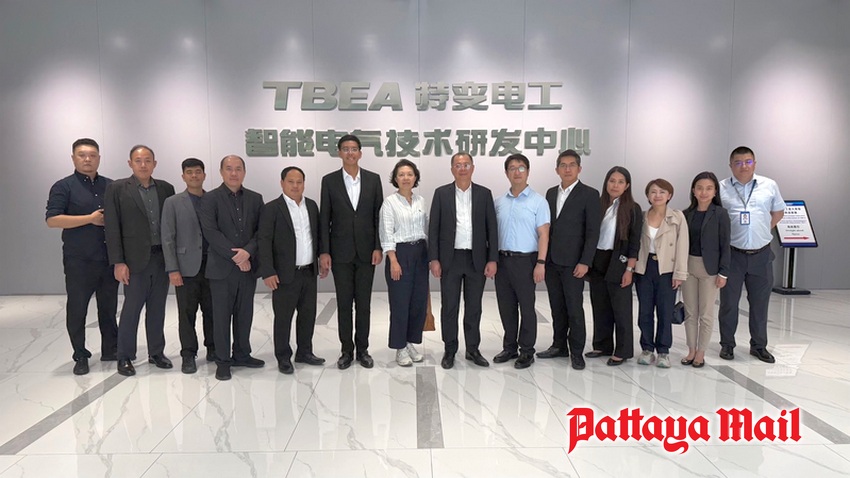
Such connections could provide Thai businesses with additional routes into Central Asian and European markets while creating opportunities for Chinese and Central Asian goods to enter Thailand through EEC infrastructure. Clean energy was another major area of discussion. EECO met representatives of Goldwind Science & Technology Co., Ltd. and TBEA Co., Ltd. to explore cooperation in wind power, energy storage systems, smart grids and engineering, procurement and construction.
The discussions included potential investment in renewable-energy manufacturing and clean-energy supply chains in the EEC, as well as the application of clean-energy technology to the EECiti smart-city project. The EEC aims to increase the share of clean energy used in the area to 30%. Technology and innovation were also central to the mission. The delegation visited the Xinjiang University Technology Transfer Center to explore closer links between universities, industry and government.
It also met YEMA Group, which operates in finance, international trade, cultural tourism and investment, with networks extending across Central Asia and Russia. At the Xinjiang Software Park, the delegation examined the region’s digital ecosystem, which includes more than 300 companies working in software, artificial intelligence, cloud services and big data. These technologies could potentially support EECiti through smart-city systems, AI, digital infrastructure and data platforms designed to serve future investment and residential development.
The Xinjiang mission represents another step toward making the EEC a stronger gateway between Thailand and markets beyond China’s eastern seaboard. By combining U-Tapao’s aviation potential with air cargo, rail, road and maritime connections, the EEC sees an opportunity to develop a more integrated multimodal logistics network. The cooperation also brings together several elements of the EEC’s future development — aviation, logistics, clean energy, digital technology and smart-city infrastructure — while creating potential new channels for investment between Thailand, western China, Central Asia and Europe.