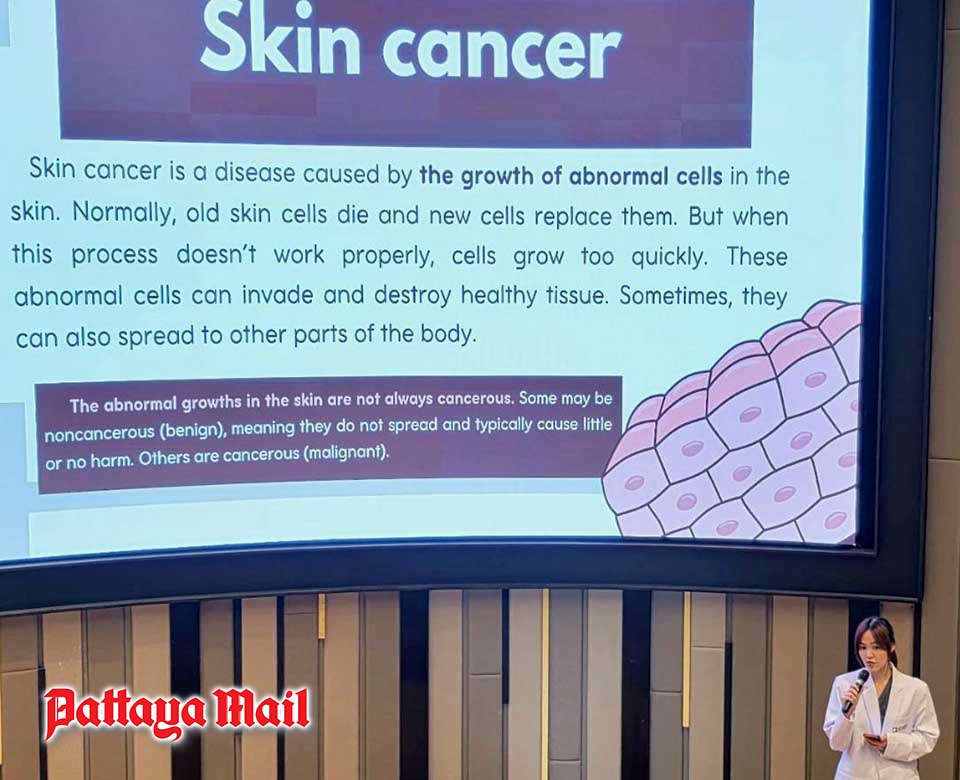
On Wednesday, September 3, Dr. Tanyaponn Puttisri, a dermatologist at Bangkok Hospital Pattaya (BHP), delivered an enlightening presentation on the threat of skin cancer to the Pattaya City Expats Club (PCEC). The talk covered various aspects of skin cancer, including its types, risk factors, prevention strategies, symptoms, and treatment options.
Dr. Tanyaponn began by explaining the nature of skin cancer, which occurs when abnormal skin cells grow uncontrollably, potentially invading normal tissue and spreading to other parts of the body. The three most common types of skin cancer discussed were Basal Cell Carcinoma (BCC), Squamous Cell Carcinoma (SCC), and Melanoma. Each type has distinct characteristics and varying degrees of severity.
BCC, the most common type, typically develops on sun-exposed areas like the head and neck. It can appear in several forms, including nodular, superficial spreading, sclerosing/morpheaform, and pigmented types. Symptoms may include shiny bumps, scaly patches, or dark pigmented lesions similar to moles.
SCC arises from the outer skin layer and can manifest as rough, scaly bumps, raised growths with central depressions, and sores that do not heal. This type of skin cancer is more dangerous than BCC due to its potential to metastasize to lymph nodes and other organs.
Melanoma, the most dangerous type, originates from pigment-producing melanocytes. It may appear as irregular moles or new spots with uneven colors, including brown, black, gray, red, or white. Early detection is crucial, as melanoma can spread to the lungs, brain, and other organs but is highly treatable if caught early. Dr. Tanyaponn emphasized the ABCDE rule for recognizing melanoma: Asymmetry, Border irregularity, Color variation, Diameter larger than 6 mm, and Evolving changes in size, shape, or color.
Dr. Tanyaponn also highlighted a precancerous condition known as Actinic Keratosis (AK), which can develop into SCC if untreated. AK appears as pink or red small spots with scaling or crusting, often on sun-exposed areas like the face and forearms.

The presentation covered key risk factors for skin cancer, including fair complexion, light hair and eyes, many freckles, intense sun exposure, personal and family history of skin cancer, and weakened immune systems due to organ transplants, autoimmune diseases, or infections like HIV.
To prevent skin cancer, Dr. Tanyaponn recommended avoiding sun exposure during peak hours (10 a.m. to 4 p.m.), using broad-spectrum sunscreen with SPF 30 to 50 year-round, wearing protective clothing, and regularly inspecting the skin for new growths or changes in moles, freckles, or birthmarks.
Treatment options for skin cancer depend on the type and stage of the cancer. Small lesions may be removed by biopsy, while larger lesions may require excisional surgery. Mohs surgery, cryotherapy, and topical chemotherapy creams are also used for certain types of skin cancer. Advanced cancers may require systemic chemotherapy, immunotherapy, or radiation therapy.
Dr. Tanyaponn’s presentation emphasized that while skin cancer can be a serious and sometimes life-threatening condition, awareness, early detection, and appropriate preventive measures can make it highly treatable. Regular skin checks and sun protection are crucial to maintaining healthy skin.
The presentation was followed by the Open Forum where questions are asked or comments made about Expat living in Thailand, especially Pattaya. To learn more about the PCEC visit their website at www.pcec.club. To view a video of Dr. Tanyaponn’s presentation, visit the PCEC’s YouTube channel at https://www.youtube.com/watch?v=MbKOUPhg4Ig. To view the post presentation interview of Dr. Tanyaponn, visit https://www.youtube.com/watch?v=OlLijaxYUVY.