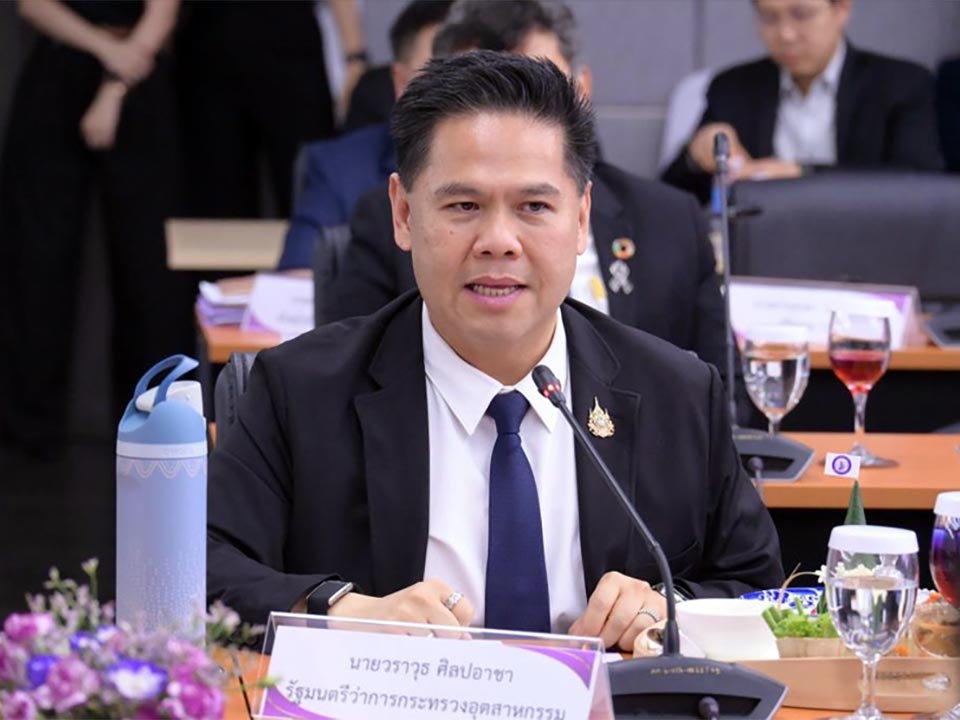
BANGKOK, Thailand – Industry Minister Varawut Silpa-archa has ordered a major rethink of Thailand’s industrial strategy, calling for greater focus on building domestic supply chains and ensuring investment creates more value for the Thai economy. Varawut said Thailand’s goal should go beyond attracting investment. The country must connect research, production, markets and investment while helping Thai SMEs become part of supply chains serving emerging industries.
The strategy comes amid rapid changes in the global industrial structure, particularly the expansion of semiconductors and optical technologies used to transmit and process data. Sales in these sectors have roughly doubled year-on-year for the second consecutive year, driven partly by the rapid expansion of data centres worldwide and growing demand for optical data transmission. To better reflect these changes, the Office of Industrial Economics is preparing to update the base year for the Manufacturing Production Index (MPI) and capacity utilisation from 2021 to 2024. The change is intended to provide a more accurate picture of Thailand’s current industrial structure and capacity.
Thailand is also seeking to develop a stronger domestic presence in high-potential New S-Curve industries, including biotechnology, digital technology and AI, next-generation vehicles, medical industries and defence-related manufacturing. The government wants Thai businesses to move deeper into the supply chains of these industries rather than remain focused mainly on conventional manufacturing.
Tax Review Targets Fairer Competition
The Industry Ministry is coordinating with the Finance Ministry on a review of excise-tax structures to create a more level playing field between Thai manufacturers and foreign competitors.
Varawut said the tax structure should facilitate competition rather than become an additional business cost that puts Thai companies at a disadvantage.
The government is also promoting biofuels, particularly biodiesel and ethanol, to help balance the market and spread the benefits of the transition towards cleaner energy to farmers.
Thailand Wants Toyota to Stay
The automotive sector remains a major focus of the strategy, with the government considering new incentives and adjustments to excise-tax structures for electric vehicles to create fairer competition between domestic manufacturers and imported vehicles.
The measures are also intended to maintain Thailand’s attractiveness to international investors.
Varawut specifically addressed concerns surrounding Toyota and reports that the Japanese automaker could expand investment in Indonesia. He said Thailand and Japan have a long-standing industrial relationship and that Thailand needs a coordinated strategy to persuade Toyota to continue investing in the country.
“We need several incentive measures to keep them with us,” Varawut said, stressing that multiple parties must work together on a strategy to bring the investment back to Thailand.
Toyota has maintained a major manufacturing presence in Thailand for more than six decades, with the company operating production facilities and developing automotive technology and exports from the country.
Combustion Engines Still Have a Role
While Thailand continues its transition towards EVs, Varawut said the government will not abandon internal-combustion vehicles, particularly those capable of using biofuels.
The proposed approach includes excise-tax and BOI incentives for hybrid and mild-hybrid vehicles, alongside measures covering fuel taxation, pricing structures and flexible E-flex and B-flex blending formulas.
The government also wants greater flexibility in fuel distribution depending on feedstock availability and global energy prices. The objective is to increase biofuel consumption, strengthen energy security and reduce Thailand’s exposure to fluctuations in global oil prices.
The National Industrial Development Committee recently approved a framework to promote internal-combustion vehicles using biofuel, alongside measures encouraging government procurement of domestically manufactured goods.
Industrial Laws Set for Update
The Industry Ministry is also preparing to move amendments to the Factory Act and Industrial Waste Act through the Cabinet and Parliament. The legislation is intended to bring Thailand’s industrial regulatory framework up to date with changing production patterns while strengthening environmental management.
Varawut’s strategy ultimately aims to shift Thailand from simply being a destination for foreign investment towards becoming a deeper participant in the global value chains created by new technologies. The focus will be on ensuring investment generates domestic production, jobs, technology transfer and opportunities for Thai businesses.