Back in my student days, I used to drive almost every Sunday afternoon to the leafy borough of Hampstead in North London with my cello. This was because Sunday was string quartet day. A couple of my friends at college were violinists, and they knew a viola player whose luxurious rented flat included a large lounge, big enough for a string quartet to play in comfort. String players need quite a lot of space for the bowing. On the other hand, they can be transported easily. Unlike an orchestra, you can squeeze a string quartet into a large car.
We had plenty of quartet music between us, and each week there were new works to play. Sometimes, one of us would go to the music shops in London’s Charing Cross Road and buy some unfamiliar music to try out. We were not rehearsing for anything, you understand, but simply making music together for the fun of it. And later, after an exhilarating but exhausting afternoon of making music, we would adjourn to the local bar and enjoy a few well-earned glasses of wine.
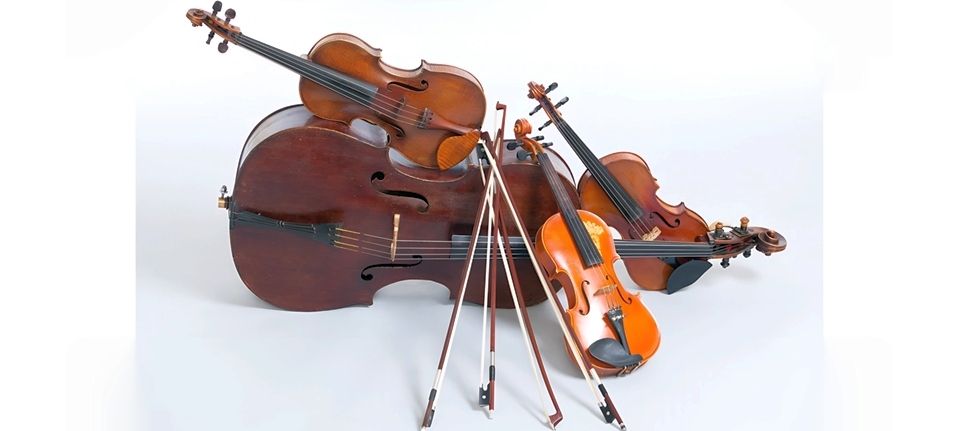
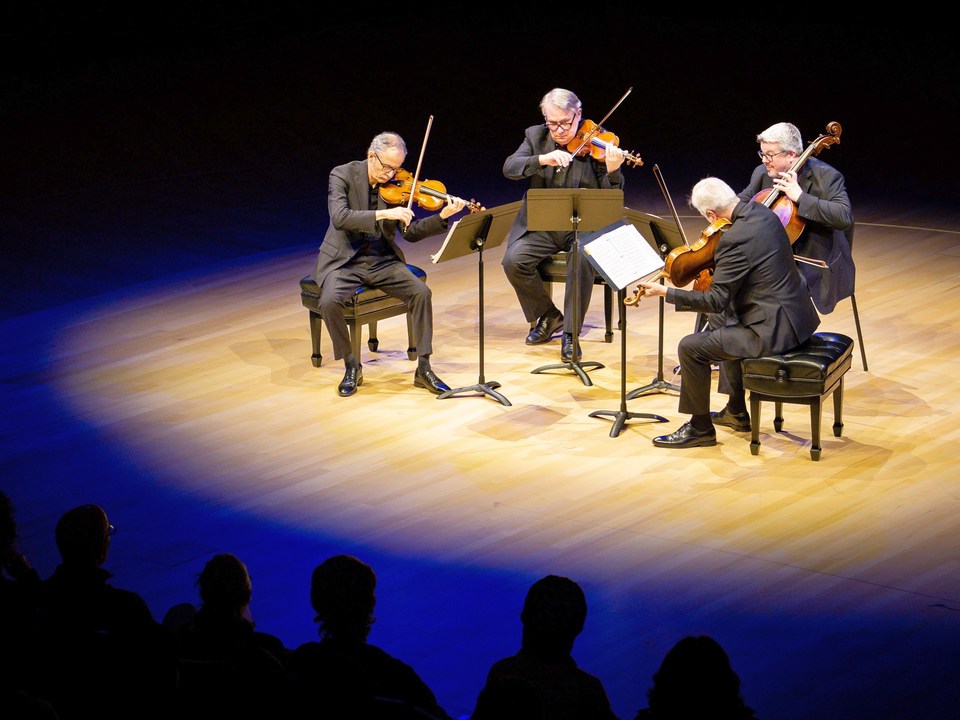
Almost every composer you can think of has written a string quartet, so there’s never a shortage of repertoire. The expression “string quartet” can, of course, mean two things. It can refer to the music itself or the four people who play it. Many professional string quartets are permanent ensembles that have become famous in their own right. There are dozens of lesser-known quartets, but they all consist of four instruments: two violins, a viola and a cello.
In my student days, I had a penchant for playing string quartets in unusual places. I’ve played string quartets in fields, in the middle of a forest, in a greenhouse full of tropical plants and many times on the top deck of a bus. Once, when I was a high-school student, I persuaded three friends to join me on the roof of one of the school’s outbuildings to play a Haydn quartet, which seemed a hilarious idea. Our rooftop position was in full view of the school classrooms, and our performance caused a great deal of merriment. Most of the teachers were not amused at the ensuing disruption, and I was later hauled up in front of the headmaster. He was incandescent with rage and nearly expelled all four of us on the spot. Sadly, there were no more rooftop recitals.
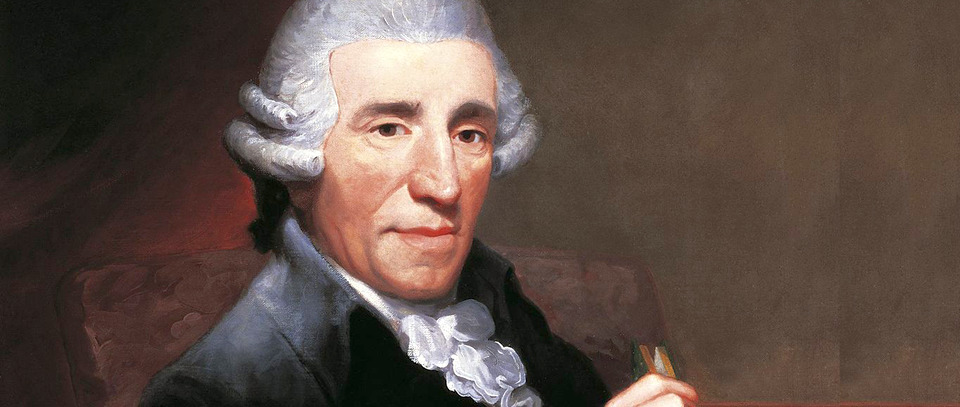
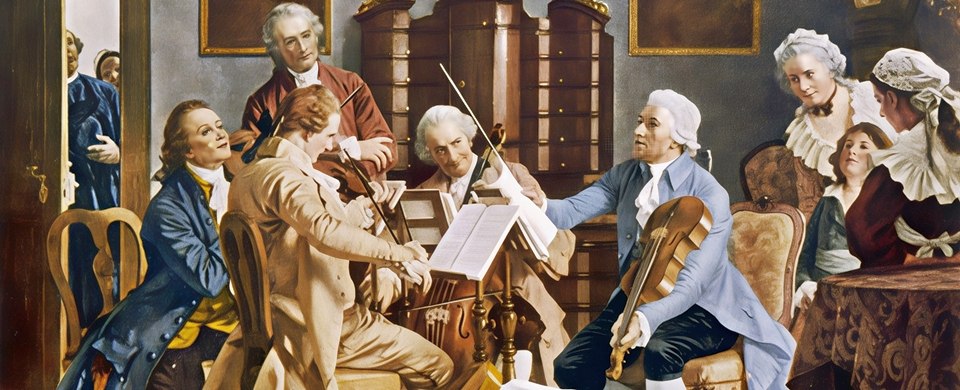
Music writer Kai Christiansen said, “The string quartet has formed the backbone of chamber music. It consistently features lyrical beauty, complex harmony, intense passion, powerful rhythm and elegant formal design. From the most intimate personal expression to the most brilliant virtuosity… the string quartet is one of the richest living musical traditions.” During the early eighteenth century, it was common practice to perform pieces for string orchestra with just four players. This was for economic reasons, but it might have sown the seeds for the string quartet. The Austrian composer Joseph Haydn invested so much time and energy in developing the genre that he eventually became known as the “father of the string quartet.” He wrote 68 of them, many of which have since acquired nicknames. He transformed the genre into a sophisticated, expressive form with emotional depth, often requiring virtuosic playing.
The classical quartet usually began with a lively first movement, sometimes preceded by a slow introduction; a second slow movement; a third in the form of a minuet and a bright and breezy finale. It became the standard format for well over a hundred years. Beethoven’s contributions to the string quartet repertoire were exceptional. Beethoven ditched the stately minuet, which by then had fallen out of fashion. He replaced it with a scherzo, the name given to a vigorous, energetic, dance-like piece in triple meter. His late quartets, composed in the 1820s, pushed the boundaries of harmony, form, and expression, and even today they pose difficult interpretive challenges for performers because of their complex counterpoint, innovative structures, and enigmatic music. As the 19th century progressed, composers such as Schubert, Mendelssohn, and Brahms expanded the genre. The string quartet became an essential form for expressing personal and emotional narratives, and all composers were expected to write at least one sooner or later.
I have to admit that this is one of my favourite Haydn quartets. I first heard it on the radio when I was about fifteen, the same year as the disastrous rooftop recital. The quartet is among Haydn’s most advanced and ambitious works. The nickname “Sunrise” comes from the wayward, ascending theme at the beginning of the quartet, played by the 1st violin over quiet, sustained chords. The theme returns, sometimes in modified form, on several other occasions during the movement. After the peaceful opening, the music scurries off at an extraordinary tempo, and the various themes are developed in surprising and delightful ways.
There’s a lovely slow movement (08:32) with a hymn-like opening, and as usual, a minuet (14:27) forms the third movement. But this minuet is far removed from a courtly dance. The music is full of quirky humour, and in the middle section, Haydn takes the listener into a mysterious world where it evokes the sound of rustic peasant bagpipes. The Finale (18:24) starts in a stately fashion, but the music soon scampers away towards the satisfying conclusion.
This is a compelling performance by the Fibonacci Quartet, based in England and formed in 2019 at the Guildhall School of Music and Drama. Fibonacci, you may recall, was a medieval mathematician best known today for the Fibonacci sequence. This is an infinite series of numbers where each number is the sum of the two preceding ones, if you can work that out. It begins: 0, 1, 1, 2, 3, 5, 8, 13, 21, 34, 55 and so on – until the end of time. You may notice that although the quartet borrows Fibonacci’s name, the sequence doesn’t include the number four.
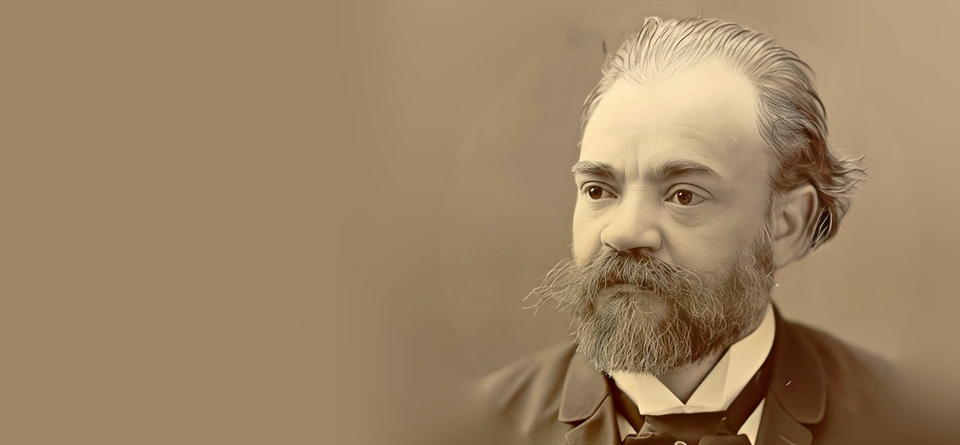
If you enjoy Dvorak’s New World Symphony, you’ll almost certainly find this quartet a delight. At the risk of becoming a bit too self-indulgent, this work is another favourite from my early teenage years and the first Dvořák quartet I heard. It was a revelation for me, for I had never realised before how expressive the string quartet could sound. This work is one of the most popular in the string quartet repertoire, so that’s another good reason to tell you about it.
In 1893, Dvořák went to America after being appointed Director of the National Conservatory in New York City. He arrived in New York in June of that year, with his wife, their six children and a maid. They also had the services of a Czech-speaking American, Josef Jan Kovarík, who served as interpreter and guide. He spent his first summer holiday in the small Iowa town of Spillville, a Czech immigrant community. He evidently felt much at ease among his compatriots. While there, he wrote his 9th Symphony, which became known as The New World Symphony. He also wrote the American quartet, which he completed in a mere sixteen days. He finished the score with the comment, “Thank God! I am content. It was fast.” The work was first performed privately in Spillville, the composer playing first violin.
One of the features of the work is Dvořák’s use of the pentatonic scale. This is the scale you hear if you play the “black” keys on a keyboard. It has a warm, simple character with no internal dissonances and was used in many of the old African-American spirituals. Dvořák became especially interested in African-American folk music, perhaps because he was familiar with the pentatonic scale used in some Czech folk music. The first movement opens with a compelling main theme played on the viola, a distinctive, spiky pentatonic melody that dominates the movement. The mood is lyrical and joyful, and it moves into the lovely second theme, which seems to have its roots in the folksongs of the composer’s home country.
The slow movement (09.24) has a timeless, magical quality, and the New York Philharmonic Quartet really captures the essence of the music. This must be the most moving performance I have heard, with expressive pianissimo playing and beautiful phrasing. There’s a haunting, endless melody that passes between the instruments and rich, heart-warming harmonies which are incredibly serene. There’s a compelling, “longing” quality to the music, or hiraeth as Welsh people say, perhaps caused by the composer’s wistful reflections on his distant homeland. You would need a heart of stone not to be moved by this exquisite movement.
To me, the third movement (17:30) sounds rather more Czech than American. It’s a scherzo with a quirky tune, full of off-beats and cross-rhythms and in the time-honoured fashion, includes a contrasting middle section. The sprightly finale (21:21) opens with another pentatonic tune, and the movement is bustling with excitement, heightened by the furious tempo. Throughout the movement, there are sections of “chugging” accompaniments from the second violin and viola. It’s been suggested that the incessant rhythm was inspired by Dvořák’s experience of travelling on American trains and being lulled by the iconic “clickety-clack” of the train wheels rolling over the gaps between the sections of track. This is a thrilling performance played with spectacular precision and control, and a fitting climax to a wonderful work.
It seems amazing that the string quartet as a form has survived for so long. Some 20th-century composers pushed the boundaries of the string quartet form to extremes. Morton Feldman’s vast Second String Quartet is one of the longest ever written, and it lasts between four and six hours. Unfortunately, musicians can’t play for this length of time because it’s physically and mentally almost impossible, a fact that Feldman appears to have overlooked.
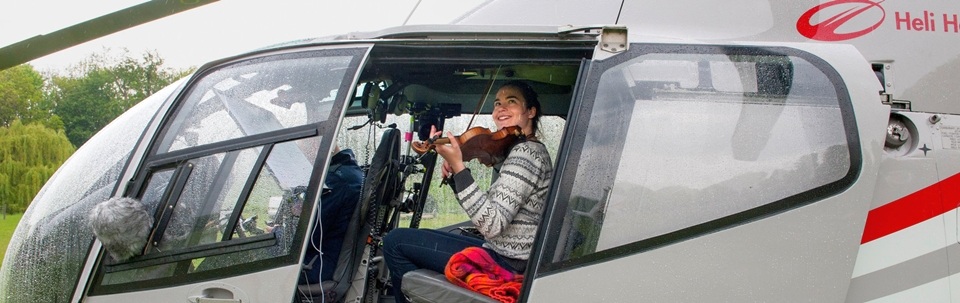
In the early 1990s, the German composer Karlheinz Stockhausen wrote a work called Helikopter-Streichquartett, which, in his typical manner, takes everything to extremes. As the name of the work implies, the string quartet also requires four helicopters, each with a pilot and sound technician, a television transmitter, a three-channel sound transmitter, an auditorium with four columns of televisions and loudspeakers, and a sound technician with a mixing desk. It must have been great fun, but it doesn’t get performed very often.