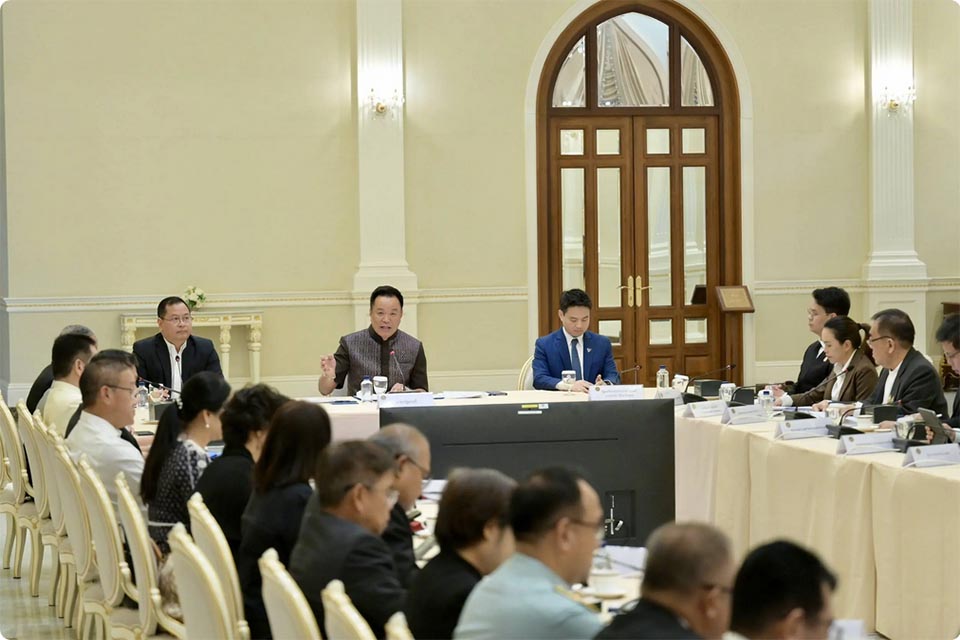
BANGKOK, Thailand – Prime Minister and Minister of Interior Anutin Charnvirakul has directed all government agencies to use modern technology to eliminate corruption vulnerabilities and reform obsolete regulations. He also expressed reservations about the methodologies of the Corruption Perceptions Index (CPI), which rely heavily on subjective surveys.
The Prime Minister chaired a joint public-private coordination meeting on May 20, 2026, to upgrade anti-corruption strategies. The assembly was attended by Deputy Prime Minister Pakorn Nilprapunt, representatives from the Anti-Corruption Organization of Thailand, the Office of Public Sector Anti-Corruption Commission (PACC), the Office of the State Audit Commission, the Department of Public Works and Town & Country Planning, and the Board of Trade of Thailand.
The Prime Minister stated the convention was organized to address transparency concerns raised by the private sector, specifically the Joint Standing Committee on Commerce, Industry, and Banking (JSCCIB). He emphasized that the government is actively reforming structural frameworks, simplifying state approval processes, and updating archaic legislation to lower corruption risks and restore international investor confidence.
The Prime Minister highlighted the recent establishment of the Anti-Corruption Coordination Committee, tasked with driving concrete outcomes and improving Thailand’s CPI ranking. However, he disagreed with relying on subjective “perception” metrics. He noted that if citizens, business leaders, or international bodies have concrete evidence of corruption involving any government official, minister, or the premier, they should immediately forward it to the National Anti-Corruption Commission (NACC), the PACC, the Anti-Money Laundering Office (AMLO), or the courts instead of relying on generalized surveys.
The Prime Minister ordered all state sectors to rigorously enforce legal codes and transition to fully transparent digital operating systems. He instructed Deputy Prime Minister Pakorn to lead amendments to public disclosure laws, removing exemptions that allow agencies to arbitrarily withhold public data. He concluded that maximum transparency and case-by-case prosecutions are essential to reassure foreign investors looking to invest in Thailand. (NNT)