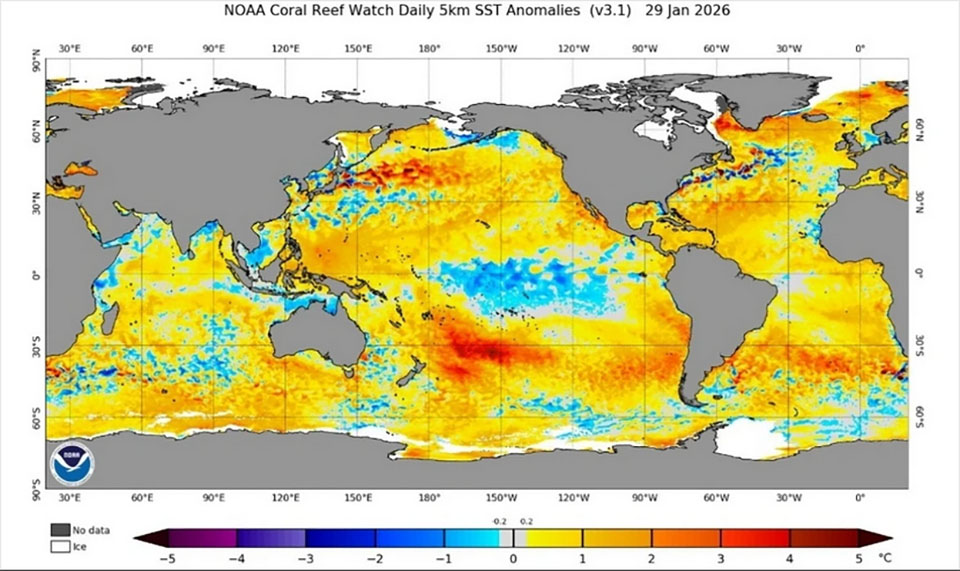
PATTAYA, Thailand – In recent months, climate scientists have been closely monitoring unusual changes beneath the surface of the Pacific Ocean. According to forecasts from the U.S. National Oceanic and Atmospheric Administration (NOAA), there is now more than a 60% probability that the climate pattern known as El Niño will return in 2026. Even more concerning, scientists estimate a roughly 1-in-4 chance that it could intensify into a “super El Niño” event.
A hidden heat buildup under the Pacific
What makes the current situation particularly alarming is that the warning signs are not only at the ocean surface. Scientists report unusually large heat anomalies accumulating beneath the Pacific Ocean. This subsurface “heat reservoir” can influence atmospheric circulation when it rises, potentially disrupting global weather systems.
When El Niño conditions develop, warm ocean waters in the central and eastern Pacific alter wind patterns, rainfall distribution, and global temperature balance. If the event becomes stronger than usual, the effects can cascade across continents.
2026–2027 could become one of the hottest periods ever recorded
Climate models suggest that if a strong or super El Niño emerges, global average temperatures during 2026–2027 could reach record-breaking levels.
For Southeast Asia — including Thailand — the expected impacts may include:
- Weaker and more erratic monsoon seasons
- Longer dry spells and delayed rainfall
- Increased risk of drought conditions in agricultural regions
- Greater stress on water resources and reservoirs
These changes could affect not only farming and food supply chains but also energy demand, urban water systems, and overall economic stability.
The hidden impact: heat stress on human health — including skin
Beyond environmental and economic effects, researchers are increasingly examining how prolonged heat exposure affects the human body at a cellular level.
Studies suggest that sustained high temperatures and increased UV exposure can accelerate biological stress through:
- Higher production of free radicals, which damage cells
- Reduced mitochondrial efficiency, lowering cellular energy production
- Low-level chronic inflammation in tissues
Over time, these processes may weaken the skin barrier, reduce moisture retention, and accelerate visible signs of aging such as dryness, fine lines, and loss of elasticity.
In other words, a warming planet may not only reshape weather patterns — it may also subtly affect how quickly our skin ages.
The rise of “cellular-level skincare”
In response to these environmental pressures, the skincare industry is shifting toward what is often called “cellular-level skincare.” This approach focuses on supporting skin health at the biological and energy-production level rather than only treating surface symptoms.
One molecule that has gained attention in scientific research is NAD⁺ (nicotinamide adenine dinucleotide), which plays a key role in cellular energy production and DNA repair mechanisms. NAD⁺ levels naturally decline with age, and environmental stressors such as heat, pollution, and UV exposure may accelerate this decline.
While early studies are still ongoing, the concept has inspired a growing number of cosmetic and wellness products aiming to support cellular resilience under environmental stress.
Science meets consumer choice
One example of this trend is a commercially marketed skincare serum based on NAD-related formulations. It is promoted as supporting cellular energy and skin repair mechanisms. However, experts emphasize that while such products may complement skincare routines, they should not be viewed as substitutes for proven protective measures such as sunscreen, hydration, and sun avoidance during peak heat.
Ultimately, in a world where climate conditions are becoming less predictable, individuals have limited control over global systems — but more control over personal resilience strategies.
A potential super El Niño may still be a forecast, not a certainty. But the signals coming from the Pacific Ocean are strong enough to warrant attention.
The real question is no longer just how hot the planet will get — but how prepared societies like Thailand will be for a future shaped by more extreme and unpredictable climate patterns.