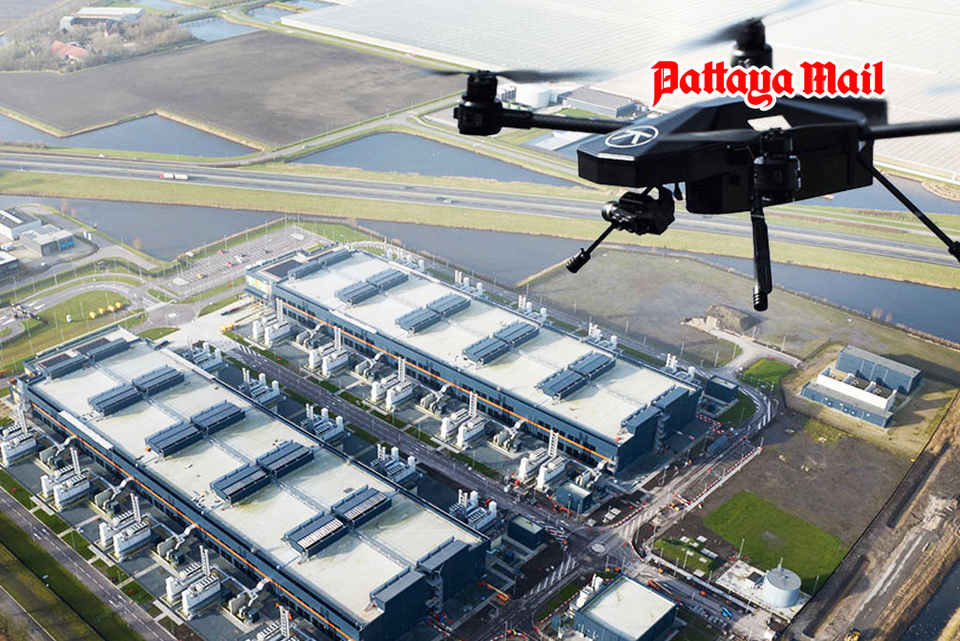
PATTAYA, Thailand – Events in early March 2026 highlighted an increasingly important reality: data centres are no longer merely economic assets. They are rapidly becoming strategic infrastructure in modern geopolitical conflict. Reports indicated that digital infrastructure in the Middle East, particularly cloud systems linked to Amazon Web Services (AWS) data centre operations in the United Arab Emirates and Bahrain, experienced disruptions following drone attacks amid rising regional military tensions.
 The damage temporarily affected parts of the cloud network, causing service interruptions that impacted banking systems, financial platforms and a range of digital applications across the region. The incident illustrates a significant shift in the nature of modern conflict. Warfare is no longer limited to cyber intrusions or digital espionage. Increasingly, it includes physical attacks on digital infrastructure capable of disrupting entire economic systems within hours.
The rise of the data sovereignty era
As data centres become strategic assets, governments and multinational corporations are placing growing emphasis on the concept of data sovereignty — the ability of a nation or organization to maintain legal, operational and geographic control over its data. The concept also reflects a broader priority: ensuring that digital infrastructure remains resilient and secure in an increasingly uncertain geopolitical environment.
Recent events in the Middle East have reinforced a strategic shift already underway. Companies are increasingly diversifying the geographic locations of their data centres. This strategy, often referred to as distributed digital infrastructure, reduces risks associated with geopolitical conflict, natural disasters and political instability.
Competition for Asia’s data centre hubs
Across Southeast Asia, competition to become the region’s primary data centre hub has intensified rapidly. Singapore remains the most established centre, hosting a dense concentration of global cloud infrastructure. However, Malaysia has emerged as a fast-growing alternative, particularly in the Johor region, where several large-scale facilities are currently under development.
Indonesia, supported by its massive domestic market and rapidly expanding digital economy, is also investing heavily in cloud infrastructure. Amid this regional competition, Thailand is increasingly being viewed as a promising new contender.
 Rising investments in Thailand
In recent years, several major global technology companies have announced significant investments in Thailand’s digital infrastructure.
Among the most notable investors are:
- Google, expanding its cloud and artificial intelligence infrastructure in the country.
- Microsoft, which has announced plans to establish a new data centre region in Thailand.
- Amazon Web Services, continuing to expand its cloud ecosystem across Southeast Asia.
Combined, these investments amount to hundreds of billions of baht and are intended to position Thailand as a regional base for cloud computing and artificial intelligence services.
Thailand’s structural advantages
Thailand possesses several structural advantages that strengthen its potential as a regional data centre hub.
Geopolitical stability
Compared with many regions of the world, Thailand faces relatively low geopolitical risk. The country is not directly involved in major international conflicts and has historically maintained a balanced diplomatic position. For global technology companies seeking secure locations for critical digital infrastructure, this stability is an important factor.
Reliable power infrastructure
Data centres require enormous amounts of electricity. A stable and reliable power supply is therefore one of the most important considerations when selecting data centre locations. Thailand benefits from a well-developed national power grid with relatively high reliability compared with many countries in the region.
International connectivity
Thailand is connected to multiple international submarine cable systems, enabling high-speed and reliable global data transmission.
Government support
Thailand’s Board of Investment (BOI) has introduced a range of incentives designed to attract digital infrastructure investment, including tax benefits, regulatory facilitation and support for importing advanced technological equipment. The long-term objective is to position Thailand as a regional digital infrastructure hub.
Can Thailand challenge Singapore?
Despite its current dominance, Singapore faces several structural constraints. Land availability is limited, electricity costs are relatively high, and environmental concerns have led authorities to tighten regulations on new data centre development. As a result, global technology companies are increasingly exploring alternative locations across Southeast Asia, including Malaysia, Indonesia and Thailand. If Thailand continues expanding its energy infrastructure and digital ecosystem, the country could emerge as one of Southeast Asia’s most important data centre hubs within the next decade.
A new strategic map for digital infrastructure
Historically, companies selected data centre locations primarily based on energy costs and internet connectivity. Today, however, geopolitics has become an equally critical factor. The recent disruptions in the Middle East demonstrate that digital infrastructure itself can become a target during conflict. As a result, multinational corporations are now searching for locations that offer long-term security, stability and operational resilience.
In this evolving geopolitical landscape, Thailand is increasingly being viewed as one of the most strategically positioned locations in Southeast Asia. In a world where data has become the most valuable resource of the digital age, the race to become a global data hub may well emerge as one of the defining economic competitions of the twenty-first century.