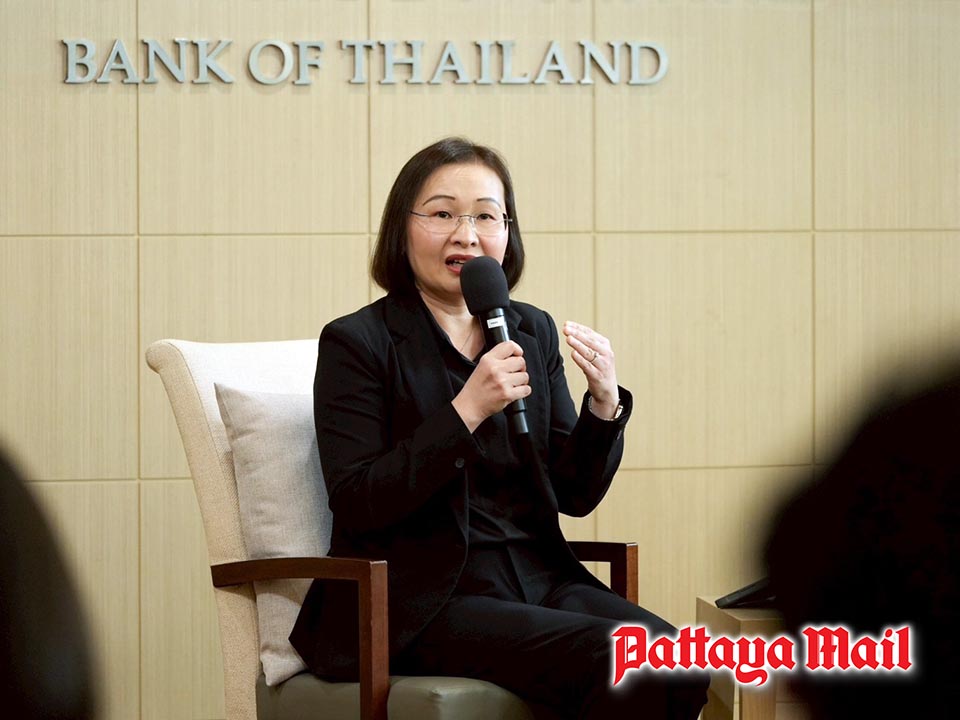
PATTAYA, Thailand – The Bank of Thailand (BOT) has reaffirmed that its interventions in the baht are aimed solely at reducing excessive exchange rate volatility, not at securing any trade advantage, amid concerns over global currency scrutiny.
Ms. Pranee Sutthasri, Senior Director of the Macroeconomic Department at the central bank, said Thailand’s economy improved in January 2026 compared to the previous month, driven mainly by strong export growth and a clear rebound in tourism.
Exports expanded 23.6% year-on-year, led by continued growth in electronics, as well as shipments of gems, jewelry, and petroleum-related products. Private investment also rose 8.3% from a year earlier, partly due to accelerated electric vehicle production ahead of the expiration of the government’s EV 3.0 support scheme at the end of January.
Tourism showed solid recovery in both arrivals and revenue. Foreign tourist arrivals reached 3.3 million in January, supported by short-haul visitors such as Chinese travelers returning in greater numbers, as well as long-haul markets including the United States and the United Kingdom. Tourism revenue in baht terms increased 9.0%, reversing a 2.2% contraction recorded in December 2025.
Public spending continued to expand year-on-year, particularly current expenditure related to election and referendum management. However, public investment began to slow after accelerated disbursements in previous months.
Headline inflation declined further to -0.66% in January from -0.28% in December, mainly due to lower fresh food and energy prices, especially oil. Core inflation remained stable at 0.60%.
The baht appreciated on average in January, largely driven by external factors including a weaker U.S. dollar, uncertainty over U.S. trade and tariff policies, and rising geopolitical risks. Domestic factors such as higher gold prices and the political atmosphere during the election period also provided support. In February, however, the baht began to weaken and moved more closely in line with regional trading partners.
The BOT stressed that its exchange rate management is focused on smoothing volatility and that Thailand does not meet the criteria for currency manipulation under U.S. Treasury guidelines.
Looking ahead, the central bank expects economic activity in February 2026 to moderate slightly as government stimulus measures — including the “Khon La Khrueng Plus” co-payment scheme and EV 3.0 incentives — gradually phase out. Budgetary momentum is also expected to soften.
Nevertheless, exports are projected to remain strong, particularly in technology and electronics, reflected in rising imports of capital goods and raw materials in January that are expected to feed into future export production. Business sentiment also improved in February, especially in the manufacturing sector.
Despite the positive outlook, businesses continue to face challenges from high production costs, limited pricing power, and intense domestic competition. The BOT suggested that the government should strengthen local content requirements to ensure Thai manufacturers participate more fully in supply chains. Although exports grew 12.7% last year, industrial production did not expand, indicating that export gains have yet to be broadly distributed across domestic producers.
Key risks going forward include uncertainty surrounding U.S. trade and tariff policies. While Thailand may initially benefit from a tariff reduction to 15% from 19%, further measures under Section 301 or Section 232 could add uncertainty. Geopolitical tensions and the sustainability of the tourism recovery — particularly after the Chinese New Year period — also remain factors to monitor, along with potential delays in the fiscal 2027 budget process and policy direction under the new government. (TNA)